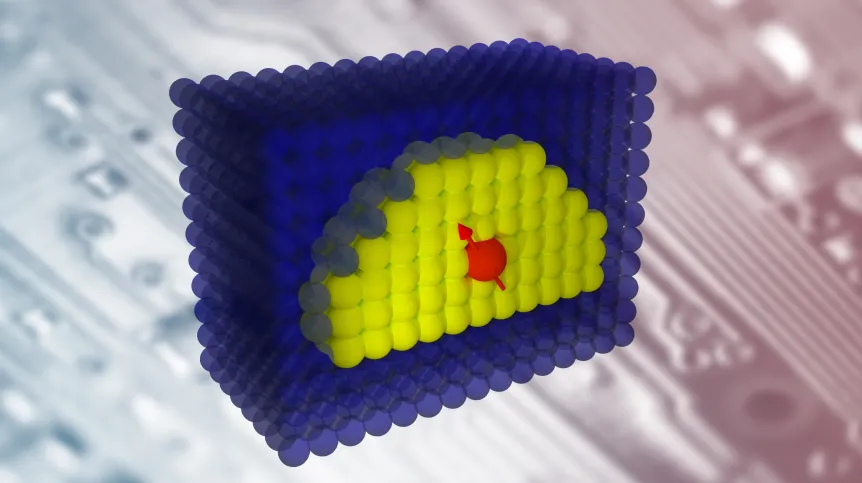
New types of structures, including the world\'s first quantum dots with single cobalt ions, have been prepared and tested at the Faculty of Physics, University of Warsaw. The research contributes to the development of solotronics - electronics and spintronics of the future, based on operations on single atoms.
For the miniaturization of electronic devices to continue, scientists want to explore performing operations on individual atoms. "The behaviour of individual atoms can be controlled today by placing them in special semiconductor structures. This is how quantum dots with single magnetic ions are created. Laboratories in the world have known them only in two varieties. Physicists from the Institute of Experimental Physics, Faculty of Physics, University of Warsaw (FUW) have managed to develop and test two new types of these structures" - announced the FUW in a release sent to PAP. Publication of indicating the direction of solotronics development, prepared by physicists from FUW, has been published in the prestigious scientific journal "Nature Communications".
"Quantum dots, or semiconductor crystals with sizes of a billionths of a meter, are so small that electrons are present in them only in the states of specific energies. The dot has similar properties as an atom, and, like the atom, it can be stimulated with light to higher energy states and then the glow accompanying the resurgence of the states with lower energies observed" - described Prof. Piotr Kossacki (FUW).
FUW laboratories prepare quantum dots by molecular beam epitaxy. The process involves precision heating of crucibles with elements in a vacuum chamber. Pairs of elements are deposited on the sample. Proper selection of materials and conditions can cause the deposited atoms to gather in small clusters - quantum dots. In a similar way, condensing water vapour forms droplets on hydrophobic (water-repellent) surfaces.
If during the deposition of the quantum dots a a small number of other atoms, e.g., magnetic ones, are introduced into the vacuum chamber, some of them will be embedded in the forming systems. After removing the sample, quantum dots in which there is exactly one magnetic atom centrally located, can be found under the microscope.
" Atom with magnetic properties disrupts energy states of quantum dots, which affects its interaction with light. Quantum dot becomes a detector of the atom state. The relationship also works the other way: by changing the energy states of electrons in the quantum dot we can affect the magnetic atom" - says Michał Papaj, FUW student who received the Gold Medal in Chemistry in the national best thesis competition of the Institute Physical Chemistry in 2013 for the work on the construction of quantum dots with single cobalt ions.
According to the FUW release, manganese atoms stripped of two electrons (Mn 2+) have the strongest magnetic properties. Using the cadmium telluride dots, in 2009 Polish physicists demonstrated the first magnetic memory running on a single magnetic ion.
"It was widely believed that other magnetic ions, such as cobalt Co2+, could not be used in quantum dots. Despite the negative predictions, we decided to verify it. Nature pleasantly surprised us: the presence of a new magnetic ion did not spoil the properties of the quantum dot" - said doctoral student Jakub Kobak of the FUW.
Researchers from the FUW presented two new systems with single magnetic ions: cadmium telluride quantum dots with cobalt atom, and cadmium selenide dots with manganese atom. Manganese ions are characterized by the strongest magnetic properties. Unfortunately, in addition to the electrons, the atom nucleus itself also contributes to these properties. As a result, a quantum dot with manganese ion is a complex quantum system. FUW physicists discovery shows that other magnetic elements, such as chromium, iron and nickel, could also work as magnetic ions. They are devoid of nuclear spin, which means that the quantum dots with their participation should be easier to control.
In a quantum dot , in which instead of tellurium used lighter selenium, exhibited an extension of recorded information storage time by the order of magnitude. This result allows to conclude that using lighter elements can prolong the storage of information in quantum dots with single magnetic ions - maybe even by several orders of magnitude.
"We have shown that two quantum systems, of which it was thought that they should not work, in fact work very well. This way, we open a wide field of exploration of other, previously rejected combinations of materials for quantum dots and magnetic ions" - concluded Dr. Wojciech Pacuski of the FUW.
Research on single quantum dots with magnetic ions was carried with grants from the National Science Centre and the National Centre for Research and Development Centre, as well as funds of the Centre for Preclinical Research and Technology (CePT) project.
PAP - Science and Scholarship in Poland
lt/ agt/
tr. RL