International H.E.S.S. consortium, whose members include Poland, reported the first successful observations with a new large telescope for observing gamma rays. The researchers were able to register gamma radiation from one of the pulsars, reported the Nicolaus Copernicus Astronomical Center PAS in Warsaw.
28-meter CT5 telescope is the latest instrument at the ground observatory in Namibia. The telescope became part of the High Energy Stereoscopic System (H.E.S.S.). The upgraded system measured gamma-ray pulses from the Vela pulsar. This is the first pulsar observed by the H.E.S.S. observatory, the first in the southern hemisphere and the second detected by ground-based gamma telescopes (the first was the pulsar in the Crab Nebula in 2011).
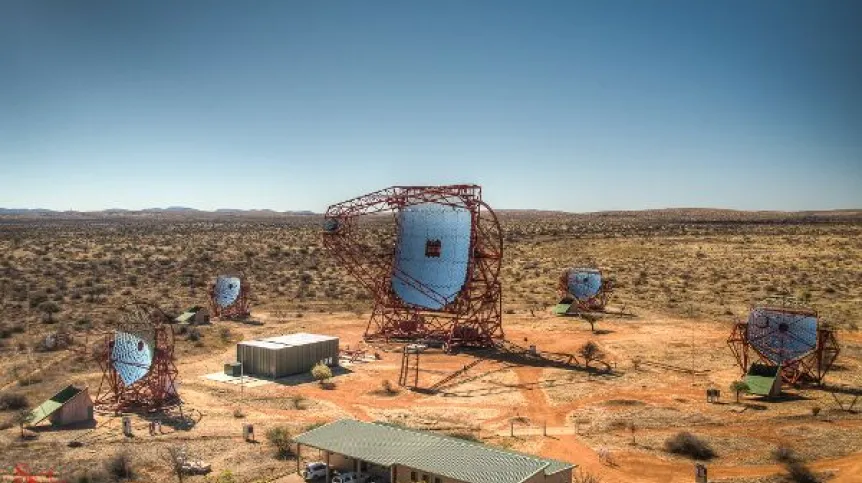
Observatory H.E.S.S. was upgraded in 2012. The current version of the system is called H.E.S.S. II. It uses synchronized telescopes of various sizes. The centre is the largest, newest CT5, surrounded by four smaller telescopes. The new telescope increased energy range of registered radiation, allowing to detect particles with energies up to 30 GeV.
Telescopes in the H.E.S.S. system are Cherenkov telescopes it. They do not record gamma radiation directly, because the Earth\'s atmosphere protects us from the high-energy radiation and direct registration required instruments in space. But scientists have found a different way to conduct ground-based observations of gamma radiation. Using large mirrors they observe so-called Cherenkov radiation, flashes occurring in Earth\'s atmosphere as a result of cascades of elementary particles caused by cosmic rays and gamma-ray photons.
Polish participation in the H.E.S.S. project is coordinated by the the Nicolaus Copernicus Astronomical Center PAS in Warsaw. The Polish consortium members are also the Jagiellonian University in Kraków, the Henryk Niewodniczański Institute of Nuclear Physics PAS in Kraków, the University of Warsaw and the Nicolaus Copernicus University in Toruń.
Poland also participates in the Cherenkov Telescope Array (CTA) project - construction of a new ground-based observatory to observe high-energy gamma radiation. It will be a network of about a hundred telescopes placed in two locations on the two hemispheres, and begin operations in 2017.
PAP - Science and Scholarship in Poland
cza/ ula/
tr. RL