
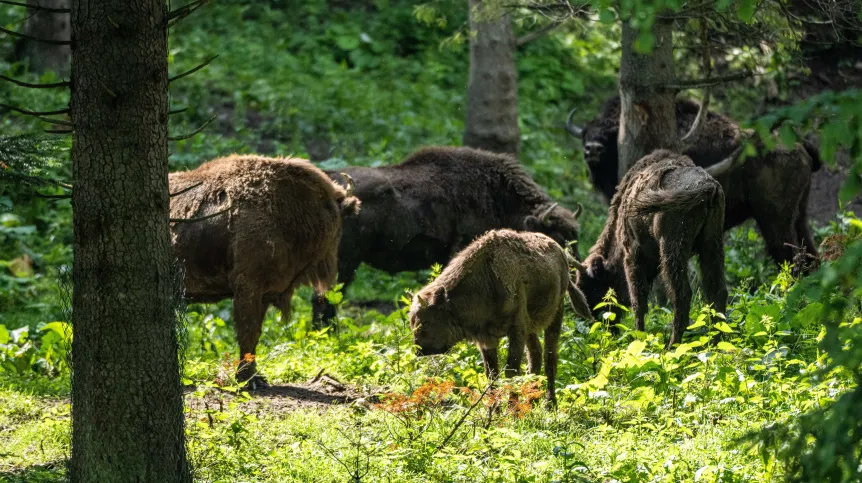
European bison are increasingly migrating from forest habitats into agricultural areas during winter, where they feed on green crops such as rapeseed instead of dry hay, a shift scientists say may be affecting their reproductive biology.
Researchers report that the change in winter diet is associated with reduced synchronization of births and the appearance of calves outside the species’ typical breeding window.
In most ungulates, births are concentrated in a short period when food is abundant.
“Synchronization of reproduction over a relatively short period of time may also be a strategy to avoid the excessive impact of predation,” the authors noted, adding that bison calves are usually born between May and August, when vegetation is most available and females can meet the energy demands of lactation.
However, scientists have observed an increasing number of late births, including calves born in mid-winter, particularly in herds that migrate to farmland during the colder months.
To investigate the phenomenon, researchers from the Mammal Research Institute of the Polish Academy of Sciences in Białowieża studied 16 bison herds in Poland, Germany and the Netherlands, covering both wild and semi-wild populations under different management systems.
Using non-invasive methods including camera traps, drones, photogrammetry and near-infrared analysis of faecal samples, the team assessed herd structure, calf size and diet quality, and examined how environmental conditions and feeding practices influenced reproductive patterns.
The results were published in the journal Biological Conservation.
The researchers found that diet quality was highest in herds migrating to agricultural areas, followed by those in mixed environments or receiving supplemental feeding in forests, while the lowest quality diets were recorded in herds relying solely on natural winter forage.
They also found that higher diet quality was associated with greater variation in calf size within herds, which the researchers link to reduced synchronization of reproduction.
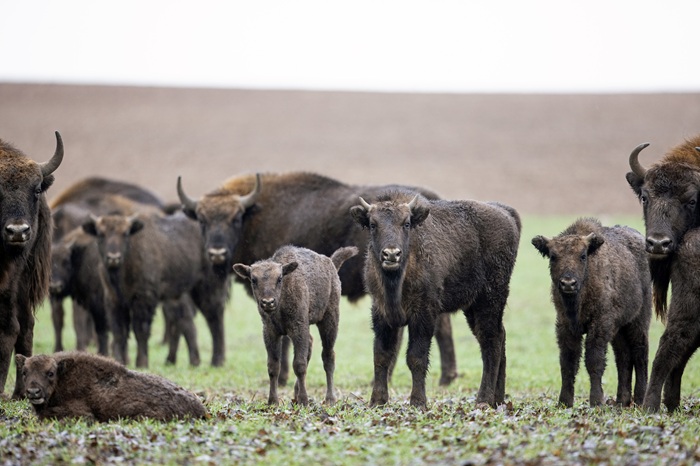
“We were surprised that in herds migrating to agricultural areas, in addition to 4-6-month-old calves, there were also those born a few weeks prior. The share of late-born calves was the highest in these herds. They could be recognized by their small size, lighter colour and the absence or barely visible horn buds. This is because herds migrating to agricultural areas had access to a high-quality diet, characterized by a low percentage of fibre fractions. Quality of this diet in winter was often higher than in spring or summer,” explains Nika Knez, co-author of the study and doctoral candidate at the Mammal Research Institute of the Polish Academy of Sciences.
Researchers say that winter migration to farmland and supplemental feeding may disrupt the animals’ natural nutritional and physiological cycles, which are normally shaped by environmental and climatic conditions.
“This study indicates that access to agricultural areas with winter crops of rapeseed and cereals, and to corn cobs left in the fields after mowing, as well as winter feeding, resulting in a higher quality of the winter diet, may lead to reduced synchronization of bison reproduction, probably increased reproduction and faster population growth, and consequently - increased conflicts with these large animals in agricultural areas. This is important for the life strategies of these unique animals, but also the protection and management of their populations,” says Professor Rafał Kowalczyk from the Mammal Research Institute of the Polish Academy of Sciences, who leads the research.
The scientists plan to continue their work to further examine how food quality and stress levels affect reproduction, as well as the broader impact of winter feeding on agricultural crops.
PAP - Science in Poland
zan/ bar/
tr. RL