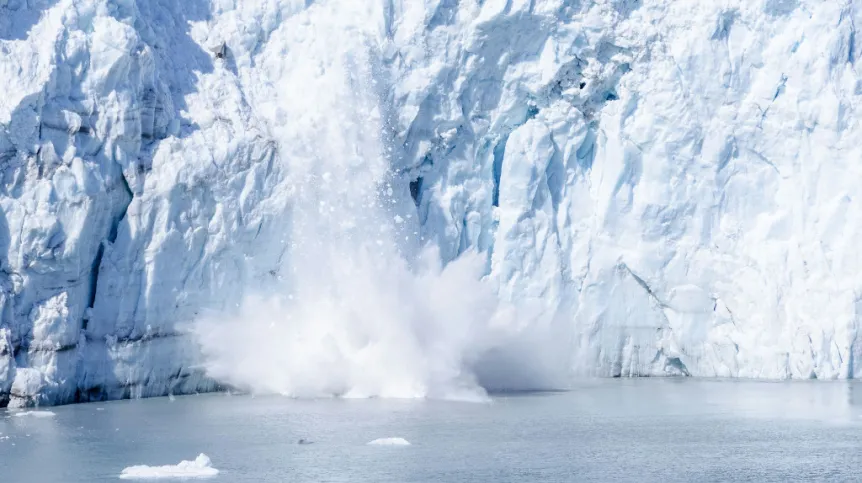
By studying the underwater sounds that accompany calving glaciers flowing into the sea, researchers will be able to estimate how much ice has melted. The work of Polish-British-American team will help better understand why the sea level rises.
The work was carried in the Polish Polar Station Hornsund, Spitsbergen. The study results have been published in "Geophysical Research Letters".
"The idea was to find new methods that will allow us to estimate the loss of mass of glaciers and the impact of this phenomenon on rising sea levels" - said in an interview with PAP one of the study authors, Oskar Głowacki, a graduate student at the Institute of Geophysics PAS. He added that melting glaciers are responsible for approx. 20 percent of the total global sea level rise.
It turned out that by using relatively simple methods - listening to underwater sounds - you can not only say when the glacier calves (ice breaks off from it on contact with water), but also more accurately classify these phenomena. Because the fact that the sound of sliding ice is louder does not necessarily mean that more ice got into the water. A lot depends on how the iceberg drops onto the surface of the sea. "We decided that this topic should be investigated further" - added Głowacki. The team was able to identify three types of sound characteristics associated with different types of calving. If you know how to tell them apart, you can estimate how much ice calved from the glacier.
To date, in the studies of calving glaciers researchers primarily used satellite data and determined the amount of ice that broke based on images. Resolution of available images is relatively small (of the order of 15 m). Such studies provide relatively accurate results especially in the case of the largest glaciers - in Antarctica or Greenland. "Until now, there was no good methods, which would show the impact of smaller glaciers on the sea level - such as those on Spitsbergen, where we have the Polish Polar Station" - said Głowacki.
He noted that the direct research on the glacier is very dangerous. "Moving on a glacier at the point where the mass loss occurs as a result of calving, would be madness" - the researcher pointed out. However, measurements with underwater microphones (hydrophones) can be a very convenient option. "Acoustic methods are relatively cheap and can be used safely - just put a hydrophone several hundred meters from the glacier, where researchers are no longer at risk" - he explained. Recording equipment can be left even for half a year or a year and then collect the recording and analyse it.
Scientists have to support their research with additional materials. They took pictures of the glacier, converted them into videos (time-lapse) and synchronized with sound, to show how big the iceberg issuing certain sounds are and how the phenomenon progresses. "This was the first step, in which we showed that underwater acoustics can be an alternative and a valuable addition to the previously used methods" - commented Głowacki. He admitted that in the future algorithms may be created that could automatically analyse recordings of glacier calving and estimate the amount of ice loss.
The research was carried out primarily as part of the project of Dr. Jarosław Tęgowski from the University of Gdańsk "The use of underwater sounds for passive monitoring of calving processes of Glacier Hans, Hornsund Fjord, Spitsbergen" in the OPUS programme of the National Science Centre.
PAP - Science and Scholarship in Poland, Ludwika Tomala
lt/ agt/ mrt/
tr. RL