The second Polish scientific satellite Hevelius will be launched into space on July 10. The launch will take place in the Chinese training ground Taiyuan, on the rocket Long March 4B, reported the website of the BRITE project that Hevelius is part of.
Currently the Polish satellite undergoes final testing in the Warsaw Space Research Centre PAS clean-room. "In a few days it will be packed and shipped to China" - we read on the Polish website of the international program BRITE - BRIght Target Explorer Constellation. Austria and Canada also participate in the project.
Originally Hevelius was supposed to be launched at the end of December 2013, also on Long March 4B rocket. However, shortly before the scheduled launch, Brazilian satellite carried by a rocket of this type landed on Antarctica instead of ending up in space. It was the first failure of this type of rocket. Since then, the launch of Hevelius has been postponed several times, and the rocket manufactures analysed the accident in detail.
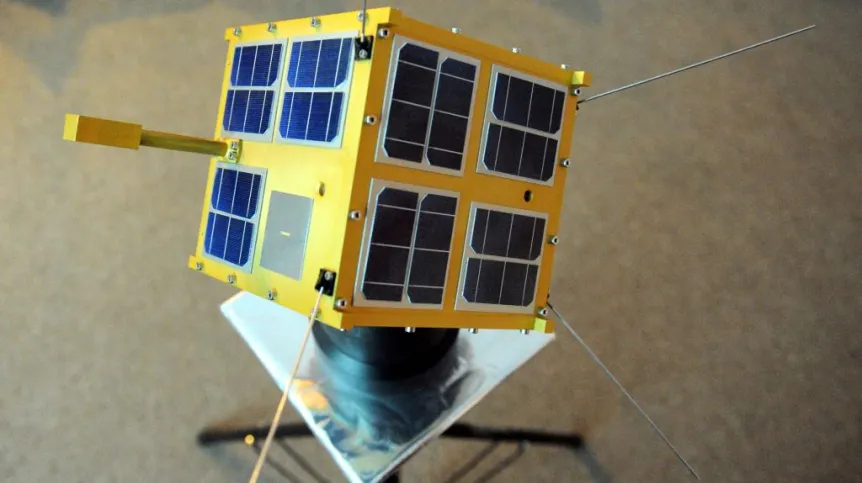
In space, Hevelius will join Lem, the first Polish satellite launched in November 2013. Like the two satellites from Austria and two from Canada, they are nanosatellites, objects with very small sizes. They weigh less than 7 kg, and have a cubic shape with a side of about 20 cm. Until now, such small devices have only been used as an amateur and educational objects.
Meanwhile, Lem and Hevelius are the first such small devices with scientific tasks. Placed at an altitude of 800 km, for a few years they will be conducting precise measurements of 286 brightest stars in the sky. While at night they can be seen even with the naked eye, because of atmospheric disturbances, small changes in the brightness of stars can not be observed even by the largest telescopes.
"The brightest stars are also neglected by the more complex satellites. Meanwhile, BRITE satellites are equipped with wide-angle cameras that see dozens of bright stars at once" - explained Prof. Aleksander Schwarzenberg-Czerny from the Nicolaus Copernicus Astronomical Center in Warsaw.
Six BRITE satellites will provide scientists with information about the internal structure of stars and the details of the physical processes taking place inside them, such as thermonuclear reactions, mixing of matter, energy transport from the centre to the surface by convection and radiation.
The devices have been developed by experts from the Centre for Space Research and the Nicolaus Copernicus Astronomical Center PAS in Warsaw, in collaboration with the University of Vienna, Technical University of Graz, the University of Toronto and the University of Montreal. Ministry of Science and Higher Education allocated PLN 14.2 million to their construction. The names for the satellites were chosen in 2010 by Internet users in the vote on the Ministry of Science website.
PAP - Science and Scholarship in Poland
ekr/ ula/ mrt/
tr. RL