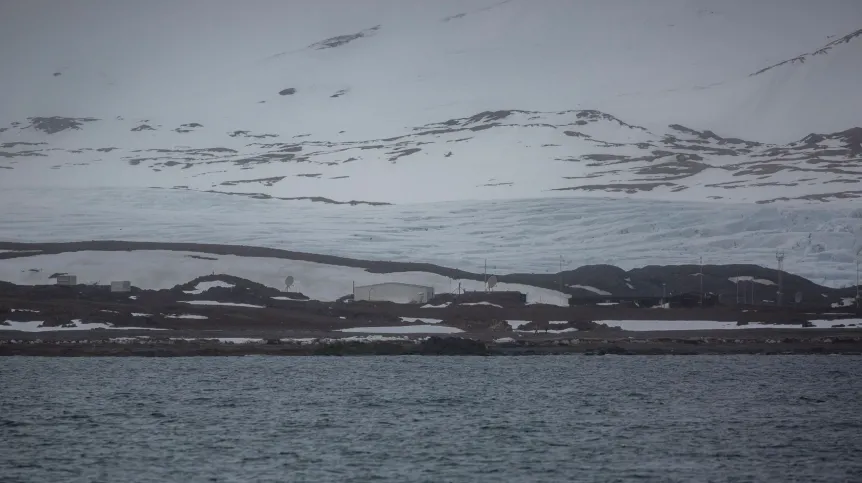
At the Polish Polar Station Hornsund, the sun remains below the horizon for more than three months. For polar explorer Dagmara Bożek, that period changes the pace of daily life. “During the polar night, metabolism slows down, sleepiness increases, and monotony sets in,” she tells the Polish Press Agency.
She adds that it is best to “organize your time in an engaging way,” go hiking, try winter swimming and “enjoy the aurora borealis.”
Bożek, from the Institute of Geophysics of the Polish Academy of Sciences, spent the polar night during the 35th PAS Polar Expedition to Spitsbergen.
The station is located at 77 degrees north, where the polar night lasts from October 31 to February 12. She also spent a year at the Henryk Arctowski Polish Antarctic Station but says that at 62 degrees south the phenomenon is different: “For certain periods of the year, the daylight hours are simply very short, about four hours.”
She says that even in the Arctic winter, darkness is not absolute. “Even during several months of polar night, it is not completely dark 24 hours a day.” Early in the season, a glow remains on the horizon. “It is darkest around mid-December, and Christmas is actually the middle of the polar night. The closer to February 12th, the more grey it becomes.”
Clear skies provide enough natural illumination from the moon, stars and snow to move around without a flashlight, though crews carry them because the region is frequented by polar bears. Longer trips away from the station are restricted for safety reasons.
Auroras appear regularly during the season. “During my expedition, we were lucky enough to be at the peak of solar activity and saw the auroras from late October to early March,” she says.
As winter sets in, the station population drops to the 10-person wintering team. The return of the sun becomes a planned moment. “The Station crew celebrates the appearance of the Sun after several months of its absence,” she says. Her group held a barbecue, drew a large sun in the snow with potassium permanganate and climbed Fugleberget mountain to catch the first light. “It only showed slightly and quickly sank below the horizon. It felt like a special day.”
Reactions vary. “Contrary to appearances, the period when the light appears is perceived as depressing by some members of the expedition,” she says. Increased daylight means more field work. “The burst of enthusiasm gives way to the reflection that we are already a bit tired of it all, and there are still a few months left until the end of winter.”
Bożek says she began her first polar expedition with curiosity but was aware of the physical effects of months without sunlight.
“Firstly, there is no natural light, so you need to supplement vitamin D,” she says. During the polar night “the body begins to function more slowly, the metabolism slows down, and you become more drowsy.” Some people develop sleep problems or thyroid issues. She adds that she handled the conditions well, though “of course, I slept more than usual.”
Timekeeping is another challenge. With no sunrise or sunset and work and living areas in the same building, circadian rhythms can shift. “Although breakfast is scheduled at a specific time, like eight o'clock, sometimes you can oversleep and lose your rhythm,” she says. In more extreme cases, “the rhythm can get thrown off course, and you start functioning when everyone else goes to bed.” She says that during her expedition “two people disappeared from our lives for a few days because they simply started functioning differently.”
Expedition members receive psychological training and support, but much depends on maintaining structure. Group routines such as shared breakfasts, language lessons, films and board games help. Both Polish stations have gyms, and outdoor activities include skiing, glacier travel, climbing and winter swimming.
“There are many possibilities; a lot depends on willingness and creativity,” she says. “If people want to spend time together, it really helps and motivates, breaking the monotony that is at its worst during the polar night.”
PAP - Science in Poland, Ewelina Krajczyńska-Wujec (PAP)
ekr/ agt/ lm/
tr. RL