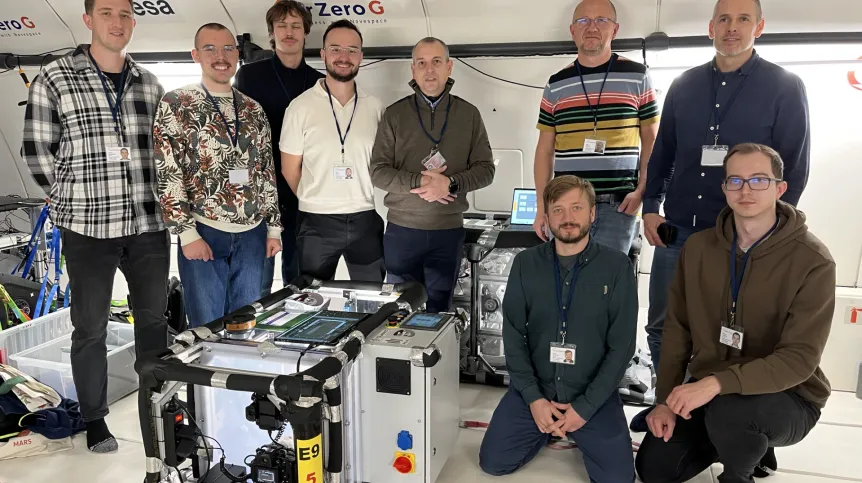
Polish scientists have successfully completed tests of a prototype space excavator designed to extract lunar regolith under simulated lunar-gravity conditions.
Regolith is the dusty upper layer of the lunar surface and is considered a key resource for future human missions. It contains oxygen, silicon, iron, calcium, titanium, aluminium and magnesium.
Conducted during the European Space Agency’s 88th parabolic flight campaign, the tests examine how lunar regolith and extraction devices behave in gravity similar to that on the Moon.
Ewelina Zambrzycka-Kościelnicka, spokesperson for the Space Research Centre of the Polish Academy of Sciences, which is part of a consortium consisting of the AGH University of Science and Technology in Kraków, the University of Warmia and Mazury in Olsztyn, and the company Spacive, said: “Operations on the lunar surface pose unique challenges – lower gravity, mass and power constraints, extreme temperatures, and a vacuum significantly affect soil mechanics.
“Parabolic flights, during which the gravitational conditions of the Moon are recreated for several dozen seconds, provide a unique opportunity to study the interactions between regolith and mechanical devices in realistic conditions.”
She adds that Polish scientific institutions are developing technologies for acquiring lunar regolith and that “the DIGGER project, implemented by the Space Research Centre of the Polish Academy of Sciences in cooperation with the European Space Agency (ESA), plays a special role.”
The DIGGER project produced the Rotary Clamshell Excavator (RCE), a mechanical regolith-sampling device that has reached Technology Readiness Level 6.
Zambrzycka-Kościelnicka says this means the device is a functional prototype that has passed environmental tests, including launch vibration, dust and temperature exposure, but has not yet operated in true lunar-gravity conditions, which justified the parabolic flight campaign.
For the ESA flights, researchers developed the PETER (Planetary Excavation Technology vERification system) experimental set. It includes the RCE device, a chamber for blade-cutting tests, a rotating drum for analysing the angle of repose, regolith simulants and a sealed enclosure to protect crew and equipment from dust.
The PETER-PFC project focuses on five scientific areas: determining regolith geotechnical properties, assessing RCE performance, analysing how different regolith simulants affect cutting mechanics and comparing results obtained under Earth and lunar-gravity conditions.
According to the Space Research Centre PAS, the research addresses key questions for future lunar missions, including technologies for In Situ Resource Utilization (ISRU)—the use of local materials for building infrastructure, producing fuel and supporting crewed expeditions.
“Space exploration is increasingly dependent on the use of local resources, which reduces costs and increases mission autonomy. The ISRU (In-Situ Resource Utilization) concept involves the acquisition, processing, and use of raw materials directly in space. Leading agencies are involved in these activities – NASA in the Artemis program and ESA in the Terrae Novae initiative,” says Karol Seweryn, PhD, project leader at the Space Research Centre PAS.
He adds that “the campaign was excellent and allowed to collect valuable data.” He says the RCE device was successfully tested in a regolith simulator under lunar-gravity conditions, the strength and angle-of-repose properties of the regolith simulant were measured, and flight operators were prepared and trained.
“You could say that we have learned a good lesson, encompassing both engineering, operational, and organizational processes – critical for future campaigns and research,” Seweryn says.
ESA parabolic flight manager Neil Melville also assessed the test programme positively. According to the Space Research Centre PAS, “the RCE test setup was properly prepared, and all key functions – from the excavation process to resetting the simulator’s geotechnical properties – functioned as intended.”
The collected data will be analysed and made publicly available in the coming months as part of Open Science. (PAP)
PAP - Science in Poland
akp/ zan/
tr. RL