
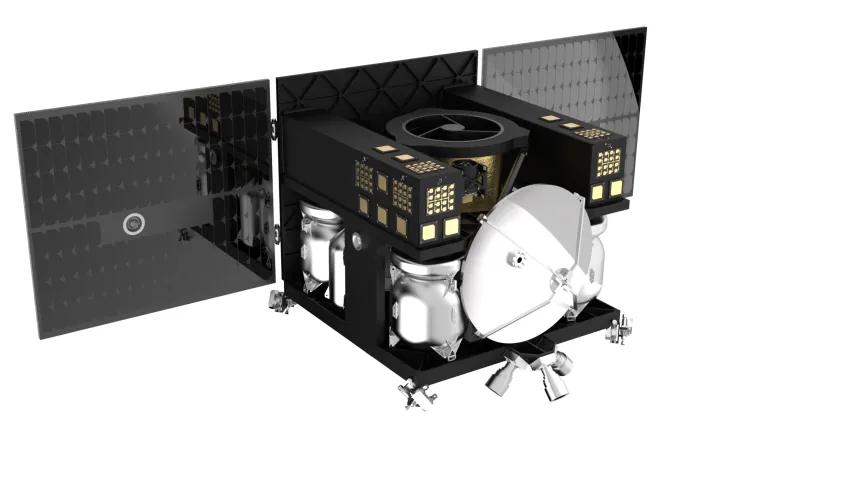
The European Space Agency has selected the Máni lunar mission, with Polish participation, for the next phase of its Small Lunar Missions programme.
The project aims to produce the highest-resolution maps of the Moon’s surface to date, improving the safety of future robotic and human landings by identifying hazards such as large rocks and cliffs.
Máni plans to place a lunar orbiter at an altitude of about 50 km to generate ultra-high-resolution imagery and three-dimensional digital terrain models. The spacecraft will carry an optical instrument designed and supplied by the Polish company Scanway.
The data are intended to support future missions to the Moon, including planning the location of a potential base under NASA’s Artemis programme.
The project was selected in 2024 from 62 submissions for Phase 0/A of ESA’s programme and has now advanced to Phase A/B1, one of seven initiatives to reach this stage.
“If the project is fully implemented, the budget will be approximately €50 million, of which we estimate Scanway's share at approximately €8.6 million over a four-year period,” said Scanway CEO Jędrzej Kowalewski.
The leading partners in the Máni project are the University of Copenhagen, Space Inventor and Scanway, which is working in collaboration with the Institute of Geological Sciences of the Polish Academy of Sciences.
According to the project partners, the several-times higher spatial resolution of Máni’s data will allow advance detection of large rocks and cliffs and precise mapping of the edges of volcanic caves, enabling detailed mission planning before landings and improving safety.
The same datasets are also expected to have significant scientific value.
“It is exciting that the new data provided by Máni will finally answer several pressing questions in modern ‘lunar science’. For example, thanks to the extremely high resolution, it will finally be possible to characterize the small impact craters whose formation we observed live in the form of lunar flashes. This, in turn, will allow us to precisely determine the properties of the regolith and thus prepare for the extraction and processing of rocks, and the construction of future bases on the Moon,” said Anna Łosiak, PhD, of the Institute of Geological Sciences of the Polish Academy of Sciences.
She added that targeted observations in other locations could also help determine whether volcanic eruptions may still occur on the Moon. (PAP)
ekr/ agt/
tr. RL