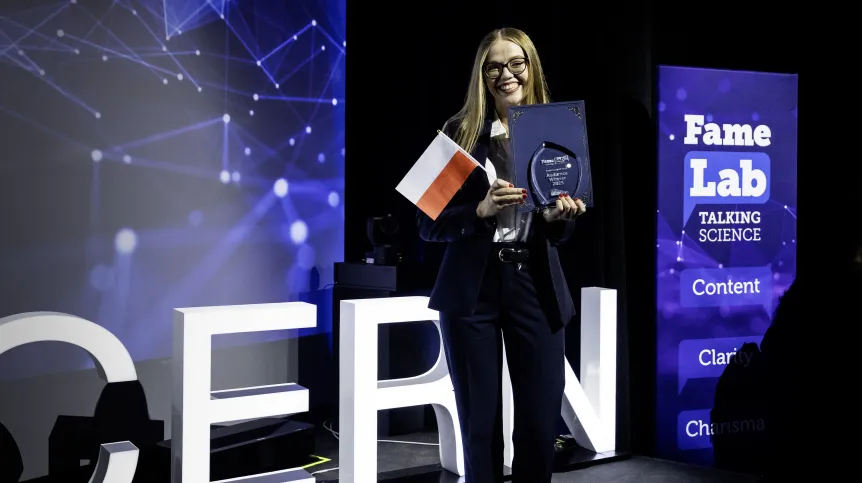
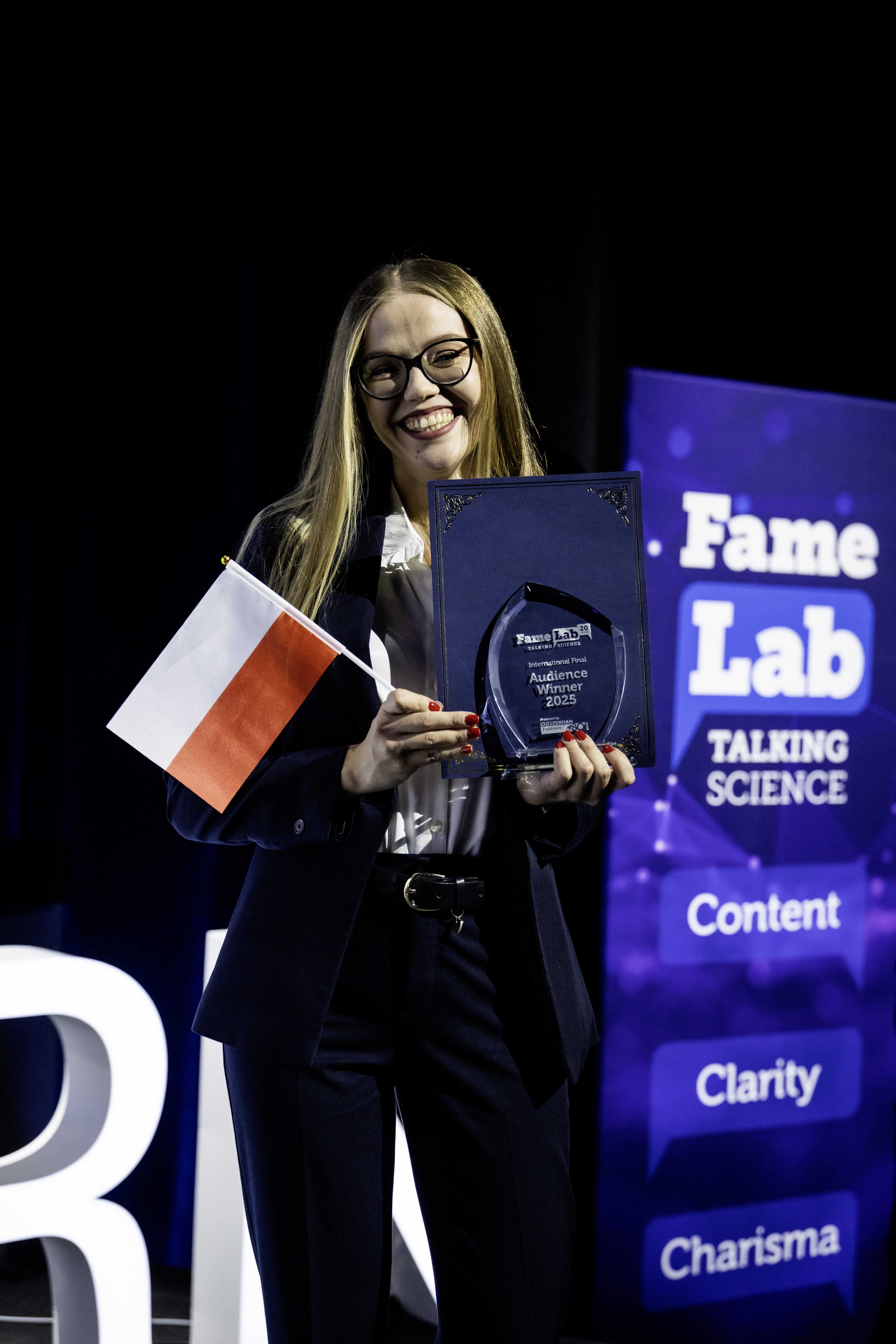
A Polish doctoral candidate at the Warsaw University of Technology has been voted Audience Winner in the FameLab international finals held at CERN in Geneva, Switzerland.
FameLab participants have three minutes to present their research or a scientific topic. Judges evaluate the talks based on content, clarity and charisma.
Natalia Izdebska advanced to the international stage after winning the Polish edition of the competition.
Her research focuses on magnesium batteries, which she aims to make safer, more efficient and cheaper than lithium-ion batteries.
During her presentation at the Polish finals in Katowice in October, she explained that lithium-ion batteries remain the standard in mobile devices and electric vehicles but face significant limitations.
She said lithium is “very expensive, difficult to obtain, flammable,” adding that “the compounds emitted in fires are harmful to humans, and batteries discharge quickly.”
Izdebska said she sees magnesium as a promising replacement for lithium. “In the Polish finals of the competition, I talked about magnesium batteries and my modification of these batteries. I add supramolecular compounds to them, which enable them to function,” she told the Polish Press Agency (PAP). Magnesium, she added, has a key advantage: “It is cheap and readily available in the Earth’s crust.”
Tammy Lee of Australia won the competition in Geneva. Two equal second-place awards went to Spatika Jayaram of the UK and Saein Lee of Switzerland.
FameLab was created in 2005 in the UK by the organizers of the Cheltenham Festivals. In Poland, finals organized by the British Council and the Copernicus Science Centre were held from 2012 to 2019 and in 2021.
After a hiatus, the competition returned in a new format organized by the University of Silesia in 2024. Editions of FameLab now take place in 30 countries.
Previous Polish winners have also succeeded internationally. Monika Koperska, PhD, placed second and was voted Audience Winner in 2012.
Another laureate, Joanna Bagniewska, reached the international top ten in 2014 and received a prize awarded by past participants. (PAP)
PAP - Science in Poland
lt/ bar/
tr. RL