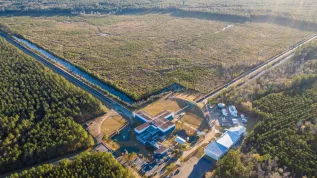

XMaS may sound like Christmas, but for physicists it is the name of a powerful X-ray beamline, and one that has now revealed, almost live, how copper atoms wander inside a catalyst critical for turning methane into methanol.
Working at the European Synchrotron Radiation Facility (ESRF) in Grenoble, an international team including scientists from Poland tracked how copper atoms move within a zeolite structure during catalyst activation, a process that ultimately determines how efficiently methane can be converted into a transportable liquid fuel.
Methane, often burned off as flares at oil refineries, is a valuable raw material but difficult to transport. For years, researchers have sought ways to convert it into methanol, a simple alcohol that can be stored and moved much more easily, ideally using compact installations suitable for remote locations.
One of the most promising solutions relies on copper-containing zeolite catalysts. Zeolites are crystalline materials with a rigid network of microscopic channels and cavities. When copper atoms are introduced into this structure, the material can trap methane and convert it into methanol. In the zeolite mazzite (Cu-MAZ), the most efficient configuration involves two copper atoms acting together in larger pores.
The challenge is that during catalyst preparation — activation in oxygen at high temperatures — copper atoms can migrate between different positions in the zeolite framework. Some of these sites are catalytically active, while others are not. When copper relocates from an active site to an inactive one, the catalyst loses performance. Until now, such changes were typically measured only after the process had ended.
In a study published in the Journal of Applied Crystallography, researchers from the University of Warsaw and the Jagiellonian University, together with international collaborators, demonstrated how to monitor copper atoms operando, meaning during the activation process itself.
The experiments were conducted at the BM28 beamline, known as XMaS, at the ESRF. Two complementary techniques were used in tandem: powder X-ray diffraction, which reveals where atoms sit within a crystal lattice, and X-ray absorption spectroscopy, which determines the chemical state of copper.
By tuning the X-ray energy to values close to the copper absorption edge, the researchers were able to isolate copper’s contribution from signals produced by oxygen or water inside the zeolite pores. Spectroscopic measurements collected between diffraction scans confirmed that no unexpected chemical reactions were taking place.
The results show that copper remains almost entirely in the Cu(II) oxidation state during activation, transitioning from a hydrated to a dehydrated form as temperature increases. Dehydration is largely complete below 300°C.
Copper-sensitive diffraction further revealed that at around 170°C, copper is not detected in small, catalytically inactive sites within six-membered rings of the zeolite structure. These signals appear only above 250°C. Because both the active paired copper sites and the inactive sites are characteristic of Cu-MAZ, the findings indicate that between 170°C and 250°C some copper migrates from active locations to inactive ones, most likely as dehydration progresses.
The researchers say that while the study does not deliver a ready-made industrial technology, it provides an important engineering insight.
Future methane-to-methanol processes will depend not only on the chemical composition of catalysts but also on how they are activated. Precise control of dehydration, without driving copper into inactive sites, may be the difference between a catalyst that performs efficiently and one that rapidly deteriorates.
Polish researchers played a visible role in the work. The participation of Kinga Góra-Marek from the Jagiellonian University was supported by the Polish National Science Centre, while access to the ESRF for Dariusz Wardecki from the University of Warsaw was co-financed by the Ministry of Science and Higher Education.
Krzysztof Petelczyc (PAP)
kmp/ bar/
tr. RL