The number of people in Poland who consciously choose pagan religions is growing, driven in part by an interest in Slavic heritage and a search for alternative forms of spirituality, says research from the Jagiellonian University.
According to the 2021 national census, the latest available data, more than 4,700 people in Poland identified themselves as pagans. Of these, over 3,300 declared membership in Slavic Native Faith religious associations. The census also recorded followers of other pagan paths, including Druids and Ásatrú practitioners.
“We could say it is several thousand people, but these numbers are definitely growing,” said Joanna Malita-Król, PhD, from the Institute of Religious Studies at the Jagiellonian University, who studies contemporary pagan religions. She is the author of the book W rytualnym kręgu. Opowieść o współczesnych poganach w Polsce (“In the Ritual Circle: A Tale of Contemporary Pagans in Poland”).
Malita-Król said that paganism, as understood today, refers to modern attempts to revive or reinterpret pre-Christian belief systems. “From my scholarly perspective, the term ‘paganism’ is a technical term denoting a phenomenon currently occurring on the religious scene. It is a return to pre-Christian beliefs, either as an attempt to restore what once was or as a creative inspiration from the past,” she said.
She noted that some believers reject the term because of its historical connotations. “‘Pagan’ – or paganus in Latin – originally simply meant a provincial resident. Over time, it acquired a contemptuous connotation that became a dividing line between Christians and pagans,” she said, adding that many people prefer to be identified by specific traditions, such as Slavic Native Faith.
According to Malita-Król, the growing popularity of pagan practices reflects a broader cultural trend. “This is visible in pop culture, in fashion, in organized festivals of Slavic mythology and culture. The number of people engaging in Slavic activities on social media is also growing,” she said. “We see this desire to return to native Slavic culture, to rediscover it. All of this may also be linked to a desire to return to the religion of our ancestors.”
She added that secularisation does not mean the disappearance of spiritual needs. “The need to seek spirituality and satisfy spiritual needs is still very strong within us,” Malita-Król said. “It just turns out that it can be fulfilled in various ways, not necessarily within the framework of an organized religion, for example, a specific church.”
Most contemporary pagans, she said, have had contact with the Catholic Church. “At some point, they simply became disillusioned with the dominant religion, which did not meet their spiritual needs,” she said. “In stories about turning to pagan religions, a sense of belonging, a sense of being at home, at a pagan ritual or among others who follow the same path, is clearly prominent.”
Malita-Król stressed that modern pagans do not fit common stereotypes. “‘Pagans are a diverse group, considering their education and what they do in life,’” she said. “I have met both students and people working as manual labourers, with technical and humanities degrees. They are people just like everyone else; they also have families, various life challenges, and shop at supermarkets.”
She noted that many pagans live in cities and tend to be highly engaged in self-education. “What they certainly have in common is their extensive, even intimidating level of reading,” she said. “Pagan homes typically have huge libraries.”
According to the researcher, contemporary pagan religions are usually polytheistic, non-dogmatic and centred on ritual rather than doctrine. “Here, ritual is the foundation, and reliance on ritual is crucial,” Malita-Król said. “Hence, pagan religions are described as orthopraxic, as opposed to orthodox, meaning faith-based.”
The pagan ritual calendar typically includes around eight annual holidays linked to the cycles of nature. In Slavic Native Faith, these include celebrations connected to solstices, equinoxes and agricultural cycles, as well as feasts dedicated to specific deities, such as Veles in February, Perun in July and Mokosh in August. Dziady, devoted to ancestors, is celebrated around the beginning of November.
Rituals also mark life events such as birth, coming of age, marriage and death. “Besides this, religious practice encompasses various daily, private acts of devotion and piety,” Malita-Król said. “It is quite an individual matter how much time one wants to devote to spirituality.”
She added that the Christmas period is also significant for Slavic Native Faith practitioners, who associate it with the winter solstice, known as Koliada or Szczodre Gody. “It is the time when the sun god Daźbóg is reborn,” she said. “It is also the time when, in this darkest winter, a glimmer of hope appears that things will get better and spring will come one day.”
Many Polish Christmas customs have pagan roots, Malita-Król said. “The custom of leaving an empty seat at the Christmas Eve table is not so much for a lost traveller, but for ancestors who come to feast with us,” she said. Other practices, such as carolling, wearing costumes, poppy-seed dishes, straw under the tablecloth and the number of holiday dishes, are “very ancient and very local customs.”
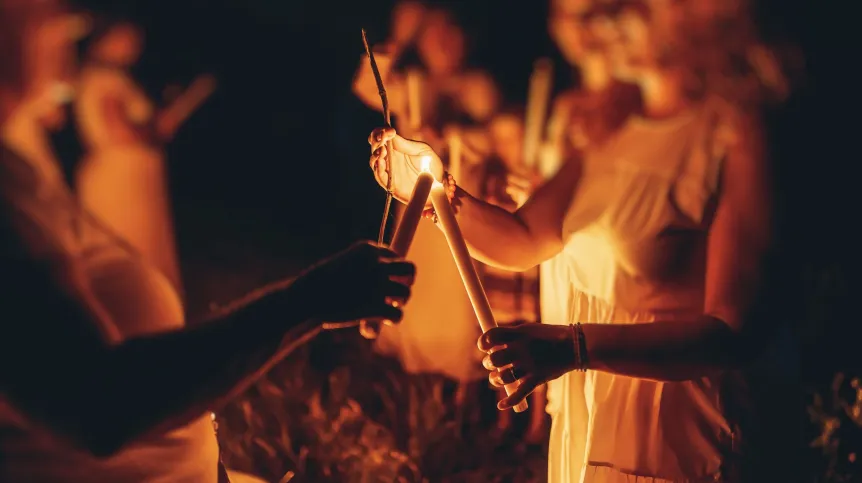
Some pagans practice alone, while others belong to organized groups or religious associations. “Pagan holidays are often open,” Malita-Król said, noting that events are frequently announced on social media and open to newcomers. “You can actively participate right away, but usually there is the option to remain outside the ritual circle and see what it is all about.” (PAP)
Ewelina Krajczyńska-Wujec, PAP - Science in Poland
ekr/ zan/ amac/
tr. RL