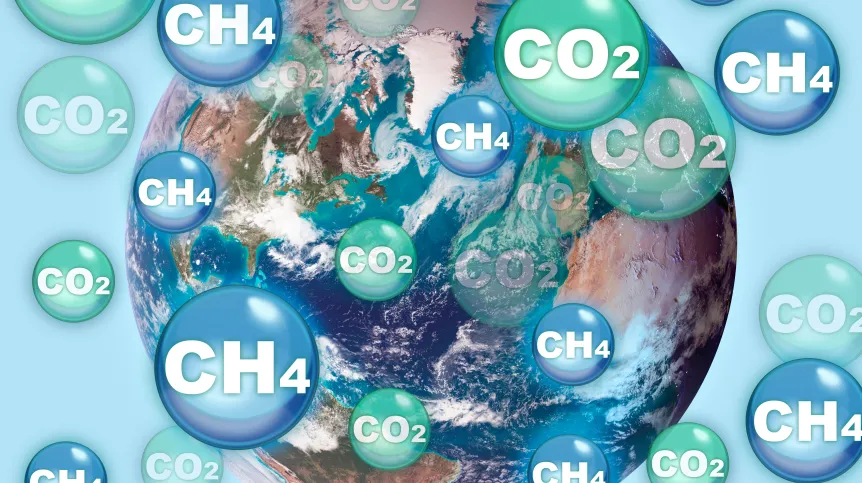
Under the right conditions, the greenhouse gases carbon dioxide (CO2) and methane (CH4) can be used as raw materials to produce industrially valuable chemicals, according to a study by researchers from Poland, Czechia, and France published in Applied Catalysis B: Environment and Energy.
The key is a specially designed catalyst that directs the reaction while remaining stable.
CO₂ is highly chemically stable, making it difficult to activate under mild conditions. Methane is also relatively unreactive due to strong C–H bonds. While it can easily be burned, selectively converting methane into more valuable products without full oxidation is challenging.
Combining CO₂ and CH₄ to produce chemicals such as methanol and acetic acid has therefore been one of the more complex problems in modern catalysis.
The study, led by researchers from the Jagiellonian University in collaboration with Czech and French teams, proposes a reaction in which methane serves as a hydrogen source and CO₂ provides carbon and oxygen.
In the presence of an appropriate catalyst, these two gases can be transformed into oxygenated organic compounds rather than contributing to climate change.
The key catalyst is a zeolite called ferrierite (FER). Zeolites are porous minerals with highly ordered channels and cavities that can accommodate metal atoms acting as active catalytic centres.
In this study, iron atoms were inserted into FER, creating a bifunctional catalyst called Fe-FER. According to the researchers, the catalyst’s design is critical: it must enable redox reactions through the iron centres while providing structural Bronsted acid sites necessary for subsequent steps in forming methanol and acetic acid.
The active catalytic site is dynamic rather than fixed. In the FER zeolite, iron atoms can shift position and coordination within the channels, changing their electronic states—such as oxidation level and charge distribution—in response to CO₂. These shifts allow the iron atom to participate more effectively in later reaction stages.
The researchers used several independent methods to study the process. They observed products and intermediate reaction steps in real time using in situ FTIR-MS and monitored the state of the iron and its environment with Mössbauer spectroscopy and neutron diffraction. In parallel, calculations supported by machine learning models helped predict which intermediate forms were most likely.
The proposed sequence begins with CO₂ interacting with iron centres to form intermediates, such as hydrogen carbonates, which modify the local environment and prepare the site for methane activation. Methane is then converted to methanol at these activated iron centres. Methanol subsequently undergoes carbonylation at adjacent Bronsted acid sites in the zeolite, producing acetic acid. At higher temperatures, some methanol also undergoes methanol-to-olefins (MTO) reactions, forming compounds such as ethylene and propene. Methanol formation occurs around 170°C, acetic acid appears around 230°C, and olefin formation becomes increasingly significant above 300°C.
The study highlights that understanding the catalyst as a dynamic system is crucial. The shifting positions and electronic states of iron, as well as the formation of intermediate carbonates, enable selective conversion of stable molecules under milder conditions and with greater control. The researchers argue that this insight is essential for designing catalysts capable of producing desired products efficiently.
From an ecological perspective, the research shows a potential pathway for chemically using CO₂ and methane, treating them as feedstocks rather than waste.
This approach could support a circular economy in chemistry, but the researchers caution that environmental benefits depend on process conditions, including the energy source, gas stream purity, and preventing methane escape.
If these elements are refined, such catalytic processes can simultaneously reduce both emissions and the pressure on fossil fuels in the production of basic chemicals. (PAP)
kmp/ agt/
tr. RL