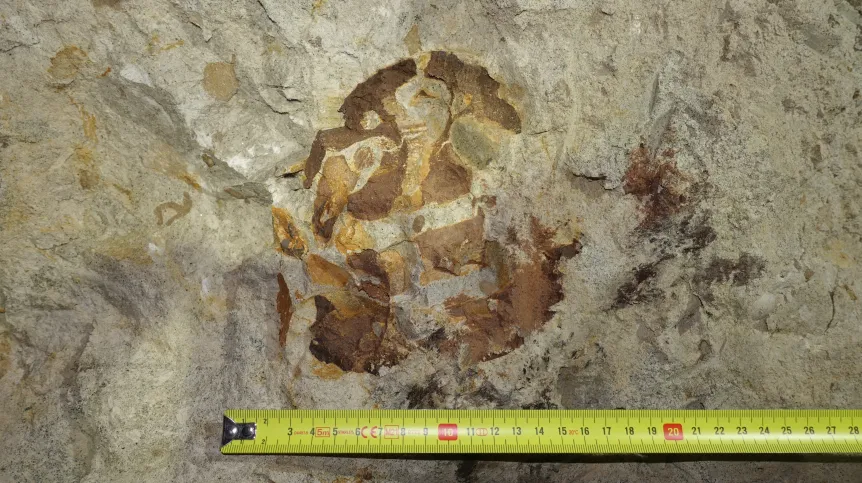
Palaeontologists have identified the remains of a large ichthyosaur, comparable in size to a modern killer whale, discovered in a phosphate mine in Annopol on the Vistula River in eastern Poland.
The fossils are estimated to be about 95 million years old, placing the animal among the last known representatives of this group of marine reptiles.
The study was published in the journal Acta Geologica Polonica. Its authors are Daniel Tyborowski, PhD, from the Faculty of Geology at the University of Warsaw, Grzegorz Gajek, PhD, from Maria Curie-Skłodowska University in Lublin, and Artur Komorowski from the Beskid Speleoclub.
Ichthyosaurs, often referred to as “fish lizards,” were marine reptiles that lived approximately 250–93 million years ago, throughout much of the Mesozoic era.
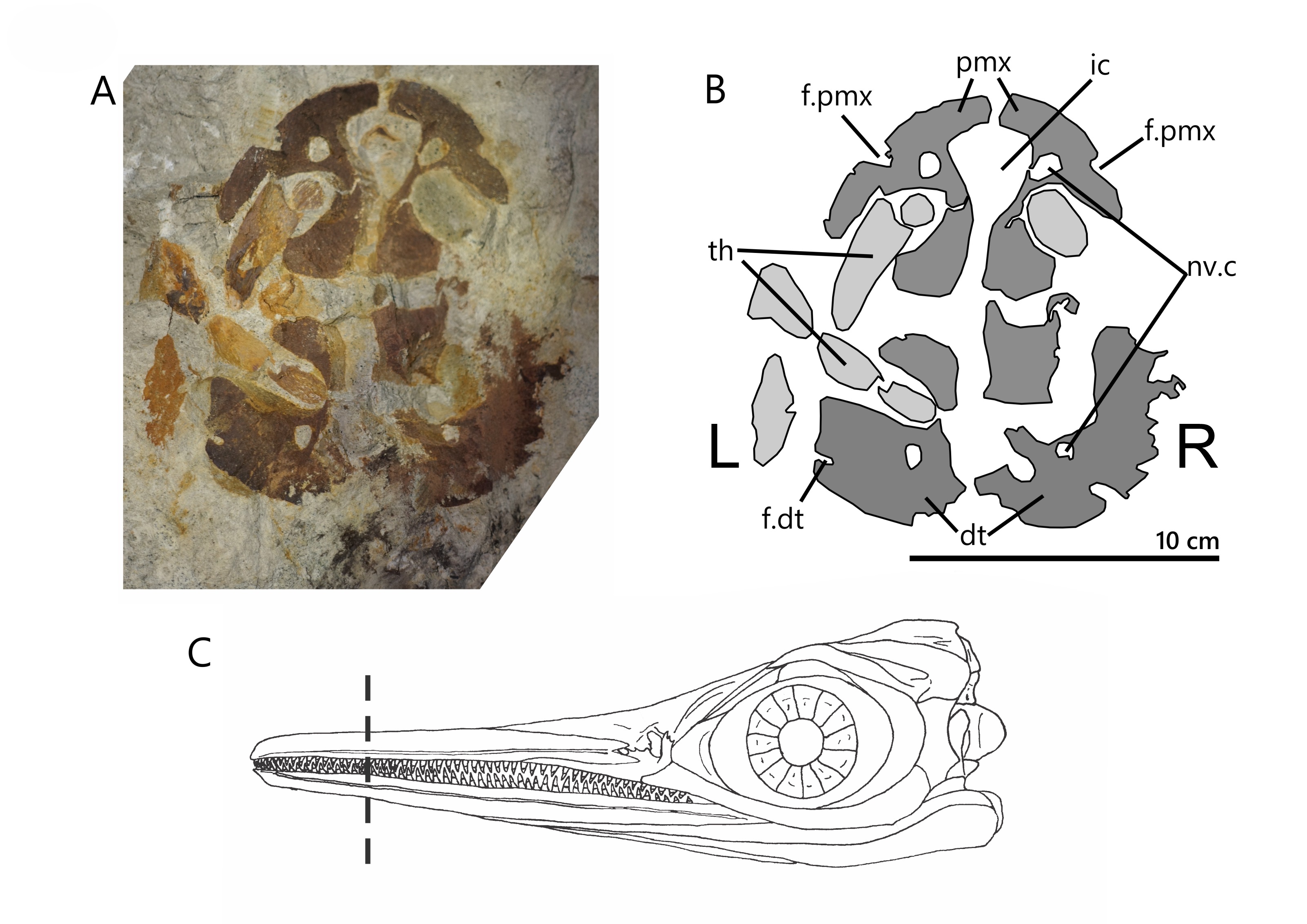
According to Tyborowski, the newly described material consists of a cross-section of the animal’s skull and was discovered by Komorowski in a phosphate mine in Annopol, on the eastern edge of the Świętokrzyskie Mountains.
“We are dealing with a specimen that perfectly demonstrates the anatomical details of ichthyosaur cranial structures,” Tyborowski said. “The rocks in which the specimen was found date to the beginning of the Late Cretaceous (the age known as the Cenomanian) and are approximately 95 million years old.
“This is very important geological information, as ichthyosaurs became extinct at the end of the Cenomanian, 93 million years ago. The Polish fossils therefore constitute a fossil record of one of the last ichthyosaurs to have lived on Earth.”
Anatomical analysis and comparison with ichthyosaur remains from other parts of the world allowed the researchers to assign the skull bones to the platypterygian group.
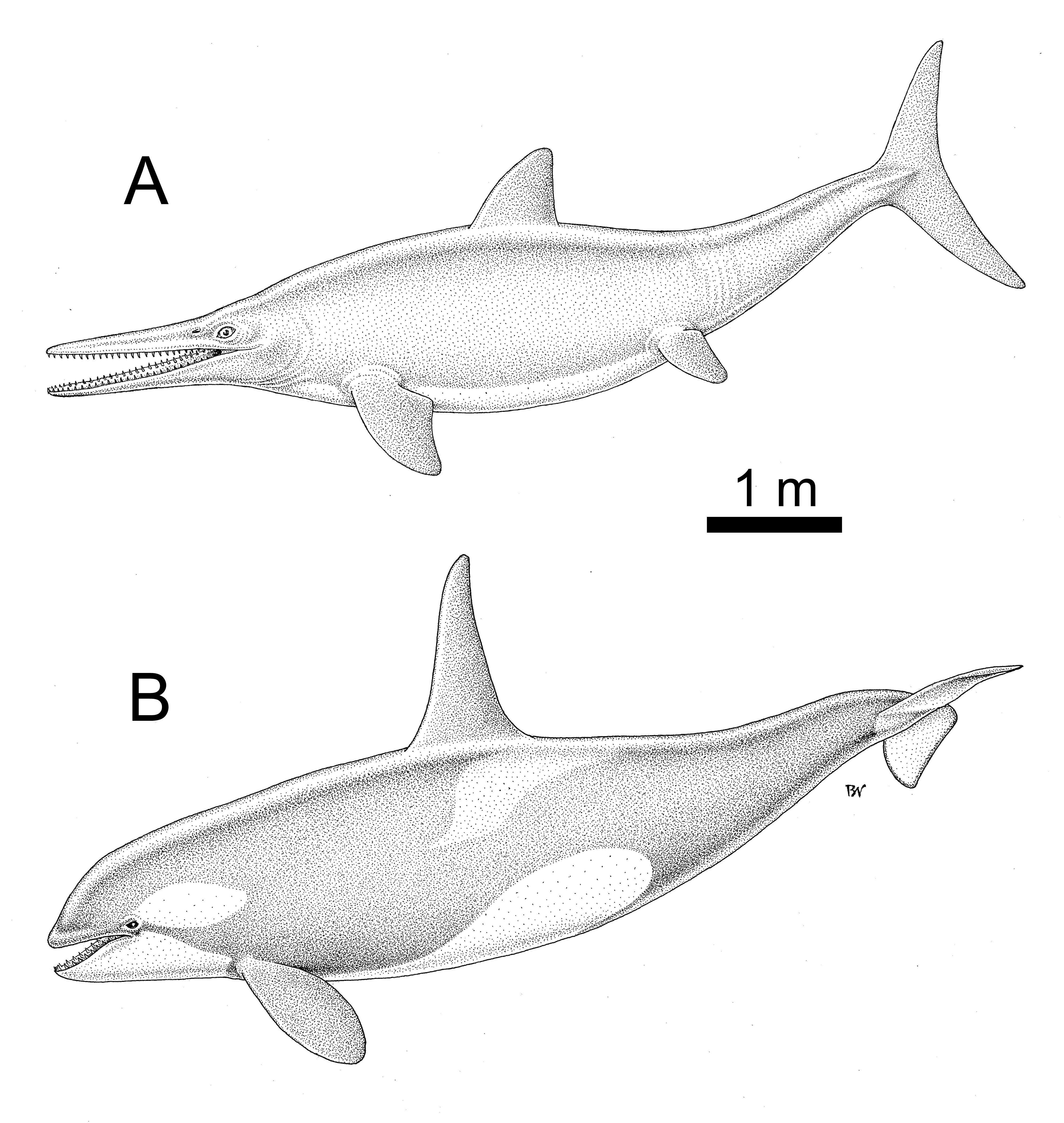
Reconstruction of the appearance of the Annopol ichthyosaur (A) and comparison of its size with a modern-day oceanic killer whale (B). Credit: Bogusław Waksmundzki.
“These were large and quite massive ichthyosaurs, which at the turn of the Late Cretaceous were at the top of the marine food chain,” Tyborowski said. “Their jaws were thick and their fins were wide for ichthyosaurs, allowing them to practically glide underwater.”
According to the researchers, the Annopol ichthyosaur measured between six and nine metres in length, comparable to modern killer whales.
“Large platypterygians were the Cretaceous ecological counterparts of these cetaceans,” Tyborowski said. “The large and massive teeth found in the mine indicate that the Polish ichthyosaur was perfectly adapted to hunting large prey, such as sea turtles, sharks, ray-finned fish, and smaller ichthyosaurs.”
In Tyborowski’s view, “the Annopol discovery shows that at the very end of their evolution, ichthyosaurs were quite well and occupied ecological niches occupied today by large, predatory cetaceans.”
PAP - Science in Poland
akp/ agt/
tr. RL