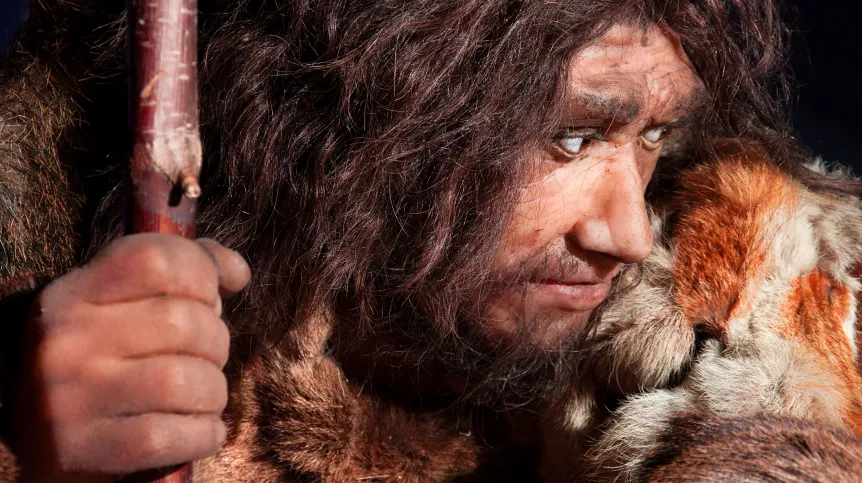
Scientists have confirmed that human remains discovered in Stajnia Cave in southern Poland belonged to Neanderthals who lived in the region between 92,000 and 119,000 years ago, according to new research.
The study published in Current Biology by an international team including researchers from the University of Wrocław, analysed “four new Neanderthal teeth and eight new Neanderthal mitochondrial genomes”, the authors said.
The findings suggest that Neanderthals moved extensively across Europe during the Middle Paleolithic period.
Genetic comparisons showed the remains from Stajnia Cave in the Kraków-Częstochowa Upland north of the Carpathian Mountains were most closely related to Neanderthals from Western Europe and the northern Caucasus.
“This means that the mobility of Neanderthals at that time was very high, and the area of [present-day- ed. PAP] Poland was crucial for their mobility. The discovery of the remains of several Neanderthals (including young children, adolescents, and adults) at a single site is extremely rare”, the researchers wrote.
Scientists also identified what may have been family ties among the individuals found in the cave. Three shared identical mitochondrial DNA, inherited only through the maternal line, suggesting one individual could have been the mother of the other two.
“The mitochondrial DNA analyses we have conducted confirm the results of the studies on tooth morphology, indicating Neanderthal ancestry”, the study authors reported.
Researchers used morphological analysis of the teeth to determine both the species and approximate age of the remains.
Wioletta Nowaczewska from the university’s Department of Human Biology participated in the analysis of tooth structure and was among the lead co-authors of the paper. The study’s first author was Andrea Picin of the University of Bologna. Andrzej Wiśniewski from the Department of Stone Age Archaeology also took part in the excavation and analysis.
The researchers said the Neanderthals lived in the region during a period of climatic cooling, a conclusion supported by animal remains recovered from the cave’s sediment layers. Krzysztof Stefaniak, Adam Marciszak and Paweł Socha contributed to that part of the research. (PAP)
PAP - Science in Poland
kak/ zan/
tr. RL