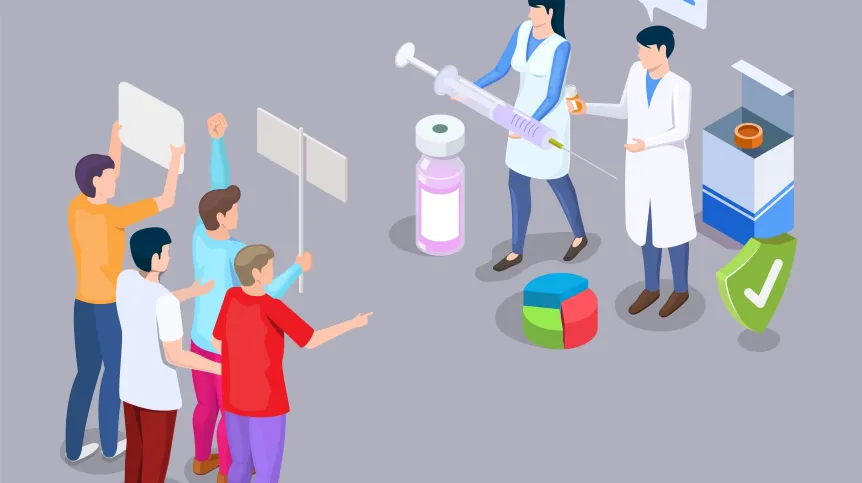
Vaccination hesitancy is driven less by medical knowledge gaps and more by psychological factors such as cognitive biases, trust, and communication style, according to a Polish psychologist who argues that how information is presented and who delivers it can be more influential than the scientific facts themselves.
Professor Wojciech Kulesza of SWPS University told the Polish Press Agency (PAP): “It is not the scientific facts themselves that are crucial, but how we interpret them and who we want to believe.”
Kulesza is a co-author of Vaccines and Vaccinations: A Psychological Perspective, a review of research on vaccination decisions and interventions aimed at improving trust in medical recommendations. The book examines factors shaping vaccine attitudes, including morality, cognitive biases, conspiracy theories, authority perception and social influence.
The authors argue that declining vaccination rates in many countries cannot be understood purely as a medical issue, but should instead be seen through behavioural and psychological mechanisms that shape how people process risk and authority.
A key focus of the work is how people evaluate information credibility, particularly among younger audiences who may later become parents. “The authors of the chapter considered various lesson plans to see which ones would increase the likelihood that teenagers, in a few years - parents responsible for their children's vaccinations, will be less susceptible to disinformation,” Kulesza said.
He added that a central skill is learning to assess not only the content of a message, but also its source and expertise.
The book also highlights a generational effect in vaccine scepticism, where the success of immunisation programmes reduces perceived risk of infectious diseases over time. Kulesza said: “Subsequent generations are less likely to remember diseases that became controlled thanks to vaccinations.
People born in the mid-20th century saw the effects of polio and other infectious diseases firsthand. Their children knew them mainly from stories, and their grandchildren have no personal associations with them. Paradoxically, the success of vaccinations may therefore weaken the belief that they are needed.”
According to the researchers, this distance can increase openness to conspiracy theories and alternative explanations, which may provide a false sense of control in uncertain situations.
“When hearing a difficult diagnosis, patients almost instinctively begin to seek messages that give them a sense of agency and reassurance. Compared to complex medical definitions, such as those concerning genetics, environmental factors, or disease mechanisms, these are easier to understand,” Kulesza said.
He also pointed to the role of perceived control in shaping trust. When patients feel excluded from decision-making or overwhelmed by authority-driven communication, they may become more receptive to simplified or non-medical explanations.
“The feeling of lack of control is debilitating. And it appears when a person feels like a pawn and has the impression that everything depends solely on doctors. In this situation, it is easy to trust someone who offers simpler solutions: drinking special water, taking left-handed vitamin C, etc.,” he said.
The book also stresses the importance of doctor–patient communication style, noting that trust increases when medical professionals adapt their communication to the patient’s pace and behaviour.
“It has been proven that we like and trust people who imitate us more. Therefore, doctors can consciously use this mechanism in contacts with patients,” Kulesza said, adding that the aim is not manipulation but relationship-building.
The authors also warn that public discourse around vaccination can reinforce resistance when it becomes polarised or dismissive. Labelling sceptical individuals or ridiculing them, they argue, tends to deepen distrust rather than reduce it.
“It is best to understand what the other side fears and try to build a dialogue based on that. It is important to note that anti-vaxxers also want to be good parents who do not want to harm their children and believe that their actions will protect them. Just as pro-vaccination advocates believe. Only this approach will make future generations less susceptible to polarization around health issues,” Kulesza said.
The researchers also describe cognitive effects such as unrealistic optimism, where individuals believe risks apply more to others than to themselves, and the better-than-average effect, where people assume they are more careful or responsible than most.
In addition, the study highlights how moral reasoning shapes vaccination decisions, particularly tensions between individual freedom and collective responsibility. The authors compare this to situations where personal choice can still endanger others, such as driving under the influence.
Risk perception, they note, is also influenced by framing. Abstract statistics are often less persuasive than concrete examples. “For example, information that the risk of severe illness increases by five percent may seem abstract. But it is completely different to imagine 100 people sitting in a room, five of whom will die from the disease,” Kulesza said.
The authors argue that effective communication should be transparent about both benefits and risks, while ensuring they are presented in a way that is understandable and meaningful.
Kulesza said lessons from the COVID-19 pandemic should inform future preparedness, including a greater role for social psychology in public health planning.
“We know that further pandemics are inevitable. Their likelihood is increasing for many reasons, and this is not scaremongering, but facts. Medicine will probably once again provide us with protective tools, but we need guarantees that people will be willing to use them,” he said.
Katarzyna Czechowicz (PAP)
kap/ agt/
tr. RL