
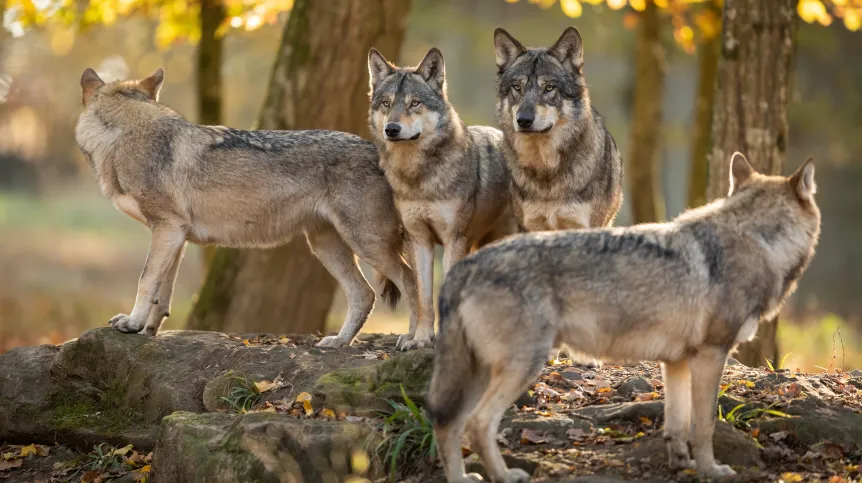
The morphology of wolves is shaped primarily by the population they belong to, the types of prey they hunt and their demographic history, including the effects of human activity, according to a new international study published in the journal "Diversity and Distributions".
An international team of researchers, including scientists from the Faculty of Biology at the University of Warsaw, analysed the skulls of 227 wolves (Canis lupus) from across the species' range, from Greenland to New Mexico and from Norway to Israel, to determine the factors driving variation in wolf morphology.
Using high-resolution 3D geometric morphometry, the researchers analysed 585 anatomical points on each skull and 96 points on each mandible, allowing them to reconstruct variation within the species on a global scale.
The study found that prey body mass was a major determinant of skull size, accounting for about one-third of the observed variation. Wolves that hunt large herbivores such as moose and bison had significantly larger skulls than those feeding on smaller prey.
The researchers also found that wolf skull size increased with latitude up to about 65 degrees north, in line with Bergmann's rule, before declining in Arctic populations from Greenland and Ellesmere Island in North America, likely because of limited food availability in extreme environments.
Population membership explained an average of 23% of the variation in skull shape and as much as 44% of the variation in skull size. The most morphologically distinct populations included wolves from Scandinavia and the Italian Peninsula in Europe, as well as Arctic wolves from eastern Greenland and Ellesmere Island and coastal Alaska in North America.
The study also found evidence that intensive wolf persecution during the 19th and 20th centuries left a lasting impact on wolf morphology. The contemporary Scandinavian population, rebuilt from a small number of individuals after local extinction, differs markedly in skull shape from the historical population that existed before 1952. Italian wolves, despite recovering in numbers, continue to display morphological traits associated with a long-term genetic bottleneck.
"Both the morphology and ecology of individual wolf populations are shaped by local environmental conditions," said Sabina Nowak, PhD, professor at the Faculty of Biology, University of Warsaw, and president of the Wolf Association for Nature.
"Effective species protection should therefore take into account population differences,” she added.
The study was co-financed by a grant from the Polish National Science Centre led by Nowak.
PAP - Science in Poland
zan/ bar/
tr. RL