
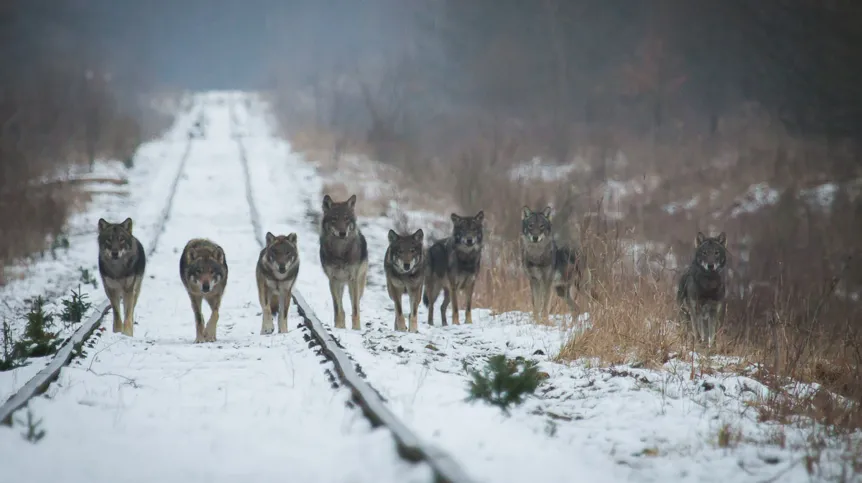
Wolves fear human voices more than barking dogs or bird calls, scientists say. On the Hel Peninsula, wolves have likely established the smallest known territory in Poland.
Wolves fear human voices more strongly than barking dogs or bird calls, scientists say. On the Hel Peninsula, wolves have likely established the smallest known territory in Poland.
The latest field research on wolves in the Pomeranian Voivodeship shows that the local population is mostly of Central European origin, but the share of individuals from the so-called Baltic population — that is, from eastern Poland and countries such as Lithuania and Belarus — is increasing, said Dr. Maciej Szewczyk, assistant professor at the Department of Ecology and Zoology at the University of Gdańsk, who also took part in research on wolves and their reactions to humans carried out by a team led by Prof. Dries Kuijper from the Mammal Research Institute PAS and his doctoral student Katharina Kasper.
The results to date have been published in Current Biology.
Dr. Szewczyk presented the results of his work during the scientific conference “Wolves Close to Us. The Coexistence of Humans and Wolves in Pomeranian Forests,” organized at the University of Gdańsk.
"In recent years, we have been observing a growing share of eastern genetic variants. This indicates the good functioning of ecological corridors," the researcher emphasized.
Despite the increase in numbers, wolves in Pomerania still occupy very large areas.
"One family covers more than 200 square kilometres. However, the degree of overlap between the territories of different groups is increasing," Dr. Szewczyk noted.
There are, however, exceptions to the typical size of occupied territory. According to the researcher, this is demonstrated by the settlement and reproductive success of wolves on the Hel Peninsula. In his view, this is likely the smallest known territory in Poland.
The researcher also pointed out that despite wolves appearing more frequently in areas under strong human pressure, the animals still maintain a natural distance from people.
"In general, fear of humans persists within the population," Szewczyk stressed.
In a field experiment, Prof. Dries Kuijper and his collaborators, including Dr. Szewczyk, used cameras with speakers that played, among other sounds, recordings of human voices.
"The experiment proved that wolves react with stronger fear to human voices than to barking dogs or bird calls," said Maciej Szewczyk.
He added that footage from the cameras showed that "most wolves immediately interrupted their activities and moved deeper into the forest."
The study also revealed that despite species protection, 10 out of 30 individuals fitted with GPS collars were illegally shot.
Dr. Szewczyk estimates the wolf population in Poland at 3,000–3,500 individuals. These figures are consistent with estimates from the General Directorate for Environmental Protection and scientific institutions, which indicate that around 3,000–4,000 wolves live in Poland (data from 2021 and 2022).
According to the expert, the main problem in human–wolf coexistence in Pomerania is attacks on dogs. Proposed solutions include keeping dogs on a leash in the forest, securing them at night, and — in exceptional and recurrent cases — removing conflict wolves.
Dr. Szewczyk also points to the need to increase research and funding.
"We must conduct research with a small team and, out of necessity, limit it to selected study areas," he said.
He explained that research results provide reliable knowledge on topics such as wolf numbers, their diet, and adaptation to areas altered by humans. In his view, GPS-GSM telemetry (so-called telemetry collars) provides particularly valuable information. Thanks to this method, it is possible, for example, to assess the effectiveness of wildlife crossings over or under roads or detect cases of illegal carcass dumping by livestock breeders, which the tracked wolves often feed on.
"Research using this method also shows the scale of cryptic poaching, mainly involving hunting weapons. Of the 30 wolves with collars, 10 were illegally shot. Extrapolating this to the entire population, this means at least several hundred wolves illegally killed with hunting weapons each year," the biologist said.
The scientist emphasized the importance of education. He gives lectures and holds meetings with residents, teaching them how to behave when encountering a wolf, how to protect dogs, and where to report conflicts.
"Education at the systemic and institutional levels is very poor," he concluded. (PAP)
pm/ joz/