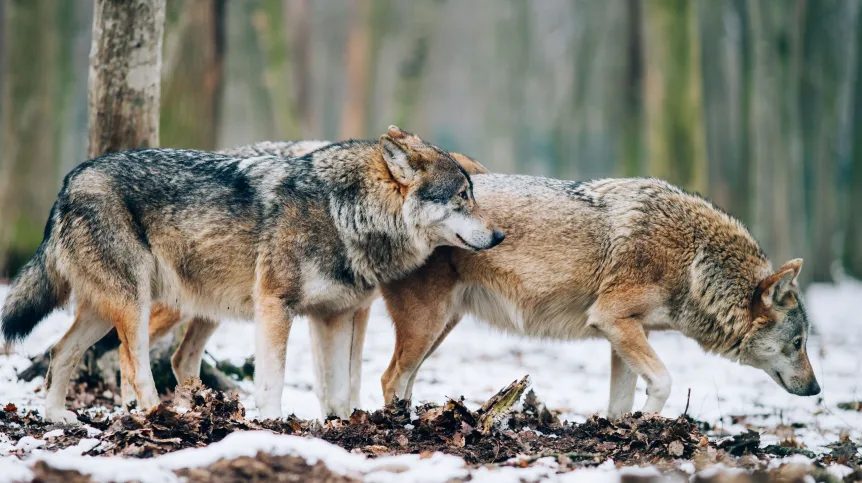
Illegally stored poultry carcasses on or near farms attract wolves and increase the risk of conflicts between predators and humans, according to a new study by Polish scientists, who are calling for urgent inspections of factory farming operations.
Researchers from the Faculty of Biology at the University of Warsaw, in collaboration with experts from the Faculty of Biology at the University of Gdańsk, the Mysikrólik Foundation and Vet-House, found that improper disposal and storage of dead farm animals significantly affects the behaviour of large predators and draws them into human settlements.
The team tracked two wolves from family groups living in contrasting environments: the extensive forest complex of the Noteć Forest and a mixed landscape of forests and agricultural land in Kashubia. The study combined GPS telemetry data with health and activity assessments based on camera trap monitoring and laboratory tests. The researchers also analysed wolf diets using macroscopic and genetic examination of faeces.
In both family groups, wolves - primarily juveniles - frequently visited farms, especially at night, feeding on poultry carcasses stored on the premises. The animals entered through gaps in fencing. Although wild ungulates accounted for most of the wolves’ diet, around 25 percent of analysed faeces contained remains of turkeys and geese. Wolves from both groups also consumed beavers, dogs and cats.
Juvenile wolves from the family group living in the western part of the Noteć Forest developed severe fungal and bacterial skin infections. The researchers linked the infections to feeding on poultry carcasses and resting on a manure pile at an industrial turkey farm located near the forest.
The findings were published in the „European Journal for Wildlife Research”.
“Our research shows that the presence of poultry carcasses within and near farms attracts wolves, especially young ones, to built-up areas,” said Sabina Nowak, PhD, from the University of Warsaw and president of the Association for Nature WOLF, who led the research project.
“As a result, the risk of predation on domestic animals and conflicts with humans increases,” she added.
The researchers warn that feeding on farm animal carcasses and contact with fresh manure from poultry farms expose wolves and other wild animals to infections with various pathogens, negatively affecting their health and behaviour.
They stress that compliance with existing regulations on the disposal of dead farm animals and improved protection of poultry farms against access by wild and domestic animals are essential to preventing conflicts between predators and local communities.
The measures are also critical for public health, given the growing prevalence of avian influenza on Polish farms—more than 100 farms affected in 2025—as well as serious cases of H5N1 virus infection in wild and domestic mammals and humans, the authors said in the press release.
The research was conducted as part of the project “From forest dweller to suburb tenant – wolf adaptations to human-dominated landscape,” funded by a grant from the Polish National Science Centre and led by Nowak. (PAP)
PAP - Science in Poland
zan/ amac/
tr. RL