
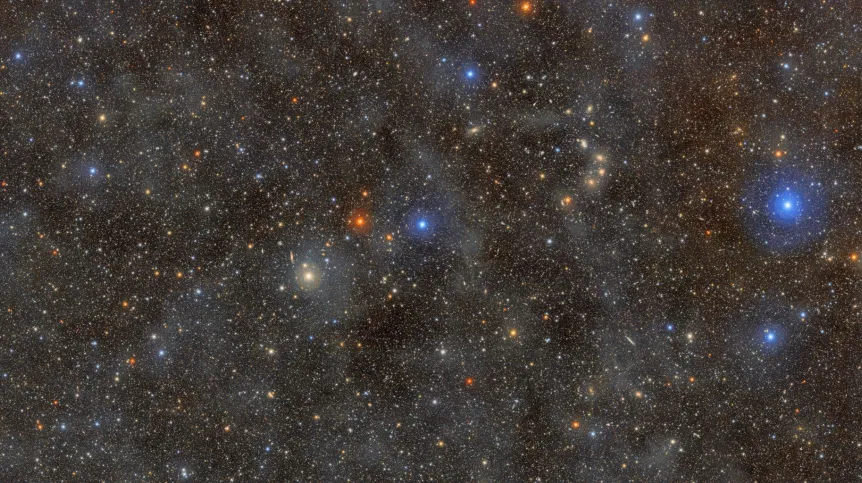
The Vera C. Rubin Observatory in Chile has begun a decade-long survey of the southern sky expected to transform astronomy, with Polish scientists playing a key role in analysing what will become the most comprehensive cinematic record of the Universe ever created.
The observatory, funded by the U.S. National Science Foundation and the Department of Energy, will spend the next 10 years producing an ultra-high-definition timelapse of the southern sky. According to the National Centre for Nuclear Research (NCBJ), it is also the most powerful observatory ever built for exploring the Solar System.
The project, known as the Legacy Survey of Space and Time (LSST), is the result of collaboration between Chile, the United States and an international network of astrophysicists, including researchers from Poland, who helped design the survey and will analyse its data throughout the mission.
Rubin combines an 8.4-metre mirror with the world's largest digital camera—a 3,200-megapixel instrument capable of capturing a new image every 40 seconds while rapidly scanning the sky. By returning to each point in the southern sky about 800 times over the next decade, the observatory will allow astronomers to detect faint objects, monitor rare and short-lived cosmic events and build an unprecedented record of how the Universe changes over time.
According to the National Centre for Nuclear Research, the survey is expected to advance research into pulsating stars, supernova explosions, galaxy evolution, dark matter, dark energy and previously unknown celestial objects. Its repeated observations will also help scientists detect moving bodies and study the accelerating expansion of the Universe.
The observatory is expected to transform understanding of the Solar System as well. By capturing about 1,000 images every night, Rubin is compiling an unprecedented census of asteroids and comets. During just six weeks of early optimisation surveys, it identified more than 11,000 previously unknown asteroids, including 33 near-Earth objects and 380 trans-Neptunian objects.
Poland has participated in the LSST project for more than a decade, and it is included in the Polish Roadmap for Research Infrastructures. The Polish LSST consortium is led by the National Centre for Nuclear Research, with Professor Agnieszka Pollo, the centre's Deputy Director for Science, serving as coordinator.
The consortium comprises eight institutions: the National Centre for Nuclear Research, the Centre for Theoretical Physics of the Polish Academy of Sciences, the Nicolaus Copernicus Astronomical Center of the Polish Academy of Sciences, Adam Mickiewicz University in Poznań, the Jagiellonian University, Nicolaus Copernicus University, the University of Warsaw and the University of Wrocław.
Poland's contribution includes the construction of an Independent Data Access Center (IDAC), which will provide access to Rubin data for researchers, and software for analysing the observatory's vast data sets.
"Given the sheer volume of LSST data, analysing it will be a challenge unlike any astronomers have faced before. These are truly astronomical big data that will require modern automated analysis methods, including those based on machine learning and AI. Building the IDAC in Poland will help us train future professionals - some of whom will remain in academia, while others will move to outside companies," says Krzysztof Nawrocki, PhD, from the National Centre for Nuclear Research, who is leading the development of the data centre.
The Polish consortium brings together more than 70 specialists in planetology, astronomy, astrophysics, cosmology, computer science, data analysis and engineering.
"This revolutionary venture requires multidisciplinary cooperation, and the development of new analysis methods that will handle the extraordinary amount of scientific data produced every night. Both the length and the precision of LSST observations will let us record extremely rare processes, which will lead to numerous discoveries, including such that are now impossible to predict," says Professor Agnieszka Pollo, head of the Polish LSST consortium, quoted in the release.
The consortium's research spans the full range of modern astronomy, from asteroids, comets and the Milky Way to distant galaxies, stellar explosions, quasars, cosmology and the large-scale structure of the Universe. (PAP)
ekr/ bar/
tr. RL