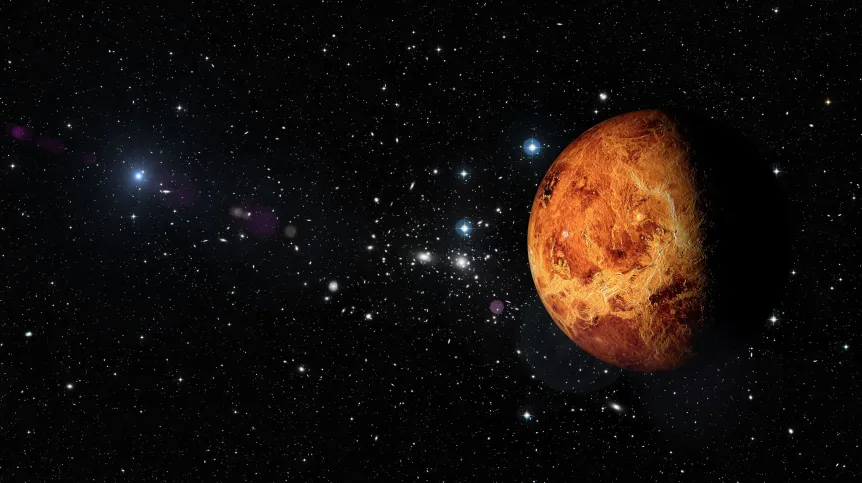
Venus appears pale yellow in visible light, but looks dramatically different in ultraviolet, where dark and light bands are visible across the planet’s clouds. Scientists have now developed a model that narrows down what the mysterious substance responsible for this strong ultraviolet absorption could be, according to the Institute for Basic Science (IBS) in South Korea.
A Polish scientist from the Wrocław University of Science and Technology participated in the research.
Four scientists from the USA, the UK, Poland and South Korea combined observations of Venus with radiative transfer modelling to determine how strongly the liquid in Venus’s clouds must absorb light to reproduce the patterns observed in ultraviolet.
At these wavelengths, Venus does not have a uniform appearance. Instead, it displays dark and light patterns that move with the sulphuric acid clouds, following the roughly four-day super-rotation of the upper cloud layer.
The ultraviolet-absorbing substance is active across a wavelength range of at least 280 to 500 nanometres.
The scientists accounted for the scattering of light by cloud droplets and developed a decadic absorption coefficient model for the liquid that makes up Venus’s clouds.
The decadic absorption coefficient describes how strongly a given medium absorbs electromagnetic radiation. It is based on a base-10 algorithm, hence the name, rather than the natural absorption coefficient.
The difference between the appearance of clouds and the appearance of the same cloud material when collected in larger quantities can be surprising.
For example, cigarette smoke appears white because its sub-millimetre particles scatter light effectively. When collected in a flask, however, it forms a dense suspension of burnt tobacco - a tarry residue.
A similar effect occurs with Venus’s clouds, whose particle sizes are comparable to those of cigarette smoke. Although the clouds appear pale yellow to a distant observer, the liquid forming the cloud droplets could therefore be surprisingly dark.
The model converted astronomical observations of Venus into a quantity that can be measured in ultraviolet spectroscopy laboratories: the absorption coefficient.
Within the modelled range of 365–455 nanometres, the decadic absorption coefficient peaks at a wavelength of 375 nanometres. It reaches a value of 1,278 per centimetre, indicating an extremely high level of absorption.
This means that the unknown substance must either absorb light very efficiently, be present in very high concentrations, or both.
The researchers point out that highly absorbing conjugated organic molecules - compounds containing a system of conjugated multiple bonds - meet both requirements.
The term ‘organic’ refers to carbon-based constituents and does not necessarily mean that they are of biological origin. For example, molecules with light-absorption properties characteristic of efficient porphyrinoid pigments would require concentrations of around 10 grams per litre.
The authors emphasise that they are not proposing chlorophyll, heme or any specific biological pigment as the light absorber on Venus. These compounds are used only as examples of efficient light absorbers.
The shape of the spectrum places further constraints on the possible substance.
Simple chemical compounds exposed to concentrated sulphuric acid can form dark, chemically complex ‘tar-like’ mixtures. However, such mixtures tend to absorb light across a broad range of the visible spectrum, making them appear brown or black.
This is inconsistent with the significant drop in absorption observed in the 365–455 nanometre range. The absorbing substance must therefore be resistant to transformation into a tar-like mixture.
‘By identifying additional constraints regarding the unknown absorbent, we have - paradoxically - made the mystery even more intriguing’, says co-author Janusz Pętkowski, PhD, from the Wrocław University of Science and Technology.
In 2020, Pętkowski participated in the discovery of phosphine on Venus, a finding that raised the possibility that the substance could have a biological origin. Parts of the scientific community remain sceptical, and scientific debate and further research are ongoing.
Future probe missions to Venus may help solve the mystery. The private company Rocket Lab is planning a joint mission with MIT to search for organic molecules in the Venusian atmosphere. The mission is named Venus Life Finder.
NASA is preparing the DAVINCI mission, featuring an atmospheric probe, as well as the VERITAS orbiter mission. The European Space Agency (ESA) and India are also planning their own missions.
The results of the research on the absorbing substance in Venus’s clouds have been published in the journal Astrobiology. The study was authored by Jan Spacek of the Foundation for Applied Molecular Evolution in Alachua, Florida (USA), Paul Rimmer of the University of Cambridge (UK), Janusz Pętkowski from the Wrocław University of Science and Technology and Yeon Joo Lee from the Institute for Basic Science (IBS) in Daejeon (South Korea). (PAP)
PAP - Science in Poland
cza/ agt/
tr. RL