Scientists have developed a new family of molecular machines that can convert the energy of ordinary sunlight into unidirectional rotational motion with exceptional efficiency.
The synthetic motors, consisting of only a dozen or so atoms, have already surpassed solutions created by nature in terms of efficiency.
In every cell of the human body, vast numbers of tiny molecular machines are at work.
'These are proteins that perform specific, directional movement and convert it into mechanical or chemical work. We live thanks to them', Wojciech Danowski, PhD, from the University of Warsaw explains in an interview with PAP.
The scientist mentions kinesins, which move along special routes to remove cellular waste, and proteins in muscles that perform a series of small steps, the sum of which can be seen in movements such as those of an arm or leg.
Most of these motors are set in motion by another mechanism: ATP synthase, which, as it rotates, charges chemical cellular batteries that power other machines.
However, there are motors in nature that only require light to operate. One such system is retinal, a molecule present in rhodopsin, a protein found in the rods of the retina, thanks to which vision is possible.
Evolution found a way to harness the Sun's energy and transform it into the work of tiny molecular machines.
'This is extremely inspiring, which is why we, chemists, make our own synthetic molecular machines. The difference is that ours are much, much smaller: only a dozen or so carbon atoms, while in the case of biological ATP synthase we are talking about several thousand such atoms. However, these machines work in an similar way - one part of the molecule performs a unidirectional spinning motion relative to the other' Danowski explains.
Now, the team in which he worked - led by Nobel Prize winner Ben Feringa - has managed to develop molecular motors powered by ordinary daylight.
This is a breakthrough because until now, powering similar structures required UV light, laser light or light from diodes, which is harmful to living cells. Now, free daylight is enough to power the motor.
The new family of machines developed by the scientists demonstrates exceptional efficiency in the use of the light that drives them - that is, it extremely efficiently converts the supplied photochemical energy into mechanical energy associated with rotation.
Danowski explains that the spinning movement of nanomotors immersed in the solution is not visible to the naked eye because each of them is tiny and rotates in a different direction.
Scientists now face the task of ensuring that these tiny machines work together and that the effects of their work are visible on a macroscopic scale.
'It is within our capabilities', Danowski says.
The researcher also aims to increase the efficiency of the motors so that no photon that has a chance to excite them is wasted.
The record efficiency of chemical reactions that scientists have achieved so far in the systems they have tested is 80 percent. However, Danowski believes that the reaction efficiency about 100% is within reach.
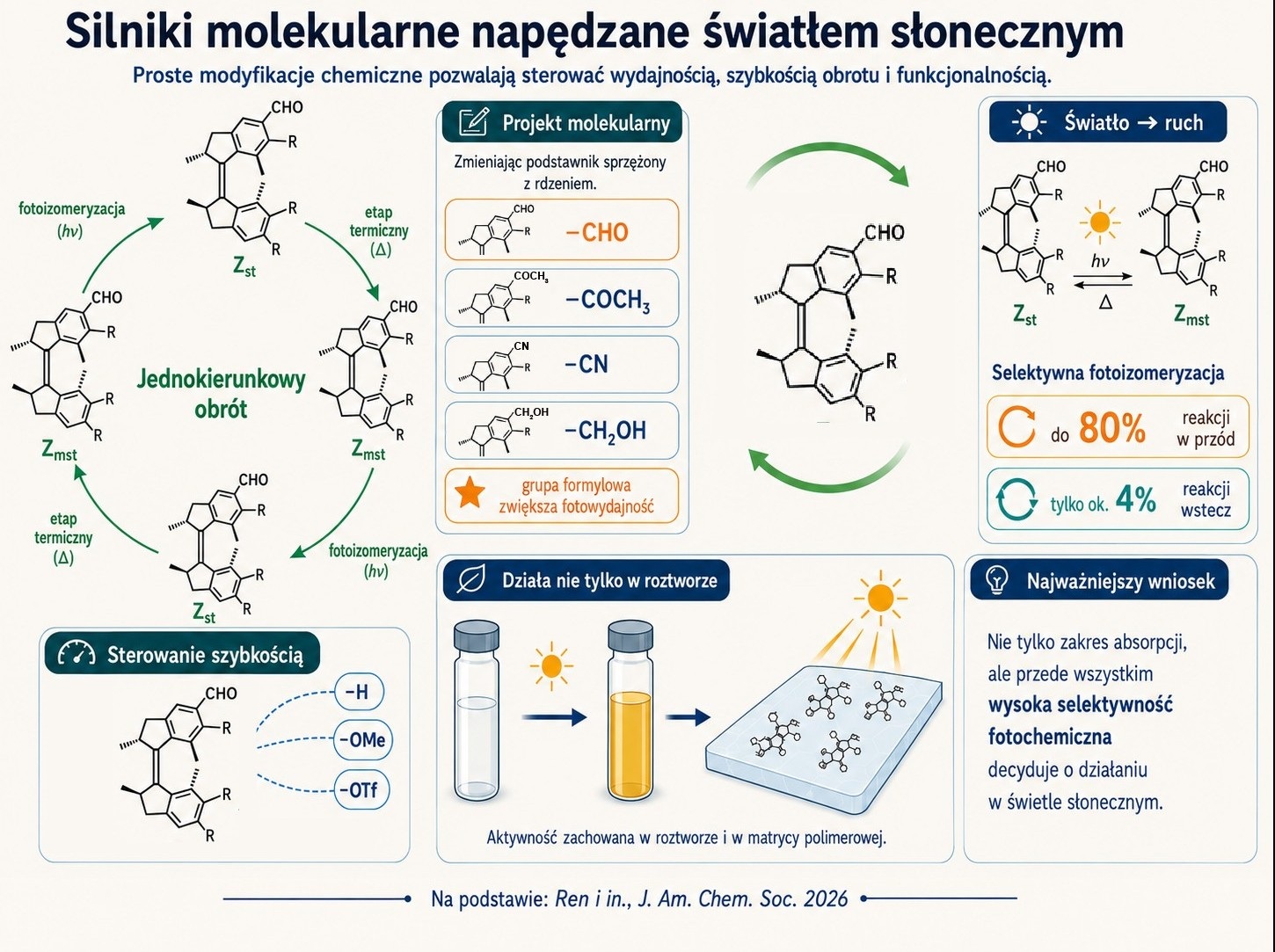
For comparison, the isomerisation of retinal in rhodopsin reaches an efficiency of 67%.
'We have already beaten nature in this respect, but we think we can do even more', Danowski comments.
When asked whether it is possible to use nanomotors in the energy industry, e.g. to build better photovoltaic cells, Danowski says it is not.
He emphasises that this is currently beyond the reach of science, but ideas for applications are just beginning to emerge.
'I would love for a new generation of carbon dioxide absorbers to be created thanks to molecular motors, which would absorb CO2 from the air at night and release it during the day under controlled conditions so that it can be transformed into a useful chemical product. Regeneration of the absorber is currently the main expense of the entire CO2 absorption process. It is worth harnessing free sun for this purpose', the chemist says.
'I am fascinated by the fact that we can design molecules with such a simple structure and at the same time capable of performing extremely complex mechanical processes. Nature needs huge proteins made of thousands of atoms to do similar work. We, chemists, only needed a few dozen atoms. We have created fully functional analogues of biological molecular machines - much smaller than solutions developed by nature and designed in an incomparably shorter time. This shows that when designing chemical compounds, we are limited only by our imagination, and practical applications of such technologies are only a matter of time', he concludes.
PAP - Science in Poland, Ludwika Tomala
lt/ agt/
tr. RL