
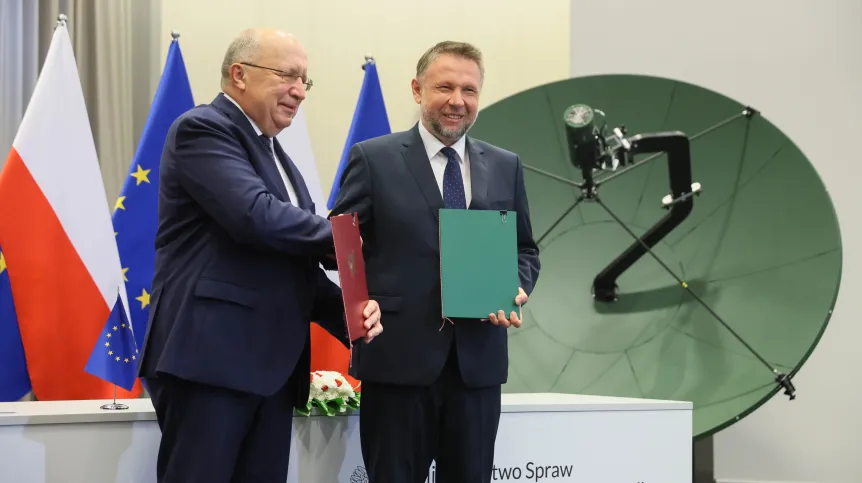
Poland has committed €656 million to the European Union's IRIS² satellite constellation, securing a major role in the bloc's strategic satellite communications system.
Poland's contribution of PLN 2.8 billion (€656 million), financed through the National Recovery Plan, represents about 10 per cent of the EU system's total cost and makes Poland one of the leading EU countries in terms of its involvement in the programme.
Interior and Administration Minister Marcin Kierwiński and European Commissioner for Defence and Space Andrius Kubilius signed the agreement on Tuesday.
Kierwiński said: “Today, Poland is joining a major European programme to build secure communications. These communications will be operated by a set of European satellites. This will be a completely independent system that will guarantee our security and full independence,” he said.
He added the project was a response to threats including the war in Ukraine, natural disasters and hybrid threats.
“We are investing to ensure full communication capacity for the most important people and institutions in the country at all times,” Kierwiński said.
He went on to say Poland would be “one of the main players in the IRIS² constellation in Europe”, alongside France, Germany, Italy, Spain, Luxembourg and the United Kingdom, the former owner of the OneWeb network.
Kierwiński said Poland's participation would make it a secure communications hub for all of Europe.
“The first capabilities of the constellation will be available as early as 2029, and its full completion will take place in 2031-2032. Then, Poland will be completely independent in terms of communications,” he said.
He said the agreement was “a great opportunity for Polish space companies, of which there are almost 400, to participate in this project and build unique competencies”.
Kubilius described the agreement as “a big day for Poland, the Eastern Flank and the entire European Union”.
“Poland is showing real leadership. (...) By investing in space, Poland is investing in its security, its economy, and its future. Today's signature will make Poland a pillar of Europe's secure connectivity strategy,” he said.
Kubilius added that the IRIS² system would use quantum encryption, which he said ensured a very high level of security for satellite communications.
Deputy Interior and Administration Minister Tomasz Szymański also signed two memoranda of understanding with the leaders of the SpaceRISE consortium, SES and Eutelsat, responsible for building dedicated satellites in medium and low Earth orbit.
Poland will also receive a ground station and command centre directly connected to the government's GovNet fibre-optic network. The Interior Ministry said this would represent a transition from dependence on private and foreign entities to full technological sovereignty.
Szymański told PAP that the agreement would provide “six satellites in medium orbit (MEO), which is at an altitude of 1,800 meters, providing global coverage, six satellites in LEO High orbit, and a dozen satellites in this lowest orbit, where research will be conducted. Poland will be able to fully utilize this infrastructure and have autonomous, reliable, and secure communication”.
Satellites in low Earth orbit, at altitudes of up to 1,200 km, enable faster data transfer, including for drone control and real-time videoconferencing, the Interior Ministry said.
Szymański told PAP that a Point of Presence and a Gateway would also be created to serve as a hub for other countries, including Nordic and Baltic Sea countries that had expressed interest in launching their satellites. He said discussions were already underway.
The satellite lifecycle is five to 10 years, Szymański said, giving Polish companies time to develop their capabilities and take a larger role in the programme.
“We have time for the Polish industry, which will be or is already in the supply chain - through the memorandum signed on Tuesday - to introduce certain data, innovations, and learn from the best companies, so that we can be a serious player and a system building satellites in the next stage,” he said.
Szymański said Poland would also be able to share and commercialise some of the system's capacity.
“Besides the government part of GovSat, we also have the ability to share and commercialise certain things, because we will be the ones deciding on the signal capacity, the amount of signal, which is extremely valuable, and the demand for which will be sent to Scandinavia, for example,” he said.
“Of course, these are also financial issues, because service costs money - these are fixed costs - and we gain a very strong leverage to negotiate mutual cooperation in this area,” he added.
The Interior Ministry said every złoty invested in the project could generate up to five złoty in economic return for the Polish economy through new jobs, innovation and the development of proprietary technologies such as encryption software and satellite terminals.
IRIS² — the Infrastructure for Resilience, Interconnectivity, and Security by Satellite — is an EU programme involving nearly 300 satellites in low and medium Earth orbit. It is intended to provide secure and interference-resistant satellite communications for public administrations, the defence sector, businesses and citizens across the EU.
The first capabilities are expected to become available in 2029, with the full system scheduled for completion in 2031-2032. (PAP)
PAP - Science in Poland
mgw/ pak/ akar/ joz/ ktl/
tr. RL