Polish scientists have developed a nanocomposite gel that has been used to safely remove old conservation materials from a historic painting by renowned artist Włodzimierz Tetmajer.
The pNIPA-LAP organogel was used to conserve Tetmajer’s 1889 painting Scena rodzajowa na wsi (“Genre Scene in the Country”), from the collection of the Silesian Museum in Katowice.
The breakthrough is the first use of the newly developed material to conserve an actual historic painting rather than simply testing it under laboratory conditions, according to the researchers.
The study, combining materials chemistry, polymer engineering and art conservation, was published in the Journal of Cultural Heritage.
The material was developed by researchers from the University of Warsaw in collaboration with conservation specialists from the Academy of Fine Arts in Kraków and the National Museum in Warsaw.
Conservators have used adhesives, wax-resin mixtures and emulsions for centuries to strengthen weakened canvases and stabilise paintings. But materials that once helped preserve artworks can eventually become a problem themselves.
They can penetrate deep between canvas fibres and become extremely difficult to remove. Traditional methods can involve mechanical scraping, toxic organic solvents or heating the old impregnation layers, potentially damaging the artwork while also exposing conservators to hazardous substances.
The new organogel works more selectively. It gradually releases solvent only where it is applied, softening the old impregnation without saturating the entire canvas.
The gel can also partially absorb the dissolved material, reducing the need for mechanical removal.
“The development of such a selective and effective cleaning material is a milestone in the conservation and restoration of easel paintings. It demonstrates how the combination of advanced macromolecular chemistry and traditional conservation techniques allows to solve the most difficult challenges related to the protection of historical monuments,” Professor Marcin Karbarz of the University of Warsaw’s Faculty of Chemistry said, according to the university.
Tetmajer’s painting presented a particularly difficult challenge because it contained stiff adhesive layers as well as numerous areas where the paint layer had become detached.
“The pNIPA-LAP nanocomposite organogel enabled the controlled reduction of adhesive masses from the reverse without the need for significant mechanical intervention, which could have endangered the detached paint flakes,” the researchers said.
After the old impregnation was removed from the reverse of the canvas, conservators were able to carry out further work, including repairing tears, stabilising the painting and retouching the paint layer.
The researchers say the successful treatment demonstrates that the material can work under real conservation conditions, not just in controlled laboratory tests.
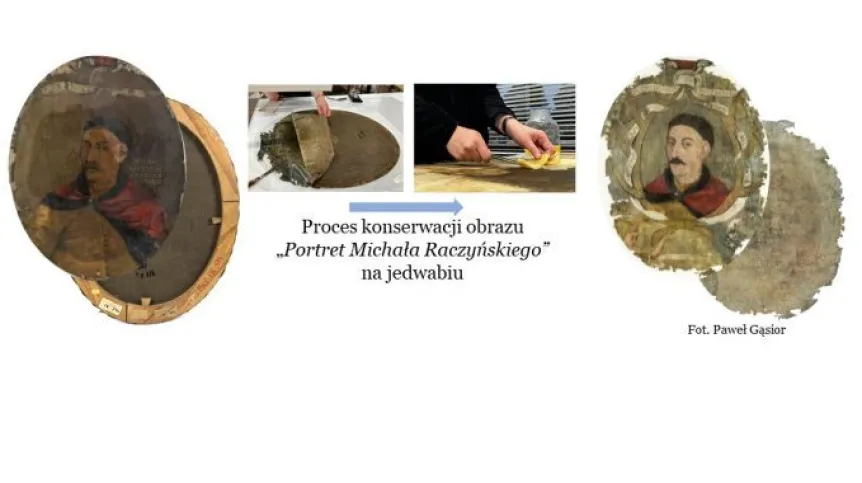
The technology has also been used to conserve Portrait of Michał Kazimierz Raczyński, a painting on silk. Removing an old wax-resin layer and subsequent repainting revealed that the surviving work was actually a fragment of a much larger composition.
That discovery led to a separate patent application, according to the University of Warsaw.
The research is part of the university’s Functional Gel Materials group’s work on using soft materials in art conservation.
The researchers stress that no conservation method is universal and that each artwork requires individual examination and testing.
However, they say the results suggest that nanocomposite organogels could become an alternative to traditional methods of removing old impregnation layers from historic paintings. (PAP)
wl/ zan/
tr. RL