Scientists from Wrocław University of Science and Technology and the US biotechnology company Genentech have developed compounds that can stop a form of inflammatory cell death without damaging healthy cells.
The approach exploits pores that appear in the membrane of a dying cell, allowing the compounds to enter only after the process has begun.
The research was conducted by members of the team of Marcin Poręba, PhD, a professor at the Faculty of Chemistry of Wrocław University of Science and Technology, and a group led by Professor Vishva M. Dixit of Genentech. The results were published in Nature.
The scientists focused on pyroptosis, a rapid form of inflammatory cell death that helps the body respond to threats but can also intensify inflammation and damage tissues when excessively activated.
During pyroptosis, enzymes known as proinflammatory caspases cleave the gasdermin D protein. Fragments of the protein then form pores in the cell membrane, allowing substances that alert the immune system to escape.
The cell swells and eventually disintegrates.
Scientists have long sought to block this process by inhibiting caspases. However, existing inhibitors can also enter healthy cells, limiting their effectiveness and safety.
The Wrocław University of Science and Technology and Genentech teams took a different approach. They designed compounds that have very low permeability through the membranes of healthy cells.
The compounds enter cells when pyroptosis begins and the first pores appear in the membrane.
‘The most interesting stage of the project began with an observation that initially did not align with our assumptions. A compound with very low permeability through the membranes of healthy cells was able to inhibit the process occurring within them. Instead of treating this result as an anomaly, we hypothesized that the pyroptosis mechanism itself paves the way for the compound to enter the cell’, Poręba explains, quoted in the university press release.
Once inside the cell, the inhibitor blocks caspases and prevents further pores from forming. The cell's natural repair system can then repair the existing damage to the membrane.
In experiments, some of the cells rescued in this way retained their ability to grow for the next 12 days.
The inhibitor also remained effective when administered several hours after pyroptosis had begun.
In animal experiments, blood levels of the proinflammatory cytokines IL-1β and IL-18 were significantly lower in animals administered the KGR-53P inhibitor.
The researchers stress that KGR-3 and KGR-53P are research compounds that require further study.
The findings do not mean that a drug for sepsis or other inflammatory diseases has been developed. However, the approach could help in the search for more precise therapies for diseases associated with excessive pyroptosis.
The researchers do not rule out possible future applications in conditions including sepsis, acute respiratory distress syndrome and COVID-19.
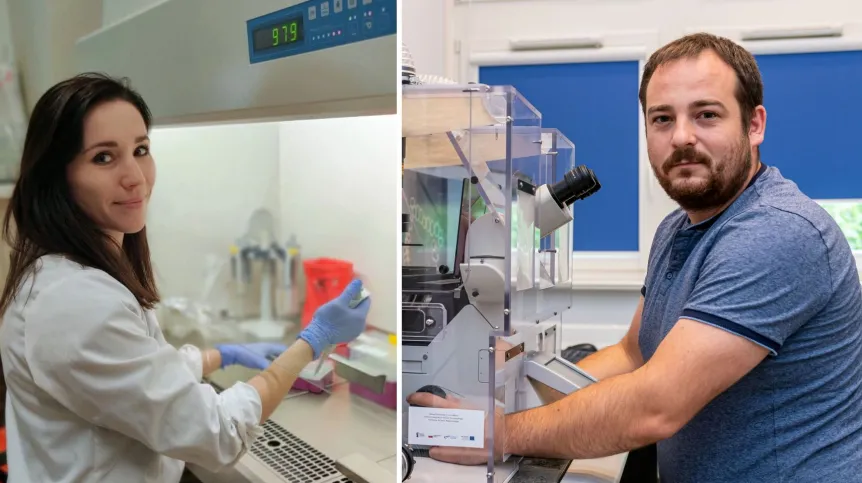
The chemical and enzymological part of the project began in Poręba's team at the Faculty of Chemistry. The researchers designed the inhibitors, prepared a library of approximately 100 compounds and studied their interactions with caspases.
Katarzyna Groborz at Wrocław University of Science and Technology developed the inhibitors that formed the basis for the subsequent work. After completing her doctorate, she went to Genentech for a postdoctoral fellowship, where she conducted cellular research.
‘The most important discovery of the project was the demonstration that pyroptosis can be stopped even after it has begun. We demonstrated the existence of a short therapeutic window in which caspase inhibition interrupts this process and allows cells to regain the ability to continue growing and dividing’, Groborz explains.
The Genentech team was responsible for advanced cell models, pharmacokinetic studies, compound preparation for administration and animal experiments, among other work.
The Wrocław University of Science and Technology team's research was funded by the Polish National Science Centre under the OPUS grant awarded to Poręba. (PAP)
kak/ zan/
tr. RL