
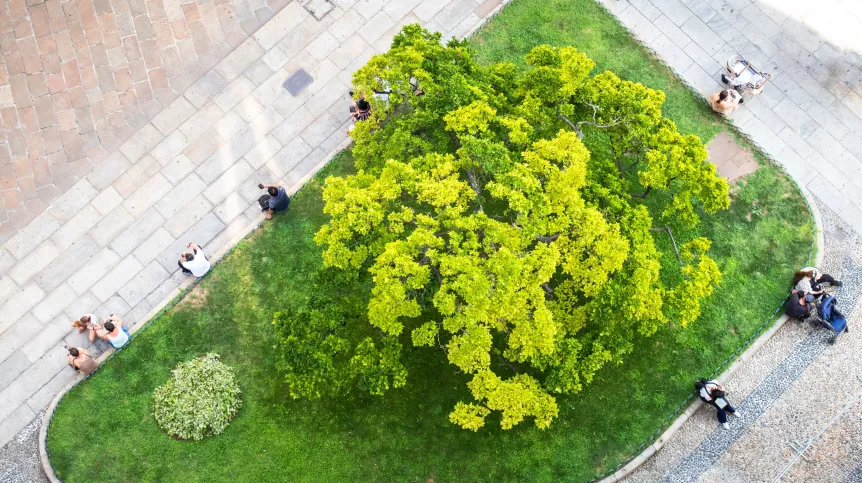
Poland needs “sponge cities” that work with nature to protect residents from heatwaves, drought and flooding during heavy rainfall, experts said during a climate debate at the Polish Sejm.
Such cities would systematically increase greenery and retain water where it falls, allowing it to soak into the ground rather than rapidly draining away, Professor Marta Szulkin of the University of Warsaw said.
“Climate change affects all of Poland, but cities exacerbate its impacts. Concrete, asphalt, and a lack of greenery cause the city to heat up even more than its surroundings. At the same time, these sealed surfaces mean that water drains quickly from the city instead of soaking into the ground,” Szulkin said.
The two problems are closely linked, with cities experiencing increasingly higher temperatures while losing water that could be retained for use during periods of drought.
“The urban heat island is a phenomenon where the temperature in a city is higher than in the surrounding area. In extreme cases in Poland, this difference can even exceed 10°C. We see this in Warsaw, but there are many other cities that are just as hot, or even hotter than the capital,” Szulkin said.
With 60 percent of Poland’s population living in cities, the impact of heatwaves is particularly significant.
“Extreme urban temperatures also pose a threat to animals. This summer, we observed young birds leaving overheated nesting sites to avoid dying from the heat,” Szulkin said.
Healthy urban ecosystems can help reduce temperatures and retain water. Higher temperatures heat and dry the soil, while intensive mowing exposes it further to the sun, increasing evaporation.
At the same time, asphalt, concrete and other impermeable surfaces cause rainwater to run off quickly instead of soaking into the ground. This means cities fail to retain water when it is available, leading to shortages when it is most needed during droughts and heatwaves.
“That is why we need +sponge cities+, cities that work in harmony with nature rather than weakening its natural processes,” Szulkin said.
In practice, this means systematic greening to provide shade and strengthen urban ecosystems, as well as retaining water where it falls so it can soak into the ground rather than immediately running off.
“Therefore, our superior goal should be to adopt a national strategy to reduce the overheating of cities and buildings, relying primarily on nature and water. Nature in the city is not merely decorative; it is, above all, a living system that helps protect us from heat, drought, and flooding,” Szulkin said.
Iwona Wagner, PhD, a professor at the University of Lodz, presented recommendations on environmental safety prepared by experts.
“Ecosystems must be given the status of critical infrastructure. In practice, this means conducting inventories and ensuring protection through spatial planning, ceasing activities that degrade nature, and securing long-term funding for ecosystem functions, just as we currently fund the maintenance of roads or energy grids. Today, nature constitutes a fundamental infrastructure that will determine our living conditions in the years to come,” Wagner said.
Water management was identified as the most urgent area requiring change.
“We must change the way we manage this resource. (...) We have a direct influence on this process through investment, economic, and planning decisions. We need to integrate water management with spatial planning. Currently, these operate as two separate realms, yet they determine the same outcome: how much water remains in the landscape for our use versus how much flows out to sea. We need robust monitoring and inter-ministerial reports on water resources presented to the Sejm at least once a year,” Wagner said.
The experts also called for action to support the climate-related functions of forests and build their resilience.
“The most important step seems to be differentiating forest functions into social, commercial, and ecological categories. Ecological forests should be exempt from any commercial production activities. We must move away from forestry operations in peatland forests, floodplains, and mountain or foothill forests,” Wagner said.
With heat accounting for as many as 95 percent of deaths linked to extreme weather and climate events in Europe, and 60 percent of Poles living in cities, protecting the population from overheating and flooding should also be a priority.
“We need to systematically update urban heat and flood hazard maps. To enable nature to function within cities, we need to retain water right where it falls. Every drop should be used to strengthen the city's natural ecosystem,” Wagner said.
Experts also called for better identification and protection of areas that play a key role in reducing climate risks.
“We also need to know exactly where our safety-generating zones are located. These areas should be subject to absolute protection. We must understand our risk map. We should limit new construction in these areas and protect existing structures. Support for municipalities is crucial in the planning process; they are the ones building our climate resilience at the local level. In this regard, we need both financial and expert support,” Wagner said.
jjj/ ekr/ zan/
tr. RL