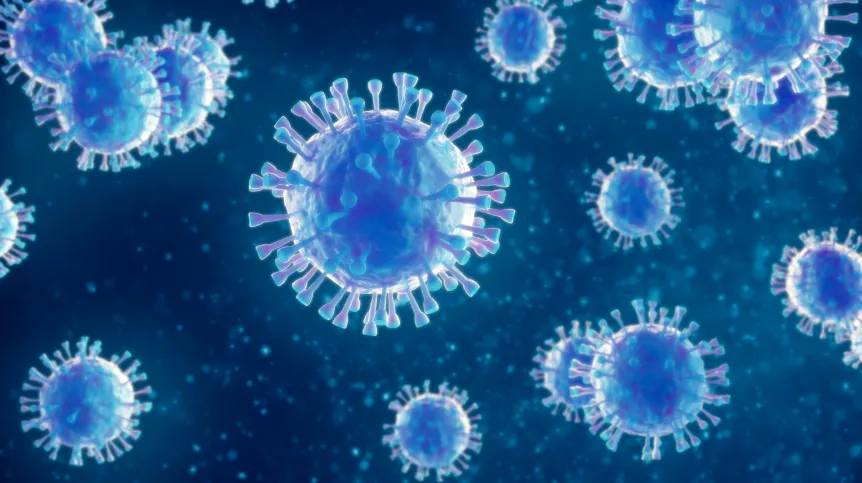
Scientists have identified nearly 55,000 potential RNA virus groups in cities and their surroundings around the world, with about 77% not previously reported, in the largest atlas of urban RNA viruses to date.
The findings come from an international team including Polish scientists who analysed 2,922 samples collected in 102 cities across 31 countries.
The study was conducted by the international MetaSUB consortium, which has been analysing microorganisms present in urban spaces for 10 years. Polish scientists, including current and former researchers from the Małopolska Centre of Biotechnology of the Jagiellonian University, also participated in the work.
One of the co-authors of the publication in Nature Communications is Paweł Łabaj, PhD, a professor at the Jagiellonian University, co-founder of the MetaSUB consortium and initiator of the global City Sampling Day (gCSD) in Kraków.
Viruses are commonly associated with diseases in humans, animals and plants, but they are also found almost everywhere: on surfaces we touch every day, in water and soil, and inside bacteria and fungi. A vast part of their world remains unknown.
To understand it, however, it is not enough to look for pre-defined viruses. Researchers must constantly and extensively study the environment and describe the genetic material found there.
‘This is more of an exploratory science. We do not propose a specific hypothesis, instead we observe the environment, examine its contents, and try to describe the role of the elements we discover, as well as their potential impact on human health and well-being’, Łabaj said.
For the study, scientists analysed 2,922 samples from 102 cities in 31 countries. The samples were collected at public transport stops, hospitals, banks, shops and streets, as well as from sewage, water, soil, green areas and bottom sediments.
The researchers focused on RNA viruses, which had largely remained invisible in previous MetaSUB analyses.
RNA viruses differ from DNA viruses in the type of genetic material they contain and typically change more rapidly, as errors are more likely to occur during genome copying.
Until now, scientists have primarily studied bacteria and viruses whose genetic material is DNA. RNA analysis requires separate sample preparation, which increases costs.
Because the latest analysis initially focused on the SARS-CoV-2 virus, the samples had also been prepared for RNA sequencing. The resulting sequences were then processed using bioinformatics methods to isolate those that could have originated from viruses.
The researchers ultimately created a comprehensive atlas, the “Urban & Peri-urban RNA Virus Atlas”. It included nearly 55,000 sequence groups, each of which could correspond to a single virus or a group of very closely related viruses.
Importantly, approximately 77% of these had not been reported before.
Łabaj stressed, however, that this does not mean that more than 40,000 new viruses dangerous to humans have been discovered.
Their full characterisation, including identifying their hosts, requires collecting and analysing larger samples. In most cases, researchers did not have entire genomes, only fragments, so they could conclude only that a given sequence probably belonged to a previously unknown RNA virus.
‘We are therefore talking about potential viruses. Only in individual cases there was enough material, and therefore enough data, to reconstruct almost entire genomes’, Łabaj said.
The analysis also allowed researchers to compare viral communities occurring in different environments.
The greatest diversity was found in soil, sediments and sewage. In places heavily modified by humans, such as bus stops, metro stations and shops, it was usually lower.
According to the authors, this may mean that human mobility and similar urban development lead to a homogenisation of the microbiological environment.
A particularly high diversity of viruses was found in sewage. According to Łabaj, this confirms its potential importance for future early warning systems against epidemics.
‘Sewage has the greatest potential as a source of information about viruses that are currently circulating in the environment and threats that may emerge in the future. Therefore, monitoring it can be the basis for early warning mechanisms’, Łabaj said.
According to Łabaj, one of the most surprising results of the study was identifying the organisms that could be hosts for the detected viruses.
This was determined for approximately one-third of them. Of this group, more than half were bacteriophages, viruses that infect bacteria.
Fungi and plant viruses followed while, to the researchers' surprise, viruses associated with humans and other animals constituted a relatively small portion.
The bacteria to which the detected phages were linked included Clostridioides difficile, which causes severe intestinal infections, and four species belonging to the ESKAPE group. These are critical pathogens, exhibiting multidrug resistance, for which effective treatments are urgently needed.
They pose a significant threat to public health and are often responsible for hospital-acquired infections.
‘This is a very important discovery in an era of growing drug resistance. According to forecasts, by 2050, millions of people could die every year from infections with antibiotic-resistant strains. And because phages attack and destroy bacteria, this opens up significant opportunities for the search for new therapies’, Łabaj said.
The study also provided new information about the evolution of viruses.
Analysis of their relationships revealed two distant groups that may in the future be recognised as new genera, and one potential new class.
The results also suggest that double-stranded RNA viruses may have formed independently in several evolutionary lineages. This means that the current classification of some of them does not fully reflect their evolutionary history.
According to Łabaj, if similar analyses could be repeated regularly, they could yield significantly more information and expand scientists' knowledge.
The material for this already exists: the MetaSUB consortium has collected tens of thousands of samples, the vast majority of which are waiting in freezers for sequencing. In Kraków, samples have been collected since 2020.
‘We could examine how the urban microbiome changes globally over time and space, and how the pressures resulting from urban tissue development affect the evolution of bacteria, archaea, fungi, and viruses, but funding is insufficient’, Łabaj said.
He explained that funding for exploratory projects can be difficult to obtain because they do not serve to test a single, previously well-founded hypothesis.
‘They are based on the data-driven science paradigm, in which the research process proceeds inductively: from broad empirical observation and the identification of regularities to the formulation of well-established hypotheses. This approach enables better utilization of the potential of high-throughput molecular techniques, the rapid development of which has been observed in recent years. It also ensures a more open and democratic approach to data analysis’, Łabaj said.
Katarzyna Czechowicz (PAP)
kap/ agt/
tr. RL