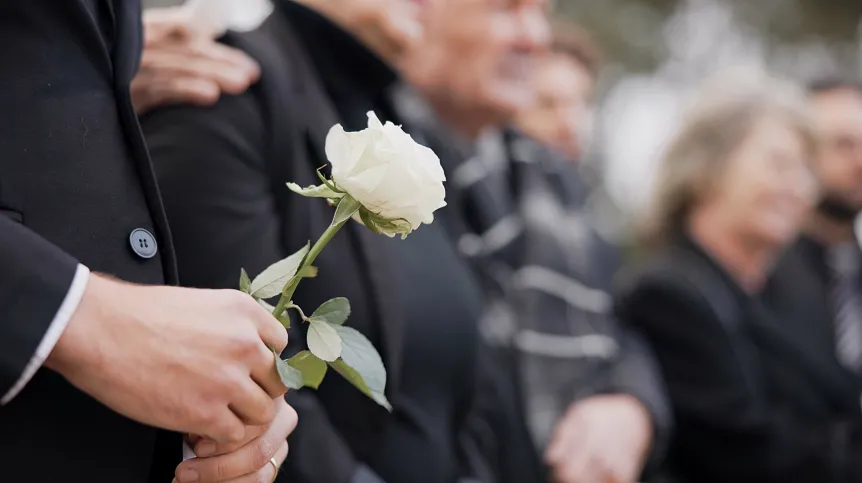
People grieving the loss of a loved one need less ready-made advice and more attentive presence, experts who have studied bereavement say. Even with the support of loved ones, loneliness during grief can be excruciating and long-lasting.
The Nagle Sami Foundation and the Institute of Psychology at Maria Grzegorzewska University published the report How do we experience grief? Voices and experiences of people after loss. The study lasted one year and included 471 people who had experienced a loss. It combined surveys with qualitative analysis of their statements. Some 88.8 percent of respondents experienced sadness and a sense of emptiness, while 83.7 percent continued to analyse events related to the deceased, regardless of how much time had passed since the loss. Some 59.1 percent felt lonely despite the support of loved ones. About one-third of participants had lost a loved one more than three years earlier.
PAP: What caught your attention most in the statements of people participating in the study?
Marcin Sękowski, PhD, Institute of Psychology at Maria Grzegorzewska University: People who had experienced a loss often spoke about loneliness and misunderstanding. In many statements, grief was a social experience, dependent on others' ability to be present, listen and not impose ready-made ideas. It is also worth remembering that an intense sense of loneliness after a loss may be one of the features of prolonged grief disorder, although it does not in itself determine the diagnosis of this disorder.
Iwona Nowakowska, PhD, Institute of Psychology at Maria Grzegorzewska University: Some respondents spoke about grief that was socially unrecognised — for example, due to the loss of a former life partner — or insufficiently understood, such as the loss of a long-time friend. Certain social conventions allow for the acceptance of emotions and states related to grief, but only if the person was 'close enough'. But what does this mean? Who would have the right to decide whether grief is 'appropriate' or 'adequate'? Therefore, when witnessing someone's grief, you need to be sensitive and open to how others experience the world and relationships.
PAP: What did you learn from the analysis of respondents' statements that the numerical data alone do not show?
Marcin Sękowski: The numbers show the scale of the phenomena, and the statements allow us to see their personal significance. The numbers indicate, for example, what percentage of respondents felt lonely, and their statements show that despite the presence of loved ones, they could feel alone. Open responses also show that the same reaction from the environment can be supportive for one person and hurtful for another.
PAP: Is there a 'typical' course of grief?
Marcin Sękowski: Common elements of grief can be identified, such as longing, recurring thoughts about the deceased, intense emotional pain and changes in everyday functioning. This does not mean, however, that there is one typical or correct course of grief. This is a very individual experience that depends on the relationship with the deceased, the circumstances of death, previous experiences, support and life situation.
PAP: Does grief really take place in stages?
Marcin Sękowski: The stages-of-grief model is still very popular, but modern psychology approaches it with caution and even points to potential risks resulting from its use. The model can be helpful as a general language for describing certain common reactions, but it becomes downright misleading when we treat it as a must-have map for bereaved people and therapists showing what emotions are to be experienced and in what order they should appear. Grief is rarely linear: different emotions can come back in waves, mix and change over time.
PAP: About one-third of respondents had lost a loved one more than three years earlier. Can the still-strong feeling of loss, despite the time that has passed, be a reason for concern? When is it worth seeking help?
Marianna Lutomska, vice-president of the Nagle Sami Foundation: Grief has no single correct duration, and the bond with the deceased stays with us forever in some form. When I think about time in the context of grief, I would say that it is not that 'time heals' — a phrase that grieving people hate. What matters is what we do with the time we are given. Are we trying to change something to make things better?
Marcin Sękowski: It is worth clarifying that, in the study, about one-third of participants were more than three years beyond their loss, which does not mean that they had been experiencing grief with the same intensity throughout that time. The length of time since the loss alone is not a sufficient reason for concern, because the bond with the deceased and longing can remain important for many years. It is worth seeking help when, many months or even years after the loss, grief remains intense and the associated suffering is very intense or hinders normal functioning in various areas of life.
PAP: Why, in addition to sadness, can anger, guilt, relief and even moments of joy also appear in grief?
Marcin Sękowski: Grief is a reaction to the loss of a significant relationship. It can trigger a wide range of emotions, not just sadness. Anger may stem from a sense of injustice; guilt, from questioning whether something could have been done differently; and relief, from the end of suffering or a gruelling caregiving situation. Moments of joy or peace do not invalidate the grieving process; rather, they demonstrate that experiencing loss is complex, much like the close relationships between people.
Iwona Nowakowska: Ambivalent reactions, such as a mixture of sadness and relief, can also arise following the death of someone with whom we shared a difficult or negative relationship. This is a very delicate subject, one often shrouded in a strong social taboo.
PAP: Many respondents frequently found their thoughts returning to the deceased and the events surrounding the loss. Is this a natural part of grieving?
Marcin Sękowski: Yes. It can be an expression of longing — a natural reaction to losing a loved one. The mind also attempts to make sense of what happened, come to terms with the irreversibility of the loss and find a place for it in one's ongoing life. Nowadays, we do not assume that healthy grieving involves severing the bond with the deceased, but rather gradually transforming that bond.
PAP: Nearly 60 percent of respondents felt lonely despite having the support of loved ones. What could cause this feeling?
Marcin Sękowski: Loneliness during grief does not always mean a physical absence of people around you. It can stem from the emptiness left by the loss of a loved one. One can have family and friends yet still feel that no one understands the magnitude of the loss or the uniqueness of the relationship with the deceased. Loneliness can also stem from people in one's social circle avoiding the subject or withdrawing from contact.
Iwona Nowakowska: It can also result from a mismatch between the support received and actual needs — for instance, hearing comments from loved ones that seem to trivialise or invalidate the grieving person's experience, such as 'You can have another baby' after losing a child, or 'You'll get married again' after losing a beloved partner. This happens even though loved ones often have the best intentions.
PAP: Why do phrases like 'Time heals all wounds' or 'Pull yourself together' sometimes hurt rather than help?
Marcin Sękowski: Such words are often spoken with good intentions but can be perceived as an attempt to box the pain into a simple formula. 'Time heals all wounds' might suggest that one simply needs to wait and the suffering will pass on its own; 'Pull yourself together' sounds like a command to suppress one's emotions. A grieving person often needs to hear 'I am here for you' more than they need advice.
PAP: So, how can we offer meaningful support to someone who has experienced a loss?
Marcin Sękowski: Simply put, a grieving person needs fewer ready-made phrases and more attentive presence. It is better to ask the person what they need rather than make assumptions. For some, a conversation might be helpful; for others, it will be silence or assistance with daily tasks. Good support entails patience, a non-judgmental attitude, a willingness to listen and making space to remember the deceased.
Marianna Lutomska: Sharing memories of the deceased is also important. Simply talking about someone who is no longer with us can make coping with their absence easier.
PAP: Thank you for the conversation.
The Nagle Sami Foundation has been operating for 15 years. It runs a free, nationwide support hotline for the bereaved — 800 108 108 — as well as a therapy centre. It also trains companies and institutions in mental health, crisis and loss in the workplace, and conducts crisis interventions in companies, schools and other organisations.
PAP - Science in Poland, Anna Mikołajczyk-Kłębek
wl/ bar/
tr. RL