Thanks to the ALMA and NOEMA instruments, an international research team led by a Polish scientist detected radioactive molecules in the interstellar space outside the Solar System for the first time, reports the European Southern Observatory (ESO).
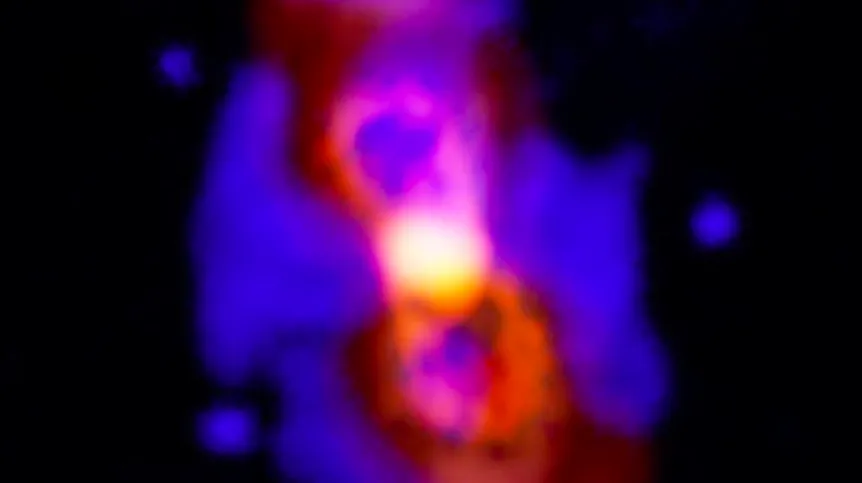
Tomasz Kamiński (Harvard-Smithsonian Center for Astrophysics, Cambridge, USA), together with his team, detected a source of radioactive 26-aluminum isotope. This radioactive nuclide occurs in the interstellar space in 26-aluminum monofluoride molecules. It was detected in the matter surrounding CK Vulpeculae, the remains of a stellar collision that happened several hundred years ago.
"We are observing the guts of a star torn apart by a collision three centuries ago. This first observation of this isotope in a star-like object is also important in the broader context of galactic chemical evolution. This is the first time an active producer of the radioactive nuclide aluminum-26 has been directly identified" - explains Kamiński.
CK Vulpeculae was first seen in 1670 as a bright, red "new star" visible with the naked eye (now astronomers call this type of object a red nova). Gdańsk astronomer Johannes Hevelius observed it. But it quickly faded and now powerful telescopes are needed to see what remains after the collision of two stars that happened almost 350 years ago.
Detection of molecules containing 26-aluminum was possible thanks to the observations on millimeter wavelengths, in which these molecules leave a distinctive "fingerprint" (spectral lines). It is a process know as rotational transition.
26-aluminum is an unstable form (isotope) of aluminium. It has 13 protons and 13 neutrons in its atomic nucleus, one neutron less than stable 27-aluminum. After radioactive decay, 26-aluminum becomes stable 26-magnesium.
26-aluminum does not occur on Earth, which is why it is difficult to see its exact spectrum in laboratory experiments. Therefore, the analyses were based on laboratory measurements of a stable version of 27-aluminum monofluoride.
The observations were carried out with the Atacama Large Millimeter/submillimeter Array (ALMA) and the NOrthern Extended Millimeter Array (NOEMA) radio telescopes.
26-aluminum was detected before in space outside the Solar System as part of the observations made at gamma-ray wavelengths. Researchers determined that in the Milky Way it was present in the amount of about two solar masses. But the process that could produce 26-aluminum and its origins were unknown.
The discovery that 26-aluminum was formed as a result of a merger of two relatively low-mass stars, as was the case with CK Vulpeculae, sheds new light on this issue. The amount of 26-aluminum resulting from the CK Vulpeculae collision is about one quarter mass of Pluto. And because objects of this type are rare, they are probably not the only source of 26-aluminum in the Milky Way. Further research could allow to better understand radioactive molecules found in space.
In addition to Tomasz Kamiński, the research team had one more Polish member, Romuald Tylenda from the Nicolaus Copernicus Astronomical Center PAS.
The research results have been published in the scientific journal Nature Astronomy. (PAP)
cza/ agt/ kap/
tr. RL