

Researchers from the Institute of Physics of the Polish Academy of Sciences demonstrated a new physical phenomenon: routing the emission of light using transverse magnetic field. This is a step towards avoiding the "bottleneck" that limits the development of fast information processing devices.
The publication of the research team describing the TMRLE effect (Transverse magnetic routing of light emission) appeared in the prestigious journal Nature Physics (https://doi.org/10.1038/s41567-018-0232-7). The Institute of Physics PAS in Warsaw informed about the research.
Today`s telecommunications links, optical fibres that entwine the Earth, use light as a carrier of information. However, once the informationj reaches target devices, computers, further information processing is carried out by means of electrical signals. These signals are transmitted through wires and printed paths, and their limited capacity and speed are the bottleneck in today`s high-speed information processing equipment.
The possibility of replacing electrical circuits and manipulating light in a manner analogous to switching electrical signals in logical memory systems and processors has fascinated scientists and engineers for a long time.
To achieve this, we need new switching nanosystems, in which light will be the signal. A prototype of such a system has been successfully built and demonstrated by an international group of scientists, including employees of the Institute of Physics of the Polish Academy of Sciences.
According to the institute`s press release, researchers demonstrated a new physical phenomenon - the effect of controlling the direction of light emission from a near-surface source, a quantum well, by means of an external magnetic field perpendicular to the direction of emission (TMRLE). Until now, such routing could be achieved only with less convenient magnetic field parallel to the axis of emission.
In the future, the effect of routing light emission from light sources with nanometer sizes using a transverse magnetic field can be used to build nanophotonic logic circuits or magneto-optical memories.
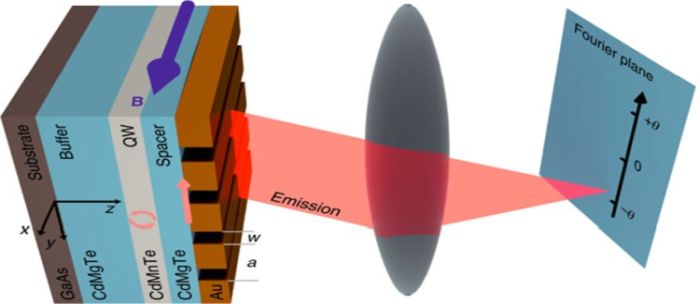
To demonstrate the TMRLE effect, researchers used very good quality nanostructures containing a quantum well located near the surface and built of dilute magnetic semiconductor CdMnTe with barriers made of CdMgTe. The structures were grown by molecular beam epitaxy (MBE) and characterized at the Institute of Physics PAS in Warsaw.
According to the release, TMRLE is a universal effect that can be transferred to various material platforms, including those based on semiconductors with high internal spin splitting that do not require low temperatures. "That`s why its first demonstration opens up the possibility of building both classical and quantum sources of light with temporal and spatial resolution, which is fundamental to the development of nanophotonics" - researchers summarize in the release.
PAP - Science in Poland
lt/ agt/ kap/
tr. RL