
Technologies helpful in medical therapy and useful to customs services in the fight against smuggling have been developed by researchers from the National Centre for Nuclear Research, as announced at a conference summarizing the project "Accelerators and Detectors".
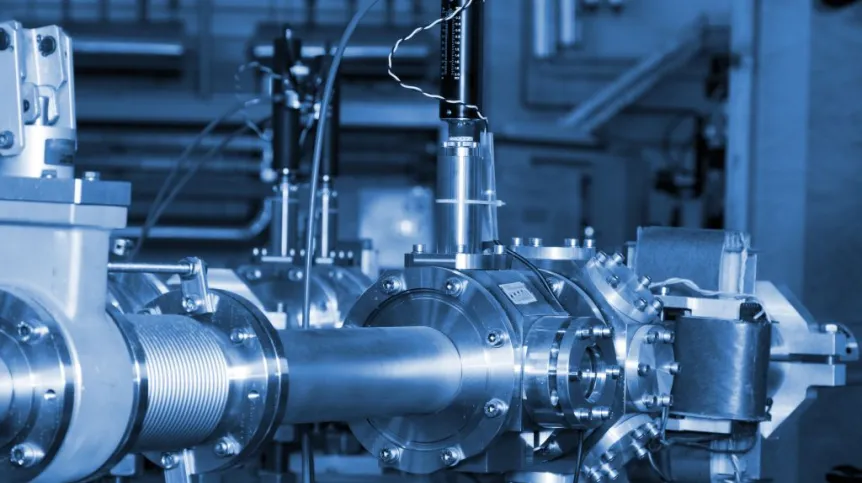
In the project "Accelerators and Detectors" (AiD), researchers have developed five device demonstrators that use ionising radiation accelerators and detectors. Among them are three devices that will help in the treatment of cancer and two that will be useful in protecting the borders and the security of the country.
"Accelerators can be both a miniature devices that accelerate electrons, and large devices, such as the ones at CERN, built on a ring with a diameter of several kilometres" - said the former project leader Dr. Agnieszka Syntfeld-Każuch of NCBJ. She explained that the project used relatively small particle accelerators.
The largest of medical devices developed in the project is Coline 6 - highly specialized medical accelerator used in advanced radiotherapeutic procedures. Cancer cells will be destroyed by the X-radiation beam. Another device is the IntraLine accelerator. It will be used in surgery. A robot will approach the patient and irradiate the tissue around the excised tumour to destroy the abnormal cells that may remain. Electron beam produced during surgery will reduce the risk of postoperative cancer recurrence. The third device developed at NCBJ is InLine PN 50. This light machine called a "photon needle" uses X-rays for irradiation.
The project also developed devices to detect contraband, hidden explosive, dangerous or toxic materials. The first solution is radiographer CANIS that scans loads on trucks, and possibly even railway carts to detect contraband, mainly cigarettes. "The use accelerators instead of X-ray tube has the advantage that the accelerator allows to penetrate 0.5 m of solid steel and see what\'s inside" - said Sławomir Wronka of NCBJ, who led the work on CANIS.
The last of the devices is neutron analyzer SWAN. The device helps detect explosives and toxic substances, even those deeply hidden. SWAN can also be used to assess the quality of minerals or materials such as cement or toxic waste.
Head of the project "Accelerators and Detectors" Dr. Jacek Rzadkiewicz of NCBJ explained in an interview with PAP that in Poland there is already equipment in use that is similar to devices developed in the project. However, the aim of the project was to improve the competitiveness of the Polish economy and catch up with the global technology. "We hope that our devices will be able to compete with the world’s best equipment and that we will find a niche in the market" - he said.
"We hope - emphasised NCBJ director Prof. Grzegorz Wrochna - that our research results will soon find practical applications and will raise the rank of Polish achievements in the international arena. We believe that acquired unique know-how will help us carry out large and needed projects in the future. The institute in Świerk is an ideal place to carry out such projects."
The AiD project is carried out under the Operational Programme Innovative Economy, its budget exceeds PLN 85.5 million.
PAP - Science and Scholarship in Poland
lt/ mrt/ jbr/
tr. RL
Source: NCBJ
Source: NCBJ
Source: NCBJ
Source: NCBJ