
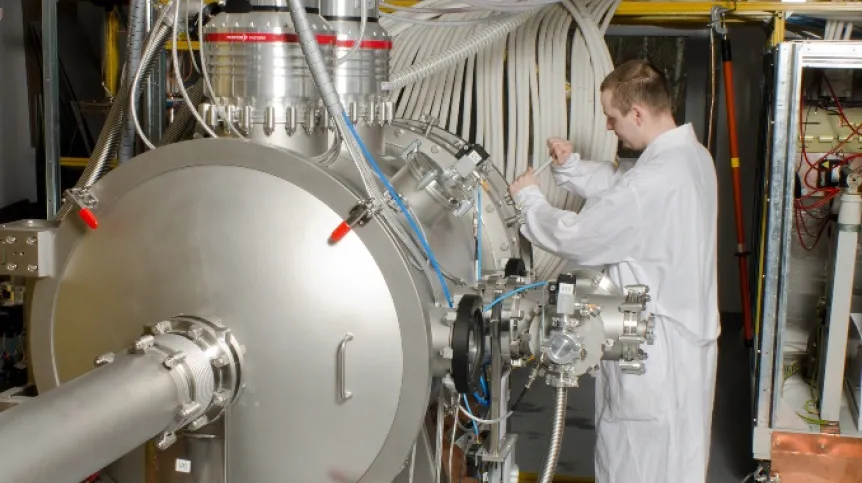
The National Centre for Nuclear Research (NCBJ) built a globally unique plasma source IBIS II. Plasma generated in the device has a temperature of up to 100 million deg. C and is obtained in high vacuum. The invention may find applications including surface modification of solids.
The newly built plasma source, IBIS II, is a modified and upgraded version of the original, protected by several patents device developed earlier by the employees of the institutes in Świerk. The device opens new opportunities for both high temperature plasma research as well as innovative novel technologies for surface modification of solids for industrial applications.
An important feature of plasmas generated by the IBIS II device is very high temperature, reaching 100 million degrees, and high turbulence of the plasmas meaning that some of the generated particles reach very high energies. One of the research topics to be studied at new IBIS will be increasing the intensity of plasma turbulences in order to more cost-effectively accelerate particles without a need to build and operate specialized accelerating structures.
"The fact that IBIS generates plasmas in high vacuum rather than in relatively dense gaseous media is its fundamental advantage, not featured by any of the other plasma generating devices operated in the world. Such conditions resemble those prevailing in deep space" – pointed out Dr Cezary Pochrybniak, NCBJ Plasma/Ion Beam Technology Division Head and leader of the project.
This video clip shows details of the IBIS II:
Another important field of research in which IBIS II can be used are plasma interactions with surfaces of solids. The researchers expect that the device will allow to produce modifications of surface properties unattainable with traditional methods. The institute in Świerk carries out research on topics including others the refinement of metal and ceramic surfaces, increasing steel resistance to high temperature corrosion, improvement of brazing capabilities, production of metal-ceramic joints. The invention may also allow to develop improved methods of bonding materials with different internal structures.
IBIS II may find application in the production of materials combine the properties of semiconductors and ferromagnetic materials that can be used not only to store information, but also to transmit and compute it.
"NCBJ has been conducting plasma research and pursing plasma applications for many years. The new plasma gun is a combined effect of our competences and opportunities created by European Union funding" - said Prof. Grzegorz Wrochna, NCBJ Director General - "These days opinions that scientists have misused European structural funds (because they do not know how to effectively use infrastructure and equipment bought for the funds) are not unusual. In my opinion it is a marginal issue. Example of our plasma gun shows that Polish scientists do not confine themselves to purchase some equipment: they can also develop their own constructions developing by the way national competences. Challenges that developers of such advanced research facilities must face are an excellent driving force to develop new technologies."
Successful completion of the project "Development of Ionizing Radiation-Based Technologies in NCBJ Świerk" significantly improves conditions for conducting research. The total value of the project amounts to nearly 40 million zlotys. The project is co-financed by European Union from the European Regional Development Fund within the framework of the Regional Operational Programme for the Mazovia Voivodeship 2007-2013.
PAP - Science and Scholarship in Poland
lt/ mki/ mrt/
tr. RL