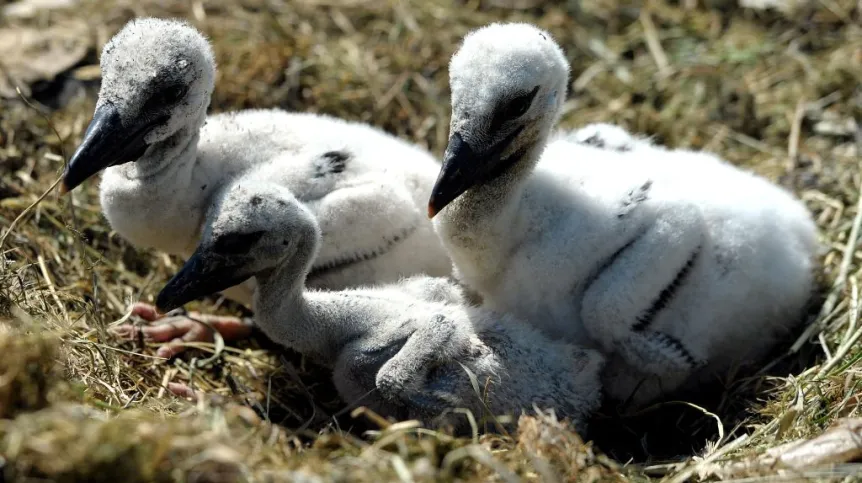
In Poland, young storks die in their nests in large numbers. The reasons for this phenomenon remain unclear. Ornithologists suspect that it could be related to atmospheric conditions, told PAP Krzysztof Gajda of the White Stork Museum in Kłopot.
An example of this negative phenomenon is the village Kłopot in Lubuskie, home of the only White Stork Museum in Poland, where the birds are constantly monitored by scientists from the University of Zielona Góra.
On June 24 this year, there were 37 chicks in 15 nests. Less than a week later, only nine chicks in five nests remained.
"Of great importance to the health of chicks are weather conditions and hydrological situation" - Gajda told PAP. He added that the high groundwater level means there are fewer earthworms, with which young storks are fed. "In addition, colder days combined with high humidity, and frequent and continuous rainfall add to malnutrition and cause hypothermia" - he said.
Another factor that may affect the mortality of young birds is offset of the breeding season by about two weeks, due to the winter weather that lasted almost until the end of March.
In general, most of the young birds are killed while learning to fly. This year the situation is different. Young storks do not learn to fly yet, but the mortality rate is high.
In in previous years in Kłopot, adult birds were able to raise 30 to 47 chicks. This breeding season will be one of the worst in recent years. Lubuskie is no exception.
"As reported by naturalists from South Wielkopolska Group of the National Society for the Protection of Birds, only 19 young storks from 11 nests have been ringed in Ostrów poviat" - said Gajda. He added that due to heavy rain, about 75 percent chicks died in the area, but the situation is even more dramatic in the former Leszno province, where the mortality rate is 90 percent, according to preliminary calculations.
In this area in recent years, ornithologists ringed around 300 birds, this year – 33.
"We receive dramatic data from across Poland, but we have to wait for the official summary of the mortality of young storks in our country. Perhaps we will have to wait several weeks before we know accurate, official reasons for this. For the first time in the last several years of studies of these birds, we are seeing such a mass mortality of young storks in nests" - said Gajda.
PAP - Science and Scholarship in Poland
mmd/ amac/
tr. RL