-
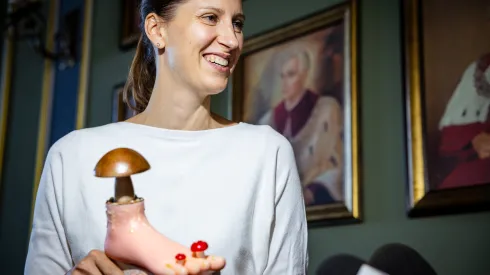
Why babies smell so good - and teenagers don’t
Parents love the smell of babies, but teenagers are a different story, and the reason may have something to do with how evolution shapes parental care.
-

University of Gdańsk joins international project to tackle energy poverty
The University of Gdańsk is joining an international project aimed at tackling energy poverty in Central Europe, with a particular focus on vulnerable communities in border regions.
-

Nobel Laureate Professor Victor Ambros awarded Polish citizenship
Nobel Prize-winning scientist Victor Ambros, whose father was born in pre-war Poland, has become a Polish citizen.
-
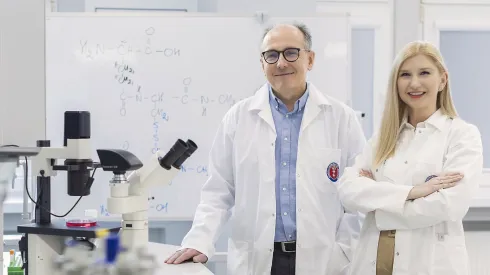
New test could detect Parkinson’s before motor symptoms appear
Scientists from the Medical University of Gdańsk and the University of Gdańsk have obtained a patent for a method designed to diagnose Parkinson’s disease at an early stage, before the first motor symptoms appear.
-

Kraków students power to victory in inaugural solar boat challenge
A student team from Kraków has won the inaugural Kraków Solar Boat Challenge, an international competition in which teams raced solar-powered boats on the city’s Bagry Reservoir.
-

AI can't replace mathematical thinking, Polish study warns
Artificial intelligence and advanced mathematical software can solve increasingly complex equations, but engineers who rely on them without understanding the mathematics behind the answers risk making poor or even unsafe decisions, according to new research from Poland.
-

European scientists warn of growing pressure on academic freedom
Instances of restrictions on academic freedom are being observed across several European countries, researchers and representatives of young academies said during a meeting in Warsaw in May, where participants warned that scientific independence is being shaped not only by political decisions but also by funding systems, institutional policies and public pressure.
-

Poland's Professor Piotr Sankowski joins UN global panel on AI
Professor Piotr Sankowski, director of the IDEAS Research Institute, has been selected to join a global scientific panel on artificial intelligence established by the United Nations, the institute announced.
-

Universities told they must lead fight against scientific ‘paper mills’
So-called scientific “paper mills” cannot be eliminated through national legislation, but universities can limit their impact through internal rules, funding restrictions and disciplinary action, says a leading legal expert in Poland.
Most Popular
-
How the brain’s ‘brakes’ help us learn and form memories
-
Iran’s spider-tailed viper has a tail unlike any other, study finds
-
Mental disorders account for the greatest loss of years lived in full health
-
Why charging your phone to 100% can damage its battery
-
Polish physicists develop sensor that remembers light
Recommended

Iran’s spider-tailed viper has a tail unlike any other, study finds
A horned viper found in Iran lures birds with a bizarre tail tip resembling a spider. Now, scientists have used 3D imaging to investigate the snake's anatomy, finding that its bizarre lure is formed by elongated scales rather than unusually shaped vertebrae.