Physicists working at the Large Hadron Collider (LHC) near Geneva have obtained the strongest evidence to date for the existence of exotic particles composed of four charm quarks, confirming a prediction that for years existed only in theoretical calculations.
The results, reported by the CMS Collaboration in the journal Nature, show that these particles are most likely compact, tightly bound states rather than loosely connected combinations of known matter.
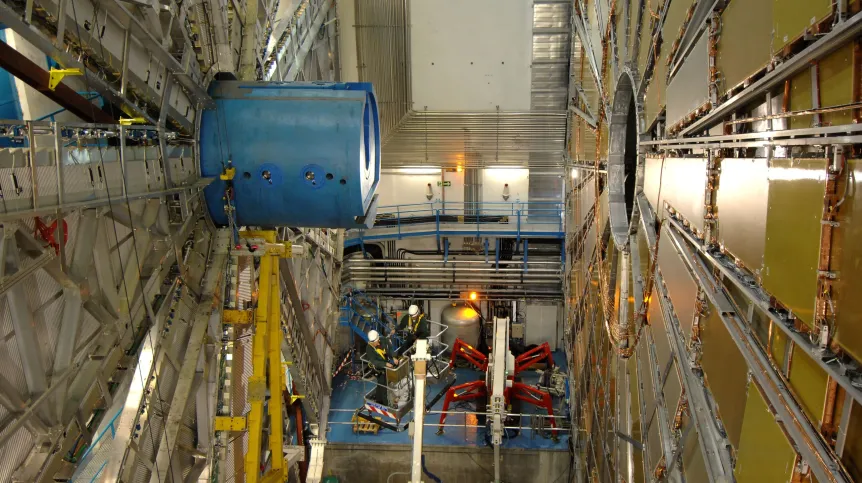
The research was carried out at CERN, the European Organization for Nuclear Research, using data from the Compact Muon Solenoid (CMS) detector, located in the 27-kilometre tunnel of the LHC.
CMS is operated by an international collaboration numbering several thousand scientists and engineers. The group includes researchers from Poland, among them teams from the AGH University of Science and Technology in Kraków, the National Centre for Nuclear Research in Świerk, the Warsaw University of Technology, and the University of Warsaw.
At the LHC, protons are accelerated to near the speed of light and collided at energies high enough to briefly produce particles that do not exist under normal conditions.
Ordinary matter is built from quarks, which typically combine into either mesons, consisting of a quark and an antiquark, or baryons, such as protons and neutrons, which contain three quarks. The underlying theory of strong interactions, however, allows for more complex arrangements, including particles made of four quarks, known as tetraquarks.
Despite decades of theoretical work, experimental confirmation of tetraquarks has been challenging. Many observed signals could also be explained as weakly bound pairs of conventional mesons rather than as genuinely new particles.
The study published by CMS focuses on a particularly unusual class of candidates: states composed exclusively of charm quarks and their antiquarks, without any lighter components.
The researchers identified three such states, designated X(6600), X(6900), and X(7100), with the numbers referring to their masses. Earlier analyses had already suggested the presence of structures with similar masses in CMS data, but key properties were unknown.
In particular, it was unclear how the quarks were arranged inside the particles and what their spin values were, information needed to distinguish between compact four-quark states and loosely bound meson pairs.
The X states themselves cannot be observed directly because they exist for only a tiny fraction of a second. They decay into two J/psi particles, which subsequently decay into four muons.
CMS records the trajectories and energies of these muons as they pass through the detector. From this information, physicists can reconstruct the properties of the original particle, including its mass, momentum, and spin.
Using a large data sample, the CMS team analyzed the angular distributions between the detected muons and compared them with predictions from different theoretical models. The results show that all three X states are best described as particles with spin two and identical quantum numbers, differing mainly in their mass. Their decay patterns and internal properties are consistent across the three states.
According to the authors, this uniformity strongly favors an interpretation in which the particles are compact, tightly bound systems of four charm quarks, rather than weakly bound pairs of two mesons. The findings therefore provide significantly stronger evidence that fully heavy tetraquarks can exist as distinct particles.
While the research concerns phenomena far removed from everyday experience, it has broader implications. Experiments at the LHC require highly sensitive detectors, fast electronics, and advanced methods for processing enormous volumes of data, technologies that often find applications in medicine, industry, and other fields.
At the same time, the results refine the understanding of how quarks can combine, adding new detail to the description of matter at its most fundamental level. (PAP)
PAP - Science in Poland
kmp/ agt/
tr. RL