Polish scientists have uncovered a man’s grave dating back approximately 4,000 years in Sudan’s Bayuda Desert, offering new insights into burial rituals and the natural environment of the region.
The Bayuda Desert in central Sudan is one of the least-explored areas of the country. While sporadic excavations took place in the mid-20th century, systematic archaeological work only began in the 21st century.
Polish researchers led by Henryk Paner, PhD, from the Polish Centre of Mediterranean Archaeology at the University of Warsaw, have conducted extensive fieldwork in the desert for over six years. During excavations, they discovered the grave of a man from the Kerma culture, an ancient kingdom that existed between 2500 and 1500 BCE. The team published their interdisciplinary findings in Azania: Archaeological Research in Africa.
“Studies have shown that the man was 30–40 years old, with a rather massive build and relatively well-developed musculature, just over 164 centimetres tall. Biological and pathological studies indicate that he lived in harsh semi-desert conditions, surrounded by animals, likely had a limited diet, and worked hard,” Paner said.
The burial pit was shallow and irregularly oval due to the rocky terrain. The body was placed on its back with the head facing east and north. The legs were twisted to the right in a heavily bent position, with the feet resting on the pelvic bones—a body posture common in older Kerma graves.
Two hand-made vessels were found behind the deceased: a medium-sized jug with a spout nearly level with the surrounding ground, and an inverted bowl. Additionally, 82 faience beads were discovered near the man’s neck.
The first vessel contained charred plant remains, animal bone fragments, coprolites, and beetle fragments, likely remnants of a hearth used during the burial ritual. “Because the vessel shows no signs of burning, these remains were most likely simply placed inside it. The bones may be evidence of consumption during a funeral feast, the leftovers of which were then thrown into the fire,” Paner explained.
Researchers suggest that the pottery could have served not only as containers or grave goods but also as components of group and individual identity. “Consequently, destroying or modifying objects associated with the deceased, including breaking or perforating vessels and placing them upside down or on their sides, rendering them useless and ‘lifeless,’ may have been an important part of funeral rituals associated with ancestor worship and the disintegration and transformation of the deceased’s body,” Paner said.
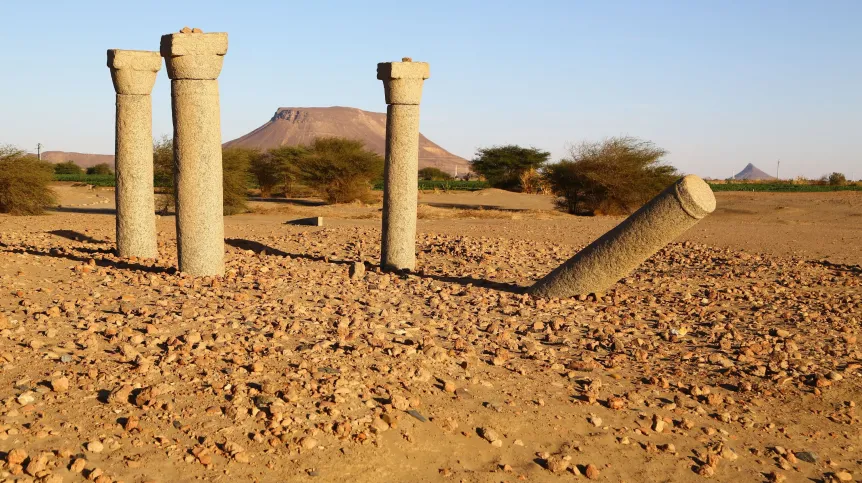
Analyses of the tomb’s contents indicate that the cemetery hill, now in open desert, was part of a slightly wetter environment around 4,000 years ago, likely a savannah with grasses, low shrubs, and a few trees.
“The tomb demonstrates that in interdisciplinary research, even a seemingly modest site can provide important clues for reconstructing past environments and climates,” Paner said.
Ewelina Krajczyńska-Wujec (PAP)
ekr/ bar/ mhr/
tr. RL