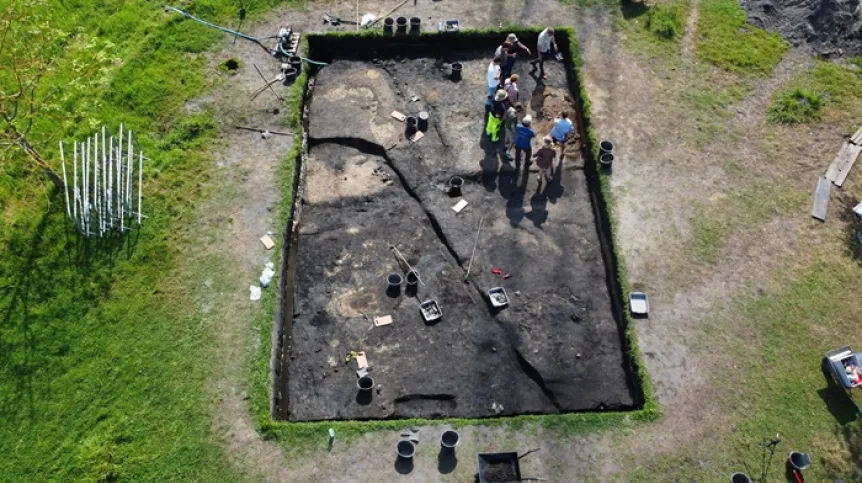
Archaeologists in the Polish town of Wolin have discovered the remains of four huts of previously unknown construction, hundreds of everyday artefacts and possible traces of an early medieval port, findings that suggest the history of the town may be more complex than previously assumed.
The discoveries were made during research in the northern district of early medieval Wolin, known as Srebrne Wzgórze, an area believed to have hosted a market and craft workshops in the city’s early phase.
The work forms part of a three-year research project led by scientists from the Institute of Archaeology and Ethnology of the Polish Academy of Sciences (PAN) and Aarhus University, in cooperation with the Wolin Commune, the Wolin-Jomsborg-Vineta Slavic and Viking Centre Association and the Moesgaard Museum.
“During the past season, we discovered four remains of huts with a structure previously unknown in Wolin. Additionally, three less well-preserved ones,” said Wojciech Filipowiak, PhD, from the Institute of Archaeology and Ethnology of PAN, who led the excavations. “They are platforms made of clay and sand, surrounded by a ditch. They are approximately five by five meters. Some have a hearth, some have an oven.”
The huts are located very close to one another, separated only by a drainage ditch about 50 centimetres wide.
“We have not seen structures like this from this period in Wolin before,” Filipowiak said. “We believe they can be dated to the 11th–12th century, which is very interesting, as this period is still very poorly documented in archaeological sources.”
He added that the discoveries may be linked to even earlier infrastructure beneath the site. “Early medieval Wolin had existed since at least since the end of the 8th century, and by the mid-9th century, it was certainly already a large centre. We are convinced that beneath these structures lies the remainder, the 10th–9th century port quay,” he said.
According to the researchers, the finds may shed new light on the function of Srebrne Wzgórze, long thought to have been a crafts and trade district, although its role may have changed over the city’s roughly 400-year history.
In addition to the huts, archaeologists uncovered several thousand fragments of vessels and animal bones, more than 500 types of Norwegian whetstones, glass beads, metal ornaments and vessels bearing potter’s marks.
“This is a mystery of early medieval archaeology, because no one knows for sure what these marks were used for,” Filipowiak said. “There are many hypotheses, whether they were ‘magical’ marks or potter marks passed down from father to son. None have been resolved yet.”
Next year, researchers plan to return to the analysis of excavations carried out at Srebrne Wzgórze in the 1960s, made possible by a grant from the National Programme for the Development of the Humanities.
One of the most unusual discoveries from that period was a boat-shaped hut. Another was a hearth containing intentionally elongated human skulls, a practice known from South American cultures. These are believed to be the only skulls of this type from the early Middle Ages found in Poland. Their origin and purpose remain unknown.
“It is possible that the origins of the town of Wolin are not at all as previously thought,” Filipowiak said. “We previously thought the town grew from the centre. Now it seems that perhaps the centre was occupied by Slavic people, and on Srebrne Wzgórze, at a distance sufficient for establishing contact, Scandinavians appeared.”
“Thanks to this new grant, we will be able to revisit the previous research, thoroughly analyse it, object by object, house by house, date it, compare it with new results, and thus perhaps solve the mystery of Srebrne Wzgórze,” he added.
The research in Wolin is being financed with support from the Salling Foundation and the Aarhus University Research Foundation. (PAP)
Ewelina Krajczyńska-Wujec
ekr/ zan/
tr. RL