
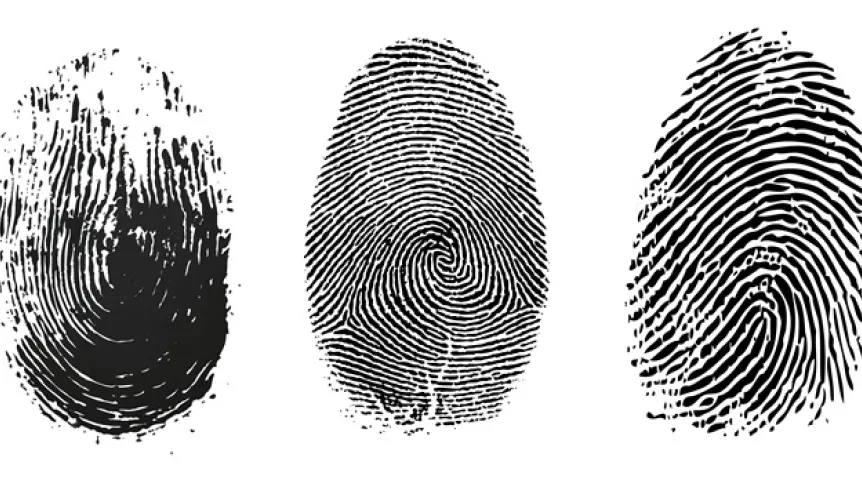
Chemical signals in a common fingerprint could help estimate the time since death during the first two days and provide information about traits such as age and biological sex, according to a team of scientists from Gdańsk and Kraków. The research identifies two key molecules responsible for these signals: tryptophan and NADH.
In forensics, time can be as important as the fingerprint.Traditional methods for estimating time of death rely on macroscopic observations and environmental conditions, but their accuracy declines as hours pass and temperature and humidity change.
Biochemical methods can improve precision, but they usually require tissue or body fluid samples that must be collected and transported to a laboratory.
In their study, published in Spectrochimica Acta Part A: Molecular and Biomolecular Spectroscopy, the researchers propose analysing the sweat-fat residue left by a finger on a smooth surface, essentially using the fingerprint itself.
The main component in the method is NADH (nicotinamide adenine dinucleotide in its reduced form), a molecule involved in cellular energy metabolism. NADH acts as an electron carrier and emits weak fluorescence when illuminated with ultraviolet light. Tryptophan, an amino acid present in the body, produces its own fluorescence signal.
Measurements of these molecules are typically complicated because the signals are weak, intermixed, and influenced by environmental factors such as pH, drugs, and chemicals used at a crime scene. To address this, the team tested the effects of an acidic environment, the common drug paracetamol, and nanosilver, which is often applied in forensic procedures.
The researchers used tryptophan as an antenna to indirectly excite NADH. By illuminating the sample with UV light tailored to tryptophan, energy is transferred from tryptophan to NADH without emitting light along the way. This process, known as excitation energy transfer (EET), includes a variant called Förster resonance energy transfer (FRET). Energy can also transfer through a short, invisible intermediate step, where NAD+ present in the sample, though not luminescent, may influence the efficiency of the process.
Laboratory experiments and tests on real fingerprint samples were conducted on both living and deceased individuals. In living subjects, fingerprints were collected on glass slides, swabbed into a solution, and centrifuged. In deceased individuals, material was collected before autopsy. Samples were taken 24 and 48 hours after death, as postmortem decomposition beyond this point strongly interferes with the signal.
Results show that NADH fluorescence differs between age groups and biological sexes in living samples, and in postmortem samples, fluorescence changes over time. Statistical analysis of the spectral data (PCA and PLS-DA) demonstrated that optical measurements alone can distinguish “live” from “dead” samples with approximately 77.4% accuracy, with high sensitivity but lower specificity.
The authors note that while they do not offer a definitive method or hourly precision for time of death, a seemingly ordinary fingerprint offers a biochemical mechanism that can be read with light and then quantified, potentially supporting investigators in the first days after death when rapid field assessments are critical. (PAP)
kmp/ bar/
tr. RL