The Wireless Acoustics experiment, which measured noise levels aboard the International Space Station (ISS), has concluded, with Polish-made devices operating without fault.
Analyses show the equipment was more effective and easier to use than older-generation models that have been in orbit for nearly a decade.
The ISS is a sealed metal structure filled with continuously operating devices, pumps, and computers. Its largely flat surfaces reflect sound, causing acoustic energy to accumulate inside the station. Monitoring noise levels is considered important for the mental and physical health of the crew.
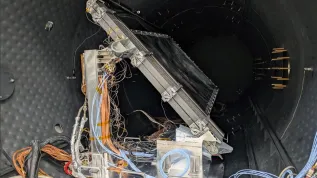
As part of the experiment, five devices manufactured by the Polish company Svantek were sent to the ISS: two SV 104A personal noise dosimeters, two SV 971A class one sound level meters, and one SV 36 acoustic calibrator, which emits sound signals with predefined parameters.
“Our older generation equipment that measures noise exposure has been on the station since 2016. One of the goals of this experiment was to compare the old technology with our new products,” said Karol Sazonow of Svantek, the project coordinator.
Two astronauts, including Sławosz Uznański-Wiśniewski, carried out the measurements. During the tests, crew members wore the older dosimeters continuously for 24 hours, including during sleep, and then repeated the procedure with the newer devices for another 24-hour period.
According to the researchers, the results confirmed that the new instruments provide more accurate measurements. Questionnaires completed by the astronauts also indicated that the newer devices were easier to use and more comfortable to wear. The updated meters are smaller and transmit data wirelessly via Bluetooth, rather than through cables.
Summarising the findings, Damian Hamowski of Svantek pointed to the consistently high noise levels on the ISS.
“At night, when astronauts are sleeping, the sound level hovers around 50–60 decibels,” Hamowski said. “This intensity corresponds to a loud conversation or office noise, which is not conducive to rest. During the day, these levels increase by another 10 decibels, reaching 70 dB. We have even observed isolated cases of exceeding NASA standards.”
He added that while an eight-hour exposure to 80–85 dB is considered harmful on Earth, the situation on the ISS is different.
“The problem on the ISS is the constant sound,” Hamowski said. “Astronauts are immersed in it 24 hours a day for many months.”
Sazonow said the project also has broader implications. “This ‘space’ project should provoke reflection on acoustic hygiene in our daily lives on Earth,” he said.
The experiment used standard, commercially available equipment. Tests revealed that some functions behave differently in microgravity. For example, motion sensors designed to confirm that dosimeters are being worn consistently registered inactivity in weightlessness, an observation that will be used to improve future designs. The researchers also noted that after returning to Earth, both devices showed lower internal noise levels than before launch.
Participation in the IGNIS mission confirmed the reliability of the Polish technology. The equipment underwent extensive electromagnetic compatibility and material safety testing by the European Space Agency.
“NASA has been using our devices for years, but technology is advancing,” Sazonow said. “When designing future stations, such as the Gateway on the Moon, it will be necessary to create even lighter solutions.”
Hamowski said the successful mission had a strong effect on the team. “Knowing that the solutions we built are working in orbit builds pride throughout the company,” he said. “Our example shows that it is possible to achieve world-class results in Poland and participate in the most important space projects.”
PAP - Science in Poland, Ludwika Tomala (PAP)
lt/ agt/
tr. RL