
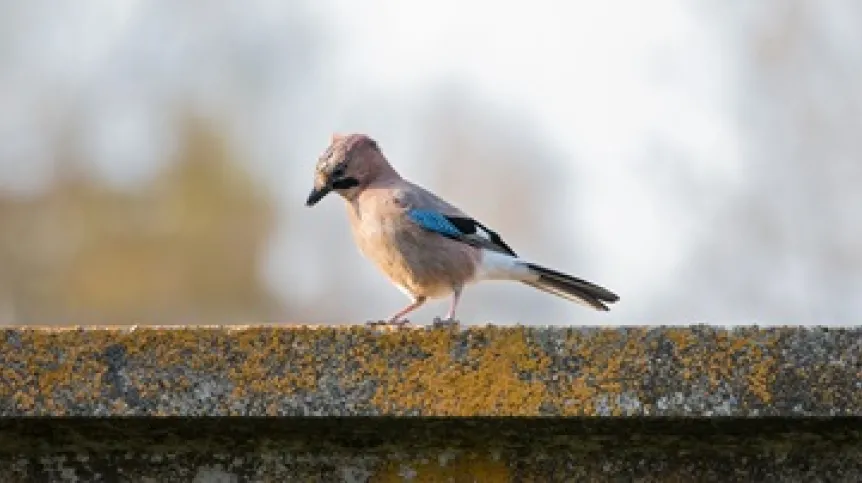
Birds living in European cities flee earlier from women than from men, according to an international study that included Polish researchers.
The research, published in People and Nature, found that the difference in flight distance related to the observer’s sex is significant and consistent across multiple countries.
In an era of increasing urbanisation, when humans and wildlife share space more than ever, understanding these interactions is important for conservation.
The study shows that urban birds perceive men and women differently, fleeing from women at an average of one meter greater distance, the co-authors from the Poznań University of Life Sciences reported in a press release.
The phenomenon was measured using Flight Initiation Distance (FID) — the point at which a bird decides to flee from a potential threat. The effect was observed consistently in Czechia, France, Germany, Poland, and Spain. FID is a common measure in behavioural ecology, indicating fear and risk tolerance; longer distances can affect foraging or reproduction in urban environments.
The study analysed over 2,700 observations of 77 species, with 37 species examined in detail, including common urban birds such as blackbirds, wood pigeons, magpies, great tits, house sparrows, starlings, blue tits, and hooded crows. Even species with the longest FIDs, like green woodpeckers and magpies, displayed the same pattern as species with shorter FIDs, such as city pigeons.
Researchers carefully controlled for other variables. Data were collected in the spring of 2023 in urban parks and green spaces in seven cities: Prague, Fréjus, Saint-Raphaël, Draguignan, Freising, Poznań, and Madrid. Observer pairs — one woman and one man — were matched for height and clothing, approached birds at a constant speed, and recorded FID, takeoff distance, flock size, bird sex, and surroundings.
Measurements were calibrated, observer order was rotated, and repeat observations on the same birds were avoided. Statistical models accounted for species relatedness, city differences, flock size, and vegetation cover.
“The study fills a gap in knowledge about the influence of an observer’s sex on wild bird behaviour,” said Professor Federico Morelli of the University of Turin, first author of the paper. “FID is a reliable measure of fear, and we tested for the first time whether birds differentiated risk based on human sex. We controlled many factors, from clothing to statistical models that account for evolutionary relationships of species, and yet birds fled approximately one meter earlier from females. This was true for all species, from blackbirds to magpies, and it was consistent from Poznań to Madrid.”
Professor Piotr Tryjanowski from the Poznań University of Life Sciences, responsible for the Polish data, said the findings have implications for urban ecology. “In Poznań, and in cities in other countries, species such as the house sparrow, wood pigeon, and great tit were less tolerant of women. The consistency of this pattern across all locations indicates a universal mechanism of risk perception in urban birds. This is fascinating because it shows how evolution shapes behaviour in a highly transformed environment.”
Yanina Benedetti, PhD, from the Czech University of Life Sciences in Prague, highlighted the perspective of women researchers in the field. “As a woman, I was surprised that birds reacted to women differently, despite controlling appearance and movement. The system works so that birds quickly assess threats, perhaps based on pheromones, gait, or even cultural associations. In our observer pairs, both sexes worked in a very standardized manner, and statistical models confirmed that this was not a coincidence.
“This study highlights how animals in cities ‘see’ humans, which has implications for urban ecology and equality in science. Women may be perceived as less predictable, but that is just an interesting hypothesis; for now, the more important aspect is that the results are consistent across species.”
The researchers said they plan to expand the study, testing hypotheses about scents, movement, pheromones, and cultural influences to better understand how birds adapt to living among humans and support urban biodiversity conservation.
PAP - Science in Poland
zan/
tr. RL