Archaeologists in Poland have uncovered ceramic vessels used to drink lactose-reduced milk beverages around 5,500 years ago, likely during ritual feasts connected to funerals.
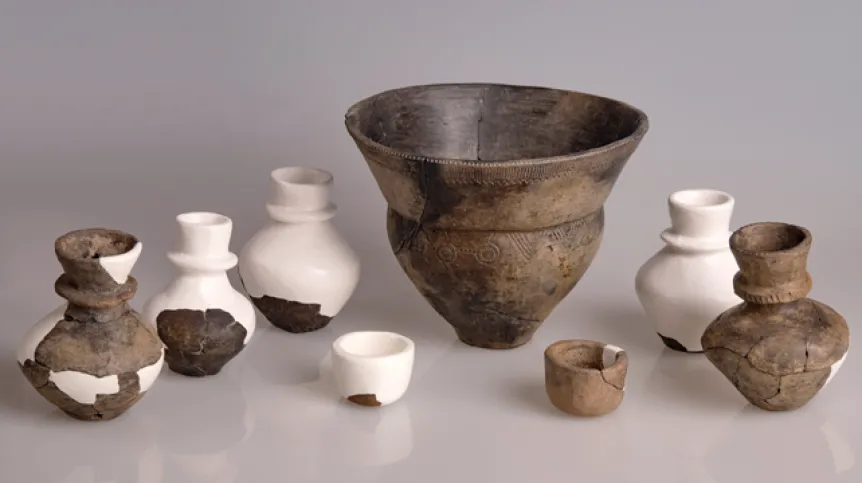
Over 6,000 fragments of pottery were recovered from the site in Sławęcinek, Kujawy, including a set of libation vessels: one large funnel-shaped beaker, five collared flasks, and two small cups.
‘We identified proteins derived from both cow's milk and sheep's or goat's milk. These products were likely produced using a process similar to cheese or whey production. Lactose intolerance was common during the Neolithic, affecting almost every inhabitant of Europe until the late Bronze Age. Processing milk into products with a lower lactose content was therefore an important way to utilize this valuable resource,’ said Łukasz Kowalski, lead author of the study from the Institute of Archaeology of the Nicolaus Copernicus University in Toruń.
We therefore hypothesized that the rituals that took place in Sławęcinek may have been related to matrilineality (a kinship system in which children are incorporated into the mother's lineage – ed. PAP), and possibly also to secret women's societies. In many traditional societies, such organizations played an important role in maintaining social bonds and transferring knowledge. The use of collared flasks for serving and consuming dairy products, which could be perceived as a liquid of fertility and health symbolizing the mother, opens the possibility of interpreting these practices as rituals strengthening bonds between women within the group,’ Kowalski said.
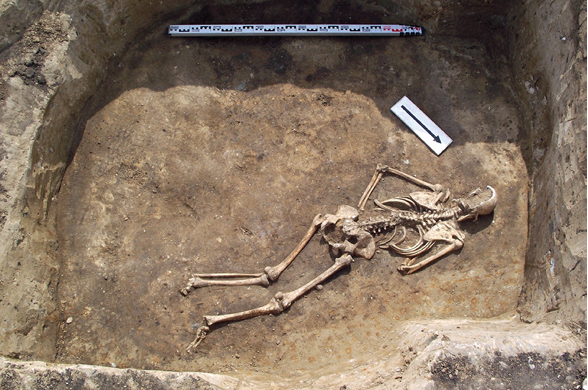
A large number of animal bones, primarily cattle and pigs, were found near the vessels, suggesting that communal feasts accompanied the ritual consumption of beverages. Burial sites discovered in the vicinity were exclusively female. Funeral rituals and feasts appeared to take place in the immediate area of households, a space often associated with women in anthropological interpretations.
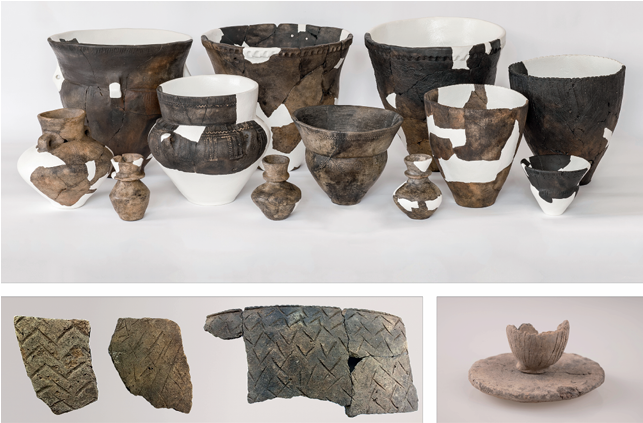
with wheels. ‘If this interpretation is correct, the decoration on the vessel from Sławęcinek is among the oldest known depictions of wheeled transport in the world. Similar depictions have also been discovered on other vessels from Poland, including the one in Kałdus and especially the famous vase from Bronocice. Radiocarbon dating indicates that they were made in the second half of the 4th millennium BCE. These dates coincide with the oldest known evidence of wagon use in both Europe and the Middle East,’ Kowalski said.
The Sławęcinek settlement, accidentally discovered in 2016 during construction of the Inowrocław bypass, yielded over a thousand archaeological objects across nearly five hectares. The Polish-British team studying the site included archaeologists from the Nicolaus Copernicus University, University of Łódź, the Institute of Systematics and Evolution of Animals of the Polish Academy of Sciences, and the universities of York and Cambridge. The results were published in Praehistorische Zeitschrift.
The archaeologists say the findings shed new light on the Funnel Beaker Culture, an early agricultural population that inhabited parts of Europe, including present-day Denmark, Germany, Czechia, and Poland, during the second half of the 4th millennium BCE.
Ewelina Krajczyńska-Wujec (PAP)
ekr/ agt/
tr. RL