
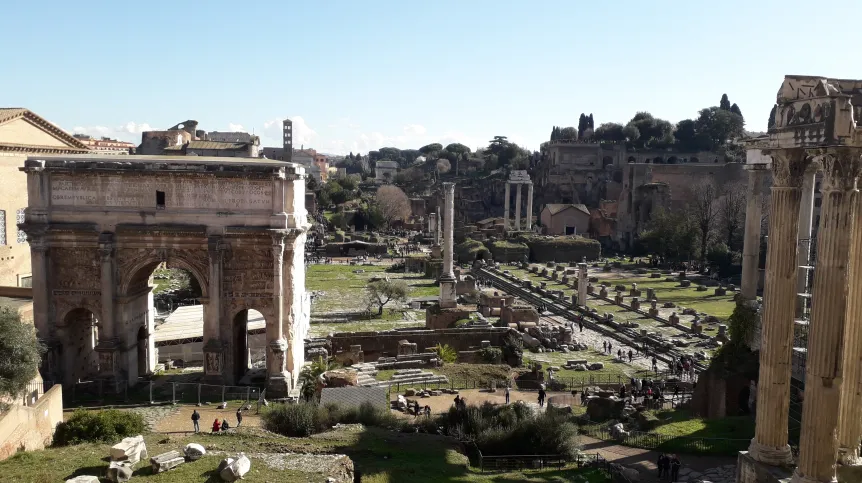
The ancient Forum Romanum — the main public square and political heart of ancient Rome — may have played a more active role in shaping political communication than previously thought, according to new research.
A study by archaeologists from the Jagiellonian University and the Vienna University of Technology, published in the Journal of Roman Archaeology, suggests that changes in the Forum’s layout over time made it harder for large parts of the crowd to fully understand political speeches — particularly the gestures that accompanied them.
The Forum Romanum was the centre of public life in the Roman Republic. It hosted elections, legal proceedings, and major political speeches delivered from raised platforms known as rostra. Communication in these settings relied heavily on oratory — a blend of speech, gesture, and physical performance designed to reach large crowds.
Researchers say that visual communication was just as important as spoken words. Gestures could structure arguments, highlight key points, and convey emotion in ways that helped audiences follow speeches across noisy, crowded gatherings.
“Gestures could indicate people or places, illustrate the course of events, emphasise the structure of arguments, and express emotions such as anger, indignation, or compassion. In some cases, they even served as a substitute for words, especially in situations where the message had to reach a large and diverse audience’, said Kamil Kopij from the Institute of Archaeology at Jagiellonian University, who led the study.
But the researchers found that how far those gestures could be seen — and understood — depended heavily on distance and crowd position. In experiments, small finger movements were only visible from relatively close range, while broad arm gestures could be seen from much further away.
The team then compared these findings with digital reconstructions of the Forum Romanum to estimate how many people in a typical assembly could actually follow a speaker’s full range of gestures. They concluded that only a fraction of the crowd would have had a clear view.
“It turns out that even when a crowd gathered at the Forum, only a fraction of the audience could fully perceive the speaker's message. Architectural changes between the late Republic and the Augustan era did not so much +enclose+ the Forum space as transform the dynamics of gatherings and the relationship between speaker and audience,” Kopij said.
“During the Late Republic, a larger number of participants could simultaneously observe the orator's gestures, which enhanced the sense of direct participation and fostered more intense interaction between the crowd and the speaker. The Forum's reconstruction under Caesar and Augustus, however, led to a reduction in the number of people capable of fully reading gestures and to a greater spatial separation of the audience gathered at different podiums. As a result, assemblies became more fragmented and easier to control,” he added.
The researchers suggest the changes to the Forum Romanum did not just affect its appearance, but how politics functioned there. As power shifted under Augustus, the Forum became more divided by space and structure, which meant fewer people could fully see and interpret what speakers were doing.
The study argues this likely reduced the shared, direct nature of political communication that had been central in the Republic. Instead, public assemblies became more fragmented, with clearer hierarchies in who could observe and fully engage with speeches.
In this sense, the design of the space itself helped shape a more controlled form of political communication in early Imperial Rome. PAP - Science in Poland, Ewelina Krajczyńska-Wujec (PAP)
ekr/ bar/
tr. RL