In the first centuries of the Common Era, far from the Baltic coast where amber naturally occurs, communities in Masovia were producing large quantities of amber jewellery—leaving behind traces of a craft that has only gradually come to light.
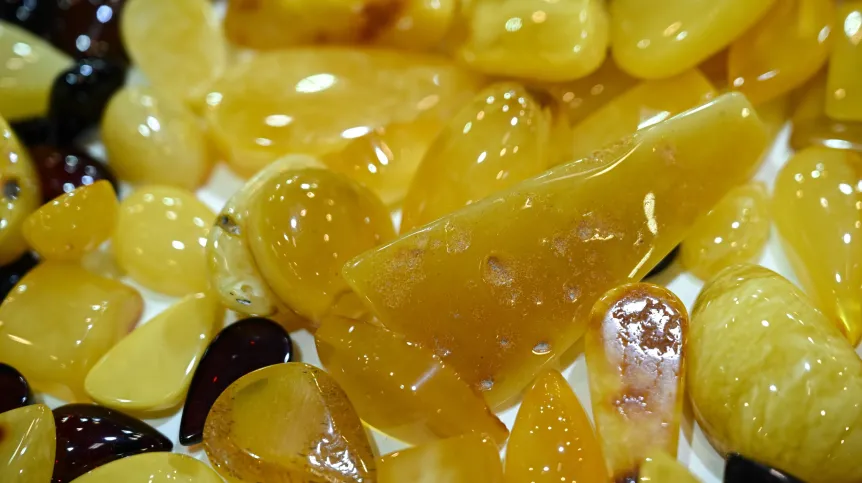
Archaeologists have identified as many as 10 ancient amber workshops across five settlements. In some of them, they uncovered up to 20,000 amber fragments, along with decorative beads and pendants, pointing to production on a significant scale.
Amber, valued for its lightness and ease of processing, became one of the most important ornamental materials in Europe. Although it is most commonly associated with coastal regions, archaeological evidence shows that between the 3rd and 4th centuries CE, amber working also flourished inland.
At the time, much of present-day Poland was inhabited by communities of the Przeworsk Culture. Known for their advanced craftsmanship, they developed large-scale iron production. In western Masovia, this activity formed the so-called Masovian Metallurgical Centre—a vast complex of settlements with clear traces of iron smelting.
Research led by Adam Cieśliński of the University of Warsaw and Marcin Woźniak of the Museum of Ancient Masovian Metallurgy shows that alongside metallurgy, another craft was taking shape: amber working.
Excavations conducted since the 1970s have revealed workshops in Biskupice, Izdebno Kościelne, Regów, Tłuste and Wierzbin.
‘In light of the research to date, Masovia appears to be the largest amber works centre outside the borders of the Roman Empire. Numerous workshops have also been recorded in Kujawy, but the scale of production in this latter centre appears to be smaller’, Cieśliński tells the Polish Press Agency.
Findings from the workshops cover all stages of production—from raw amber lumps and semi-finished pieces to completed objects, primarily beads and pendants. The variety of forms indicates that craftsmen were familiar with multiple production techniques.
Particularly large quantities of material were found in Biskupice and Izdebno Kościelne. In one workshop alone, more than 20,000 amber fragments were discovered. Such numbers suggest that production may not have been limited to local needs, but could have been connected to wider exchange.
The workshops themselves were modest. They were typically located in dugouts—small, partially underground structures covering only a few square metres.
‘Amber is a relatively soft material, so its processing did not require complex tools. Artisans used knives, bone or iron drills, as well as stone tools for grinding and polishing. The production process involved several stages: initial forming of the lump, grinding and shaping, drilling holes, and polishing the surface’, says Cieśliński.
Some objects show traces of processing on primitive lathes, which made it possible to achieve regular, symmetrical shapes.
One of the key unanswered questions concerns the origin of the raw material. Natural amber deposits in Masovia are limited, occurring mainly in the northeastern part of the region, in Kurpie. This suggests that most of the amber used in the workshops was imported.
The most likely sources are areas along the Baltic coast, particularly Sambia and the Bay of Gdańsk.
Masovia was not the only region where amber was worked. Similar workshops have been discovered in Kujawy and other parts of Poland. In some areas, production was also intensive, though it rarely reached the scale observed in Masovia.
In regions rich in amber, such as the Baltic coast or Scandinavia, traces of workshops are much rarer. This may reflect differences in how production was organised, or simply the current state of archaeological research.
‘The import of amber may have been linked to the exchange of locally produced iron. However, a significant chronological problem arises: most amber workshops date to the 3rd-4th century CE, while the heyday of iron production is more likely to have occurred earlier. Therefore, further research is necessary to better understand the relationship between the two phenomena’, Cieśliński says.
Ewelina Krajczyńska-Wujec (PAP)
ekr/ agt/
tr. RL