Genetically modified baker's yeast carrying a gene from tardigrades has performed well aboard the International Space Station (ISS), with preliminary results suggesting the added gene helps protect the organisms under the stressful conditions of low Earth orbit.
The Yeast TardigradeGene experiment, led by Polish researchers, is investigating whether genes from tardigrades—microscopic animals renowned for surviving extreme environments—could help make microorganisms more resilient during long-duration space missions. The work could eventually contribute to biological systems capable of producing food, nutrients and other essential compounds during future missions to the Moon and Mars.
"We are implementing our project under the slogan 'before we fly to Mars'," Professor Ewa Szuszkiewicz, an astrophysicist and astrobiologist at the University of Szczecin and coordinator of the Yeast TardigradeGene experiment, told PAP.
"Humanity is now preparing for exploration of the Solar System, especially the Moon and Mars. And yeast are excellent biofactories," said Andonis Karachitos, professor at Adam Mickiewicz University in Poznań. He added that the space sector is interested in yeast because it is easy to cultivate and can produce a wide range of compounds, from proteins to nutrients. During long-distance space missions, such "living factories" could significantly reduce the amount of cargo that must be transported from Earth.
The researchers used baker's yeast (Saccharomyces cerevisiae), a species widely used in the food industry, but genetically modified it by introducing a mitochondrial alternative oxidase (AOX) gene derived from tardigrades.
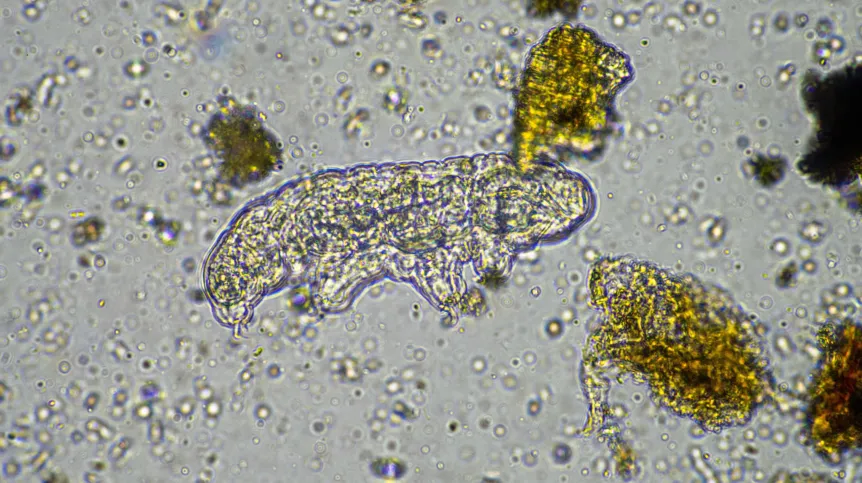
Tardigrades, also known as water bears, are microscopic invertebrates famous for their remarkable resilience. They can survive prolonged periods without food or water, tolerate ionising radiation, extreme temperatures, high pressure and high salt concentrations, and even endure exposure to space. Their survival depends on cryptobiosis, a state in which metabolic activity slows to almost zero.
The AOX gene encodes a protein involved in mitochondrial function. Mitochondria generate the energy required for cells to function, and the researchers hoped the gene would help protect them under microgravity conditions.
"The results indicate that under terrestrial conditions, this gene actually protects mitochondria. Our modified yeast grows better and can thrive on specific media requiring active mitochondria," Karachitos said.
According to the scientist, yeast with protected mitochondria multiply more efficiently.
"Our preliminary analyses confirm that the functioning, shape, and structure of mitochondria are significantly more favourable in the strain with the AOX gene than in the control strain," Karachitos said
The team is now analysing whether the genetically modified yeast performed as well in microgravity as it did in laboratory tests on Earth.
"We hope that the presence of the AOX gene will reduce or completely eliminate the negative effects of microgravity. We hope that it will act as a protective shield for the yeast," said Professor Ewa Szuszkiewicz.
Microgravity alters the movement of fluids inside cells and changes the way yeast colonies develop. Because gravity-driven convection, turbulence and shear forces are greatly reduced in orbit, the researchers used a solid, jelly-like growth medium to minimise these effects and make comparisons with Earth-based control experiments more reliable.
The yeast samples were transported from Poland to the United States and then to the ISS at 4 degrees Celsius in a fire-resistant Nomex container designed to meet the station's payload safety requirements.
Polish astronaut Sławosz Uznański-Wiśniewski initiated the experiment aboard the ISS by removing the yeast from refrigeration and placing the container in the Columbus laboratory module for incubation.
The biological samples returned to the laboratory in Poznań two days after the astronauts landed and the transport capsule was recovered.
"When, after one day, the first cell divisions could be observed with the naked eye, we knew the experiment was a complete success," Karachitos said.
Following their return to Earth, some of the yeast samples were frozen in liquid nitrogen while others were cultured further to investigate whether adaptive changes occur in subsequent generations.
"What we are doing now is a preliminary experiment, which we want to expand in the future to include additional extraordinary tardigrade genes, because these creatures have many more up their sleeves," Karachitos said.
Ludwika Tomala (PAP)
lt/ agt/
tr. RL