
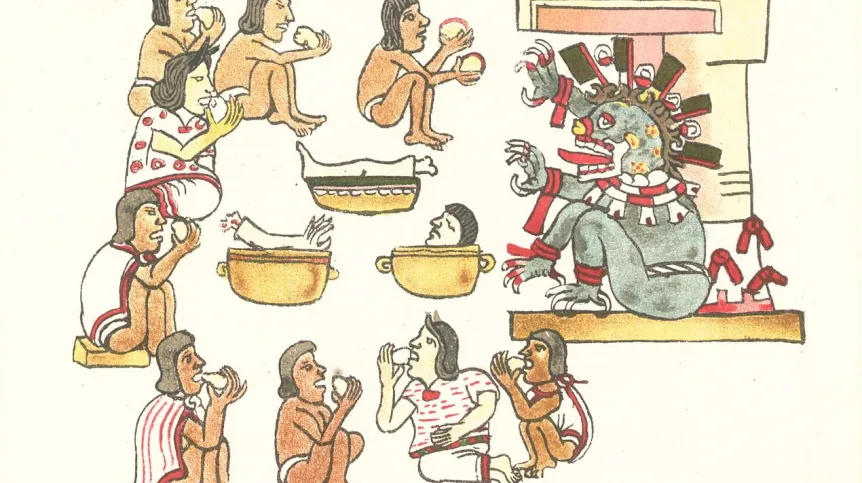
Cannibalism did not disappear by accident. It became too costly for the societies that practiced it, with long-term human consumption driving epidemics and ultimately contributing to population decline, according to a new study by Polish and Czech scientists.
The study, published in the Proceedings of the National Academy of Sciences (PNAS), concludes that cannibalism is "biologically non-viable." Using a mathematical model, Michał Misiak, PhD, of the University of Wrocław and Petr Tureček, PhD, of Charles University in Prague found that the long-term practice of cannibalism leads to the decline of populations that permit it.
Cannibalism is one of the most widespread taboos in human societies. Archaeological, ethnographic and historical evidence, however, shows that it repeatedly appeared in different human populations, both during periods of extreme famine and in ritual contexts. Until now, researchers have debated whether cannibalism was primarily a survival strategy or a practice with symbolic and ritual significance. The new study combines both ideas in a single model to examine their long-term consequences.
"We looked at the human body as a potential food source, analysing both the energy gains and the hidden costs. From a caloric perspective, a human proves to be an average meal, especially considering the difficulty of obtaining one. However, the key problem lies elsewhere: the risk of infection. Pathogens have an easier task because they enter an organism with an almost identical physiology," said Misiak, quoted in a University of Wrocław press release.
The researchers found that the greatest threat arises when cannibalism becomes repetitive. In so-called consumption chains, where one cannibal consumes another, the risk of disease increases exponentially. Although heat treatment reduces the number of bacteria and viruses, it does not eliminate prions—heat-resistant proteins that cause fatal neurological diseases such as kuru.
The model found that cannibalism is viable only under very narrow conditions, such as extreme hunger combined with a low cost of obtaining human flesh. Once the practice becomes more common, however, the epidemiological costs quickly outweigh the nutritional benefits, leading to population collapse.
According to the authors, these hidden biological costs may have contributed to the emergence of one of humanity's strongest taboos. Cultural prohibitions against cannibalism, they argue, are neither random nor arbitrary but serve an important protective function.
"Taboos act as an evolutionary safety fuse. Our results suggest that this is a biologically justified response to the growing risk of epidemics. Societies that did not restrict cannibalism simply did not survive," Misiak emphasised. (PAP)
ekr/ zan/
tr. RL