
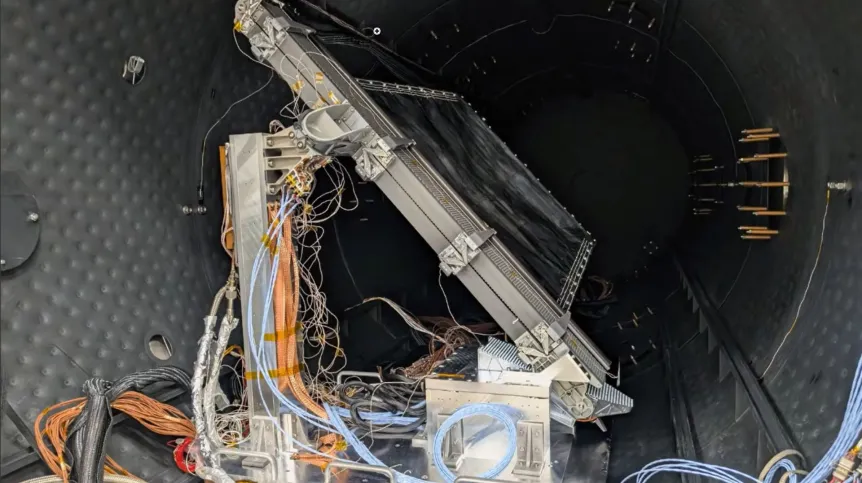
Polish-built ramps that will carry the Rosalind Franklin rover from its lander onto the surface of Mars have passed a series of extreme tests designed to ensure they can operate after the spacecraft reaches the Red Planet.
The three-metre-long aluminium structures were developed by Polish space company Astronika for the European Space Agency's ExoMars mission and spent more than two weeks undergoing thermal and vacuum tests in Italy.
Engineers placed the descent system in a vacuum-thermal chamber designed to reproduce key aspects of the Martian environment, then activated its release mechanism and successfully deployed the ramps and guides.
The system will perform a critical task after landing: allowing the Rosalind Franklin rover to leave the lander and begin its search for signs of past life.
The lander carries two sets of ramps, which will deploy automatically. The entire operation is expected to take no more than five minutes.
“This is an extremely satisfying moment for our team. The system, which we have been designing for years, has proven its performance in conditions very similar to those it will encounter on Mars. Each successfully completed test stage brings us closer to the moment when Polish technology will enable the commencement of European exploration of the Red Planet's surface”, said Maksymilian Gawin, who coordinates the project at Astronika.
The thermal and vacuum tests were carried out at the Criotec facility in Civasso, Italy. Engineers cooled the chamber with liquid nitrogen and removed almost all the air, allowing them to test the mechanism under extreme thermal and near-vacuum conditions.
Mars has an average surface temperature of around −55°C and atmospheric pressure of less than 1 per cent of Earth's.
The latest tests follow successful vibration tests at the Airbus Integrated Technology Centre in Friedrichshafen, Germany. Those tests simulated the loads the descent system will experience during the rocket launch, which is scheduled for 2028.
Astronika is responsible for the design and development of the Egress Subsystem, the system that will allow the rover to leave the landing platform, as part of a European consortium supplying landing components for ExoMars.
Airbus is building the landing platform, while Thales Alenia Space is the prime contractor for the mission.
The mission carrying Rosalind Franklin is scheduled to launch in 2028 and land at Oxia Planum, a Martian plain that scientists believe contained abundant water in the distant past.
Once on the surface, the rover will search for signs of ancient life in clay-rich sediments. It will be the first Mars rover capable of drilling up to two metres below the surface, allowing it to investigate material that has been shielded from the harsh Martian surface environment.
Its scientific instruments include a panoramic camera, an infrared spectrometer, a neutron spectrometer for detecting underground ice, ground-penetrating radar and an analyser for organic molecules.
The rover is named after British chemist and DNA research pioneer Rosalind Franklin. Its planned mission on Mars is expected to last around seven months.
ExoMars is the European Space Agency's programme for investigating Mars and searching for evidence of past or present life. The Trace Gas Orbiter and Schiaparelli lander were launched in 2016 as part of the programme. (PAP)
abu/ agt/
tr. RL