More than 620 mysterious marks carved into the limestone blocks of an ancient Libyan gate have revealed how stonemasons organised their work more than 2,000 years ago.
Anna Kordas, an archaeologist from the University of Warsaw, decoded 626 marks on the blocks used to build the Tauchira Gate in the ancient city of Ptolemais. Her analysis reveals how the markings were used to organise construction teams, manage materials and keep track of the work being carried out.
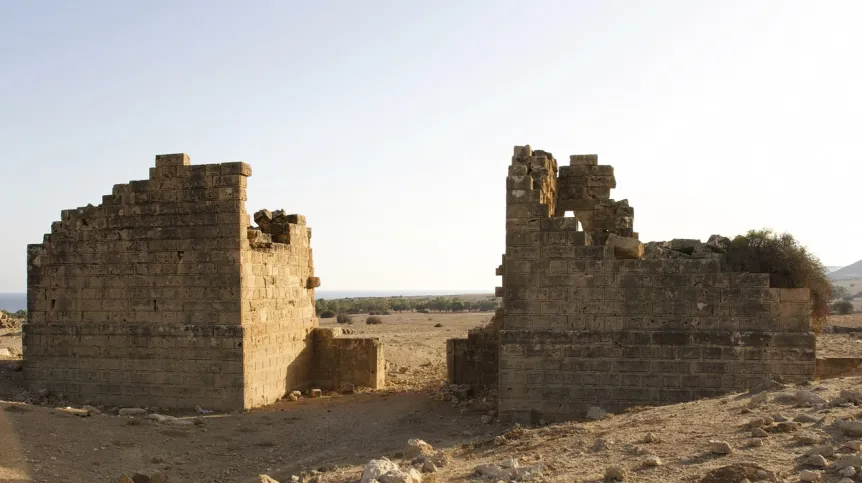
The Tauchira Gate stands in the ancient city of Ptolemais in what is now Libya. Ptolemais was one of the most important cities of Cyrenaica, a region on the northern coast of Africa that came under the rule of the Ptolemaic dynasty after the conquests of Alexander the Great.
The city developed as an important administrative and trade centre, while its monumental buildings were intended to emphasise the importance of power and the wealth of the region.
The gate was one of the most impressive elements of the city's fortification system. It was built or thoroughly rebuilt in the 2nd century BCE, perhaps during the reign of Ptolemy VIII Physcon, who ruled Cyrenaica from around 145 to 116 BCE.
Hundreds of its carefully worked limestone blocks have survived, and several bear Greek letters or more complex signs in the form of monograms. Archaeologists have long wondered about their purpose.
Kordas carried out the first comprehensive analysis of the markings, presenting her findings in the European Journal of Archaeology. She identified 27 different types among the 626 marks, allowing her to reconstruct how the construction site operated and how teams of stonemasons organised their work.
One marking system used letters of the Greek alphabet, including alpha, beta, gamma, delta, epsilon, zeta and eta. This suggests that at least seven separate construction teams worked on the project.
The second system was based on monograms – signs formed from two or more Greek letters. According to Kordas, these could represent craft workshops or wealthy benefactors who financed part of the work.
She analysed the arrangement and shape of the markings, as well as whether they were repeated on other blocks with a similar structural function. This allowed her to determine whether they were accidental or part of a well-organised system used by the builders.
She also took into account previous research on similar signs found elsewhere in the Mediterranean Basin, including Greece and Egypt.
'These markings should not be treated solely as the signatures of specific craftsmen. The material indicates a much more complex system. The markings could help sort limestone blocks, control subsequent stages of processing, plan transport from the quarry to the construction site, and properly arrange materials during the construction of structures. Small engravings are elements of a well-functioning logistics system, without which it would be much more difficult to build a monumental structure', the author of the study explains.
Some of the markings on the Tauchira Gate are large, less carefully made alphabetical signs carved into unprocessed surfaces of the stones. Many are upside down, indicating that they were made before the blocks were placed in their final positions.
They were probably used to identify individual construction teams during stone extraction and transport. This group of signs has survived only on the city side of the gate wall, providing evidence that a wooden staircase probably originally stood against the gate on this side.
The second group is found only on the outer walls of the gate towers. These markings were carefully made, centrally positioned and vertically aligned. They were probably added after the blocks had been fitted and finally processed.
Unlike most Greek and Hellenistic buildings, where similar markings were removed during the final stage of stoneworking, those at Ptolemais were deliberately left on display.
The signs also had a financial purpose, helping to record the work of individual stonemasonry crews.
The letters alpha through eta may indicate that the work was financed from city funds, with workshops marked using successive Greek letters to streamline the organisation of the work.
The appearance of a second marking system above the plinth height suggests a change in the financing model. From that point, the work could have been covered by workshop owners who, as local benefactors, donated their workers' labour to the city.
A similar donation is attested by a 2nd-century BCE inscription from ancient Teangela in Caria, in present-day southwestern Turkey.
According to the publication, each stone block passed through numerous stages from extraction to its final position in the structure.
First, the point at which the block was to be cut from the rock had to be marked. It was then pre-hewn and transported to the construction site before being finally fitted with the other elements.
Each stage required markings. Some were added in the quarry, while others appeared only during assembly.
'Construction of the monumental gate was a massive logistical undertaking. Each stage required the coordination of many specialists. In such circumstances, even small markings could have a crucial function. They allowed to quickly identify of a block's purpose, indicated its intended location in the structure, or informed of the work group to which it belonged', the archaeologist describes.
The system is similar to modern markings used for prefabricated components on large construction sites, where numbers and symbols help manage thousands of structural elements.
PAP - Science in Poland, Ewelina Krajczyńska-Wujec
ekr/ agt/
tr. RL