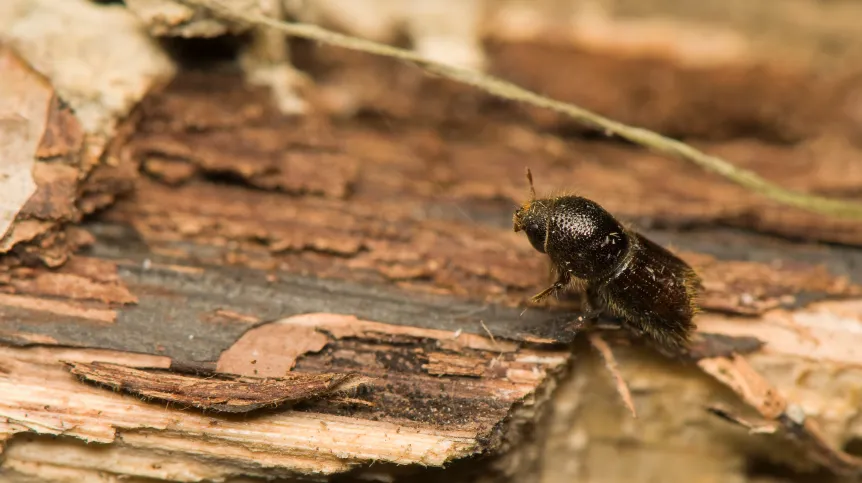
Bark beetles and other forest pests are usually treated as a threat to trees. But insects collected in forests could also become a valuable source of raw materials for medicine, food production and agriculture.
Eugeniusz Świstuń, a doctoral candidate at the AGH University of Science and Technology, is investigating how these insects could be used to produce chitosan, a biodegradable substance with a wide range of industrial applications.
Insect exoskeletons contain chitin, one of the most abundant natural biopolymers alongside cellulose. By chemically processing chitin, researchers can obtain chitosan, which is used in cosmetics, pharmaceuticals, agriculture and the food industry.
In an interview with the Polish Press Agency, Świstuń points out that most industrial chitin currently comes from shrimp and crabs harvested in Asia.
‘Most industrial chitin comes from shrimp and crabs harvested primarily in Southeast Asian countries, such as China and India. Access to this raw material in Poland and the rest of Europe is limited, and we rely largely on imports. Hence the idea to find alternative sources of chitin to reduce dependence on foreign supplies. Insects that are common in our geographical latitudes could serve as one such source’, the researcher says.
Chitosan is non-toxic, biodegradable and has antiseptic properties. It can be used in wound dressings and drug delivery systems, as well as in dietary supplements. In agriculture, it can be applied in sprays to combat harmful microorganisms, while the food industry uses it to coat fruit and vegetables and help keep them fresh for longer.
The material can also bind ions from other substances. This makes it useful in water treatment and efforts to remove environmental pollutants.
Świstuń's project focuses on a potential advantage over conventional insect farming: forest pests are already being collected as part of efforts to protect trees.
Breeding insects such as houseflies requires specialised facilities and can be expensive. Forest pests, by contrast, are removed through pest-control measures, including pheromone traps, and their biomass is generally discarded.
‘Obtaining, for instance, several kilograms of houseflies is relatively difficult without specialized breeding facilities. But the situation is different when it comes to forest insects, specifically, tree pests. These pests are already being controlled, primarily through chemical means or pheromone traps, and once eliminated, they have no further use. Yet, a single trap for the spruce bark beetle can contain up to one and a half kilograms of insect biomass. Given that hundreds of thousands of hectares of forest are at risk from bark beetle infestations, and assuming a density of 2–3 traps per hectare, even a fraction of the affected areas would yield a massive quantity of potential, currently unused raw material’, the researcher says.
This could make insect-derived chitosan cheaper to produce, as the biomass is already available through existing forest-protection measures.
‘Industrial-scale insect farming involves significant expenses related to infrastructure, equipment, and so on. In the case of forest pests, however, the product is +manufactured+ by nature; the insect biomass is essentially a waste product, we only need to process it’, the doctoral candidate says.
The researcher also notes that pheromone traps are designed to attract particular pest species rather than other organisms.
Funded by the National Science Centre, the project examines four species: the European spruce bark beetle, the six-toothed spruce beetle, the black arches moth and the striped ambrosia beetle.
The next step is to identify which species offers the greatest potential in terms of available biomass and the practicalities of collection. Świstuń then plans to optimise the extraction of chitin and chitosan and assess whether the process can be scaled up to semi-industrial production.
‘In the near future, I intend to focus on a single insect species, the one that proves most promising in terms of available biomass and the logistics of its collection and use. For the chosen biomass source, I plan to optimise the conditions for isolating chitin and chitosan, and to verify the feasibility of processing these insects on a semi-industrial scale’, says Świstuń. (PAP).
abu/ bar/
tr. RL