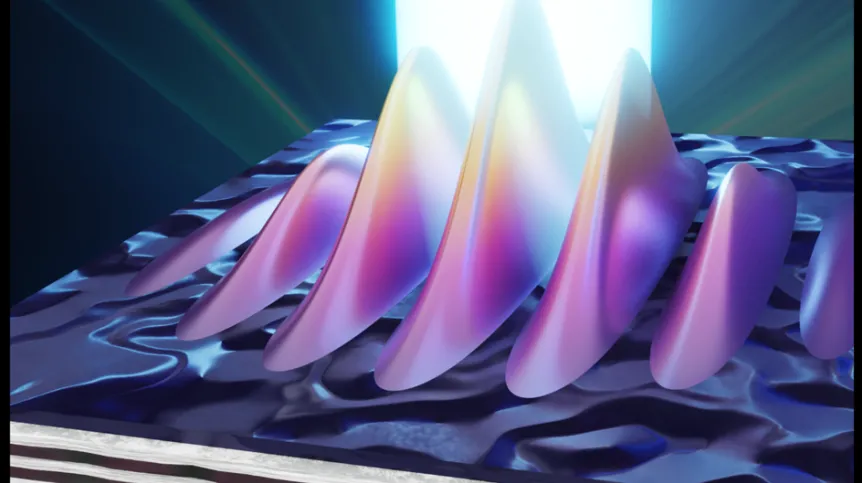
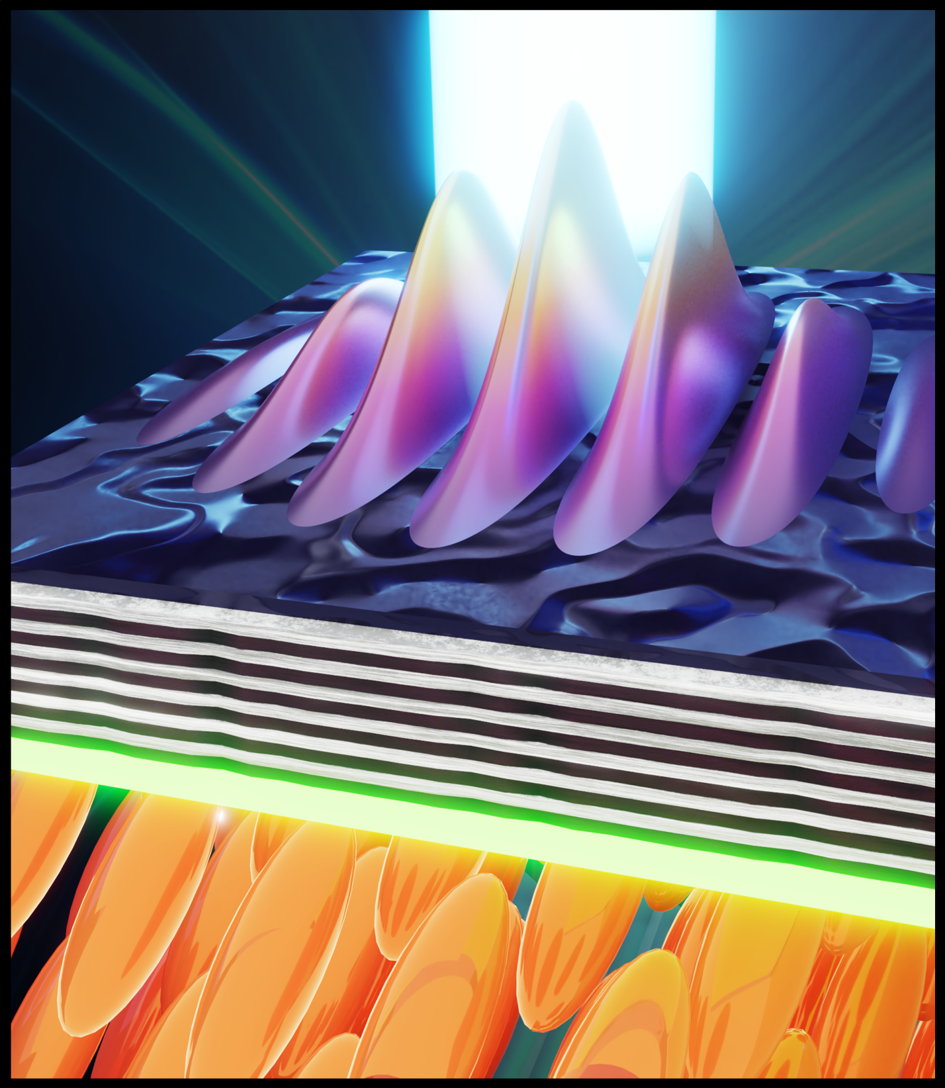
Physicists from the University of Warsaw have created an unusual quantum state of matter known as a supersolid at room temperature, using light trapped inside an optical microcavity.
The state combines the properties of a fluid with no viscosity and an ordered, crystal-like structure. Previous experiments producing supersolids required temperatures close to absolute zero. The findings have been published in the journal Science Advances.
An international team led by researchers from the University of Warsaw achieved the result by trapping light in a cavity formed by two closely spaced mirrors, offering a way to study an exotic phase of matter without the need for extreme cooling.
A JOURNEY ACROSS A SUPERSOLID LAKE
‘A supersolid is an extraordinary state of matter that combines superfluidity with the spontaneous formation of a periodic, crystal-like structure’.
‘A crystalline fluid made of light sounds like an oxymoron, yet these are precisely the characteristics of the new quantum phase observed in our experiments’, says the study's lead researcher, Professor Jacek Szczytko from the Faculty of Physics at the University of Warsaw.
A supersolid can be imagined as a fluid with no viscosity – a superfluid – in which regular, dense structures form, much like those in a crystal. Szczytko offers the example of rowing a boat across a supersolid lake: the oars would encounter no resistance because of the fluid's lack of viscosity, and the fluid would climb up the sides of the boat. Any vortices created by the oars would continue spinning indefinitely.
A defining feature of a supersolid is that the non-viscous fluid spontaneously develops an ordered structure. It effectively organises itself into regular layers, alternating between regions of low and high density, rather like the tapioca pearls in bubble tea.
According to Szczytko, supersolid phases are also thought to occur naturally in extreme environments such as neutron stars, where researchers predict the existence of a form of matter known as ‘nuclear pasta’. Such a phase can influence the properties of these massive celestial objects. Although it is impossible to create an entire lake of supersolid material on Earth, scientists are investigating ways to reproduce the state under laboratory conditions.
One approach involves systems at the interface of light and matter. When light interacts with matter, it can produce quasiparticles with properties similar to those of particles in different phases of matter.
‘Previous research on supersolid phases, conducted, for example, using atomic condensates or monolithic semiconductor cavities, required cryogenic temperatures, close to absolute zero. Our system operates at room temperature’, says Szczytko.
Professor Wiktor Piecek from the Military University of Technology in Warsaw, who was responsible for preparing the liquid-crystal structures, says the optical microcavities can function even at temperatures of around 60°C.
To create the supersolid phase, the researchers trapped light between two mirrors separated by just 2–3 microns. They introduced an organic dye and a liquid crystal into the resulting microcavity.
‘Exciton-polaritons formed within the microcavity – states that could no longer be described simply as light or excited matter, but rather as a quantum mixture of light and matter, or quantum fluids of light. You cannot touch these particles, as they are, in part, made of light’, Szczytko explains.
By controlling the liquid crystal with an electrical voltage while simultaneously exciting the system with short laser pulses, the researchers generated a Bose-Einstein condensate – a state of matter in which particles behave collectively as a single quantum wave. They then induced it to spontaneously form a periodic, crystal-like structure.
‘In our experiments, we compel our world to abandon the distinction between energy, that is, electromagnetic waves, and matter, which one can touch. What we have here is a blend of both, and we demonstrate that it behaves in a surprising way’, Szczytko says.
THE RACE TO PUBLISH AND FUTURE APPLICATIONS
The Polish scientists were not the first to report achieving a supersolid phase. Researchers from Italy published their findings after both teams submitted papers to the journal Nature at around the same time in 2024.
The Polish team's experimental system was less familiar to the journal's reviewers, who requested additional experiments. These took a further two years to complete. In the meantime, the Italian group published its results, while the Polish team's findings have now appeared in Science Advances.
The achievement could make it easier to investigate exotic quantum states without complex and costly cryogenic cooling. The researchers are now studying the stability of the observed phase and working to optimise the materials used in the microcavities.
Szczytko says reports of entirely new phases of quantum matter are rare. The research approach developed in Poland has attracted interest from the international scientific community, offering a way to investigate a state that had previously been predicted theoretically but remained extremely difficult to study.
For now, the work is fundamental research into the unexpected properties of light and matter. However, if these new states can eventually be harnessed for practical applications, they could contribute to the development of advanced technologies, including new sensors, optical computing devices and components for neuromorphic computers. Such devices could operate at room temperature.
‘Unfortunately, swimming in a crystalline fluid made of light will not be possible’, Szczytko says.
PAP - Science in Poland, Ludwika Tomala (PAP)
lt/ bar/
tr. RL