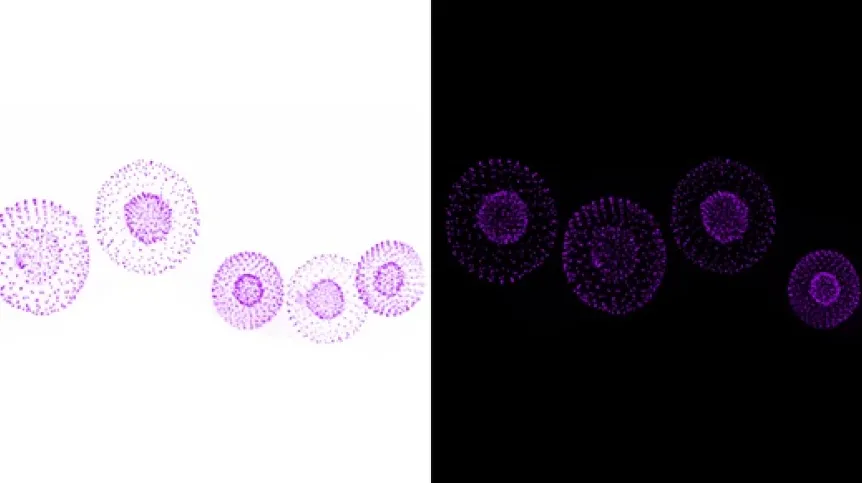
Some egg cells collected during fertility treatment are not mature enough to be fertilised and are therefore unusable. But what if they could be given another chance to develop? A researcher in Poland is working on a method that could enable immature egg cells to mature in the laboratory, potentially opening up new possibilities for infertility treatment and fertility preservation.
Over the past 50 years, approximately 14 million children have been born thanks to assisted reproductive technologies (ART). One promising area of research involves maturing egg cells outside the body, under laboratory conditions.
This is the focus of Taisiia Yurchuk, a researcher at the InLife Institute, part of the Institute of Animal Reproduction and Food Research of the Polish Academy of Sciences. Before Russia's full-scale invasion of Ukraine, she specialised in cryobiology at the Institute for Problems of Cryobiology and Cryomedicine of the National Academy of Sciences of Ukraine and worked as a clinical embryologist at an infertility treatment centre.
‘My research was inspired by my clinical work and daily exposure to the challenges patients face’, Yurchuk says.
During infertility treatment using ART, women typically undergo hormonal ovarian stimulation to produce a larger number of oocytes (egg cells) that can subsequently be used for fertilisation. However, not all the cells retrieved are mature enough to be fertilised. In some cases, as many as half fail to meet this criterion and cannot be used.
A key role in the maturation process is played by cumulus cells, which surround the egg cell in several layers.
‘They play a crucial role in the oocyte maturation process. They provide nutrients and participate in transmitting signals essential for proper development’, Yurchuk says.
Before a sperm can be injected directly into an egg cell using a technique known as intracytoplasmic sperm injection (ICSI), these surrounding cells must be removed. This allows an embryologist to assess the egg cell's maturity and determine whether it is suitable for fertilisation. However, if it is still immature at this stage, it has very little chance of developing further because its natural connections with the surrounding cumulus cells have been severed.
Yurchuk is working to overcome this problem as part of the POLONEZ BIS project, funded by the Polish National Science Centre and the European Union.
‘We are developing a method that would restore the connection between an immature oocyte and its cumulus cells, thereby enabling it to mature in the laboratory’, the researcher says.
Her team has developed a system that uses appropriate growth-promoting substances to create the conditions needed to restore the connections between an immature egg cell and its surrounding cumulus cells. The second stage supports the egg cell as it matures.
Another challenge is how to freeze immature egg cells so that they can be stored and matured later in the laboratory. This could be valuable both in infertility treatment and fertility preservation, particularly for patients who cannot undergo hormonal ovarian stimulation or face an increased risk of complications. These include some cancer patients and women with polycystic ovary syndrome (PCOS).
However, freezing and thawing immature egg cells together with their surrounding cumulus cells can damage the delicate connections between them, reducing the chances of successful maturation.
To address this problem, Yurchuk proposes freezing the egg cells and cumulus cells separately, using different cryopreservation methods. After thawing, the two can be brought back together to restore the conditions needed for the egg cells to mature. Her research has shown that this approach produces maturation rates comparable to those achieved when the entire egg cell-cumulus cell complex is frozen and thawed together.
This work is now continuing under the MSCA4Ukraine programme, funded by the European Union.
One potential application is fertility preservation for cancer patients. Before starting treatment that could damage the ovaries, women may have ovarian tissue collected and frozen. Once treatment is complete, the tissue can be re-implanted to restore ovarian function. However, this procedure is not suitable for everyone. In patients with certain types of cancer, there is a risk that cancer cells could be reintroduced into the body along with the transplanted tissue.
Immature egg cells can also be collected when ovarian tissue is prepared for freezing.
The method Yurchuk is developing could eventually allow these cells to mature in the laboratory and be used for fertilisation, without the need to re-implant ovarian tissue and the associated risks. (PAP)
ali/ bar/
tr. RL