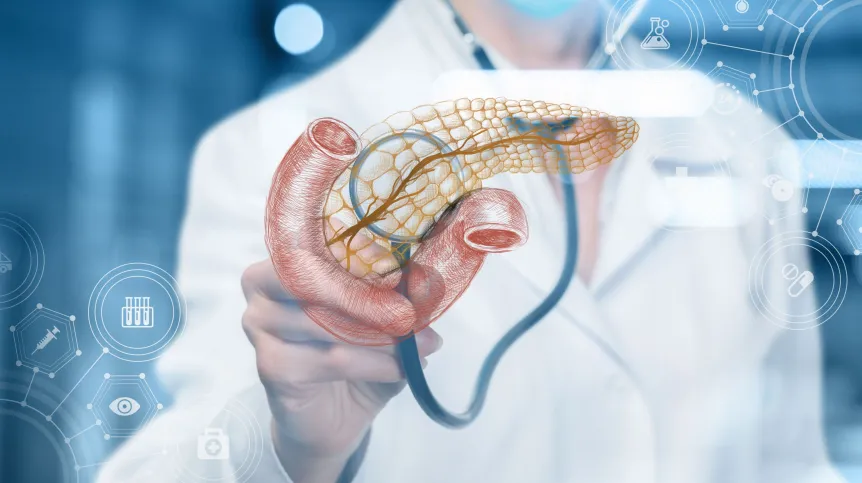
Researchers in Poland are testing an experimental treatment that uses calcium and electrical pulses to kill pancreatic cancer cells, a disease for which patients often have few effective treatment options.
The technique, known as calcium electroporation, has already been used in patients with locally advanced pancreatic cancer by a team from the Medical University of Wrocław and the University Clinical Hospital in Wrocław. According to the university, it is the first time the method has been applied to such patients in Poland.
Pancreatic cancer is among the deadliest forms of cancer and is often diagnosed only after it has reached an advanced stage. Its location deep within the abdomen can also make some conventional tumour-destroying procedures difficult or impossible to perform.
Calcium electroporation involves injecting a calcium chloride solution directly into a tumour and then exposing it to short electrical pulses. The pulses create temporary microscopic openings in cell membranes, allowing large amounts of calcium to flood into cancer cells. The resulting imbalance disrupts vital cellular functions and ultimately causes the cells to die. Unlike some other cancer treatments, the method does not require the use of cytotoxic chemotherapy drugs.
The work builds on years of laboratory research at the Medical University of Wrocław and has now progressed to clinical testing. The project was based on preclinical studies, including research conducted under the SONATA BIS 6 programme funded by the Polish National Science Centre.
The Medical University of Wrocław is currently conducting a non-commercial clinical trial known as IREC, funded by the Polish Medical Research Agency. The study includes 70 patients and compares three treatment approaches that use electroporation technology. Researchers are primarily evaluating patients' quality of life and progression-free survival.
Early observations have been encouraging, according to the research team.
“Patients often come to us from other centres in Poland after exhausting standard treatment options. We observe a reduction in pain, including neuropathic pain, and weight stabilization or weight gain. From the perspective of patients with inoperable pancreatic cancer, this translates into a real improvement in quality of life,” said Professor Wojciech Kielan, Head of the 2nd Department and Clinic of General Surgery and Surgical Oncology at the Medical University of Wrocław.
Researchers stress that calcium electroporation remains an experimental treatment and is still being evaluated in clinical trials. They emphasize that it is not intended to replace established therapies, but could eventually provide an additional option for patients whose cancers do not respond to current treatments or cannot be treated using standard methods.
“Our goal is not to replace existing methods, but to expand options for patients for whom standard treatment is not possible or has proven ineffective. Calcium electroporation is one of the paths oncology is taking toward more selective, less toxic, and more accessible therapies for a wider group of patients,” said Julia Rudno-Rudzińska, PhD.
The research has brought together specialists from molecular biology, pharmacy, surgical oncology, radiology and biomedical engineering, reflecting what the university describes as a successful transition from laboratory science to clinical practice.
Researchers say the treatment works by exploiting one of the body's most tightly controlled biological systems: the regulation of calcium inside cells.
“Under physiological conditions, calcium ions are among the most tightly regulated second messengers, and their rapid influx into the cytoplasm, induced by electroporation, deregulates calcium homeostasis: mitochondria become overloaded with Ca2+ ions, the inner mitochondrial membrane depolarises, as do nonspecific protein channels (mPTP megachannels) in the inner mitochondrial membrane,” said Professor Julita Kulbacka from the Department of Molecular and Cellular Biology, Faculty of Pharmacy, Medical University of Wrocław.
“The result is a decrease in ATP production, which is simultaneously absorbed by transporters attempting to restore ionic balance. The cell depletes its energy resources and dies, primarily through necrosis, although we also observe features of other types of cell death, including apoptosis and pyroptosis,” she said.
PAP - Science in Poland
ros/ zan/
tr. RL